10 Reasons Why Missing Teeth Should Be Replaced — And What Happens If You Don’t
A missing tooth is never just a cosmetic problem. Here is what really happens inside your mouth when you ignore it — and the right ways to fix it.
In India, more than 30 crore people are estimated to have at least one missing tooth, according to data cited by the Indian Dental Association. Yet most people delay treatment — sometimes for years. They adjust their chewing, cover their smile, and assume the gap will stay harmless. It does not.
This article explains exactly what a missing tooth does to your body over time, and why replacing it sooner is almost always better — and more affordable — than waiting.
A Missing Tooth Does Far More Damage Than It Looks
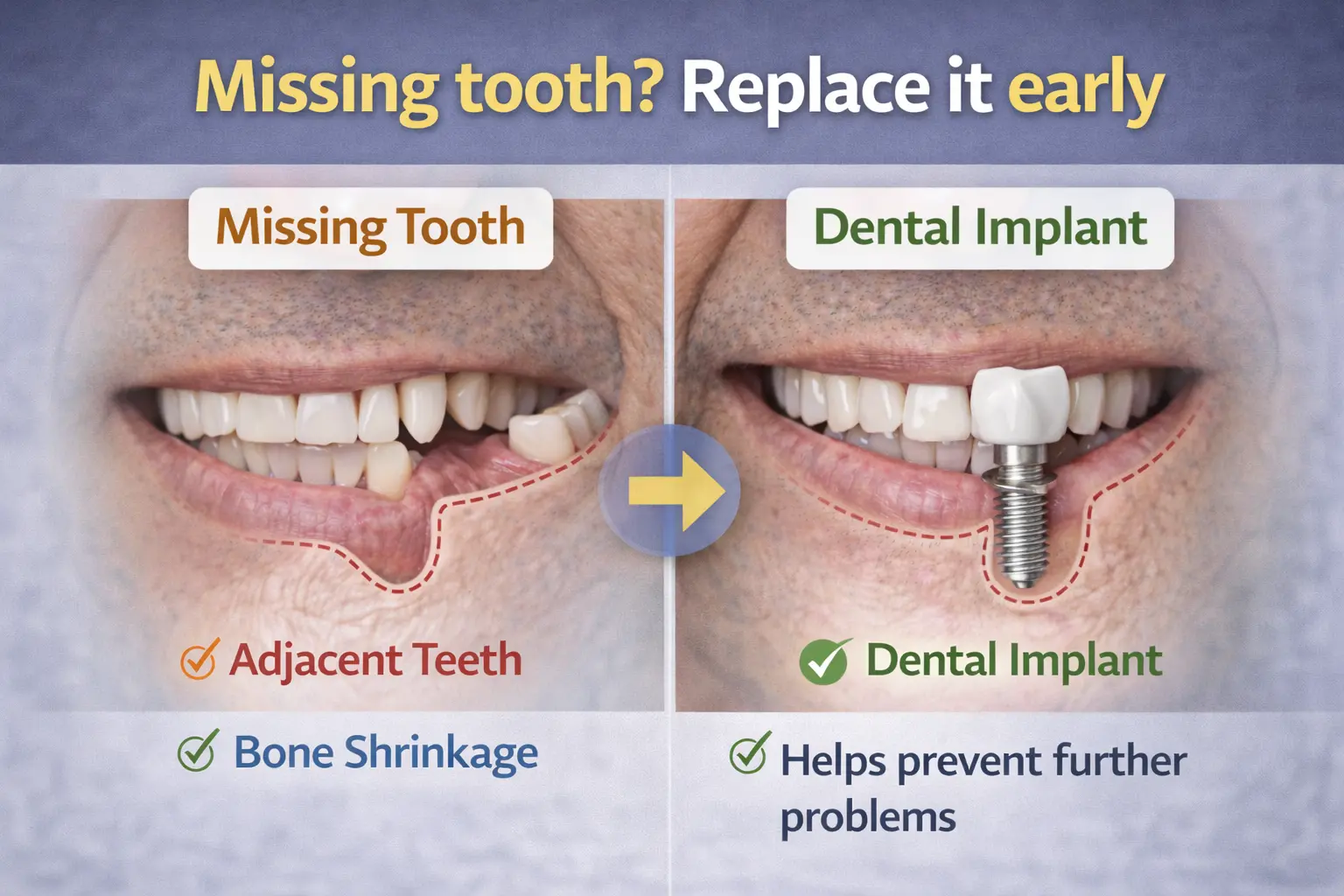
Think of your teeth like pillars holding up a roof. Remove one pillar, and the others start to tilt and shift to fill the gap. The bone underneath starts to shrink. The bite becomes uneven. What began as a single missing tooth slowly creates problems across your entire mouth.
This is not an exaggeration. It is basic dental anatomy. And the longer you wait, the more complicated — and expensive — the fix becomes.
In my clinical experience of over 17 years and more than 10,000 implants placed, I have seen countless patients who came in after waiting 5 to 10 years. What could have been a simple single implant became a full bone grafting procedure — because the jaw bone had already shrunk significantly. Replace early. It saves you time, money, and discomfort.
— Dr. Jyoti Singh, MDS (MAIDS), Diplomate WCOI, Nobel Biocare Trained ImplantologistCenter for Dental Implants & Esthetics, Gurgaon
10 Reasons to Replace a Missing Tooth
Your Jaw Bone Starts Shrinking
Your jaw bone stays strong because tooth roots stimulate it with every bite. Once a tooth is gone, that stimulation stops. The bone in that area begins to shrink — a process called resorption. Research shows you can lose up to 25% of bone width in just the first year after extraction (Atwood, Journal of Prosthetic Dentistry). Only a dental implant stops this loss by acting like a natural root.
Neighbouring Teeth Start to Tilt and Drift
Teeth need each other for support. When one is missing, the teeth next to the gap slowly tilt inward. The tooth above or below the gap can over-erupt — meaning it grows longer looking for its opposite. This misalignment makes cleaning harder and increases your risk of decay and gum disease in those teeth.
Your Bite Becomes Uneven, Stressing the Jaw Joint
An uneven bite puts excess pressure on your jaw joint — the temporomandibular joint (TMJ). Think of it like a car with one flat tyre. The load shifts unevenly. Over time this can cause jaw pain, clicking sounds, and even chronic headaches. A study in the Journal of Oral Rehabilitation (2020) found that patients with multiple missing teeth had significantly higher TMJ disorder rates.
Your Face Can Look Sunken or Aged
The jaw bone gives your lower face its shape and volume. As bone resorbs, your cheeks can look hollow and your chin can appear to rotate forward. Patients who have been missing multiple teeth for years often look older than their actual age. Replacing teeth — especially with implants — preserves facial volume and a more youthful structure.
You Cannot Chew Properly, Which Affects Your Health
We chew on both sides of the mouth. Missing teeth force you to favour one side, putting unequal stress on the remaining teeth and jaw muscles. Research from the European Journal of Clinical Nutrition shows that people with tooth loss tend to avoid hard vegetables, fruits, and proteins — leading to nutritional deficiencies over time.
Certain Sounds Become Difficult to Pronounce
Front teeth and the teeth near the tongue help form sounds like ‘s’, ‘f’, ‘th’, and ‘v’. A missing front tooth or premolar can affect the way you speak — causing a slight whistle or slur. Most patients notice this more in formal or social settings and it affects confidence significantly.
The Gap Becomes a Trap for Bacteria
An empty socket and the surrounding gum tissue around a gap are much harder to clean. Food particles and bacteria accumulate easily. This increases the risk of gum disease (periodontitis) in the adjacent teeth — which can eventually cause further tooth loss if untreated. You can read more about this in our early signs of gum disease guide.
A Missing Tooth Affects How You Feel in Public
A 2019 survey by the American Academy of Cosmetic Dentistry found that 74% of adults feel an unattractive smile affects career confidence and social interactions. Whether it is a job interview, a wedding, or a simple conversation — a visible gap often makes people hold back their smile or cover their mouth when speaking.
Waiting Always Costs More Later
A simple single-tooth implant today costs a fraction of what you would spend later if neighbouring teeth shift, decay, or also need to be extracted. Bone grafting adds significant cost. A simple early replacement — a bridge or an implant — is almost always cheaper than complex full-mouth reconstruction later.
Your Entire Mouth Becomes Harder to Maintain
Shifted and tilted teeth create new, awkward angles that are difficult to brush or floss properly. Plaque builds up in areas you cannot easily reach. This accelerates decay and gum disease in the teeth that remain. Replacing a missing tooth restores proper alignment and makes your daily oral hygiene routine more effective.
What Exactly Happens If You Don’t Replace a Missing Tooth?
Most patients do not feel much in the first few months. That is the deceptive part. The damage is happening silently, underneath the gum.
| Time After Tooth Loss | What Is Happening Inside | Visible Signs |
|---|---|---|
| 0–3 months | Bone resorption begins. Neighbouring teeth start early drift. | Usually none. Slight gum tenderness possible. |
| 3–12 months | Up to 25% bone width lost. Teeth visibly begin to tilt. | Slight gap widening. Food getting stuck more often. |
| 1–3 years | Significant bone loss. Bite shift. TMJ stress begins. | Jaw discomfort. Facial appearance changes slightly. |
| 3–5 years+ | Bone grafting likely needed before implant. Risk of adjacent tooth loss rises. | Sunken cheek. Multiple teeth affected. Jaw joint pain. |
Dental implants have a documented 95–98% long-term success rate over 10 years in patients with healthy bone and no uncontrolled systemic disease. (Source: Pjetursson et al., Clinical Oral Implants Research, 2012.) The earlier you place an implant, the more bone is available — and the better the long-term outcome.
What Are Your Options for Replacing a Missing Tooth?
Not every patient needs the same solution. The right choice depends on how many teeth are missing, the state of your bone, your age, your health, and your budget. Here is a plain-language overview of the main options available at Center for Dental Implants & Esthetics.
Dental Implant
A titanium screw is placed into the jaw bone — acting like a new root. A ceramic crown sits on top. This is the gold standard — it is the only option that stops bone loss. Lasts 15–25+ years with good care. Learn more about dental implants.
Dental Bridge
A false tooth held in place by crowns fitted over the two neighbouring teeth. No surgery needed. However, the supporting teeth must be filed down, and bone loss under the gap continues. Read our guide on 6 reasons to be cautious about bridges.
Removable Partial Denture
A removable appliance that clips onto remaining teeth. Most affordable upfront. However it does not prevent bone loss, can feel unstable while eating, and needs replacement every few years. Details on removable teeth costs in India.
All-on-4 / All-on-6 Implants
For patients missing most or all teeth in a jaw. A full arch is supported by just 4 or 6 strategically placed implants. Fixed, natural-looking, and permanent. See our detailed All-on-4 vs All-on-6 comparison.
Implant-Supported Bridge
If two or more adjacent teeth are missing, implants are placed at either end and a bridge spans across. This avoids shaving healthy teeth and still prevents bone loss. A strong, permanent option.
Full Dentures
For completely edentulous (no teeth) patients. Traditional full dentures are removable. Implant-stabilised dentures are a significantly better alternative for chewing efficiency and comfort. Explore dentures vs implants.
Comparing Your Tooth Replacement Options
| Feature | Dental Implant | Dental Bridge | Removable Denture |
|---|---|---|---|
| Prevents bone loss | Yes | No | No |
| Adjacent teeth untouched | Yes | No (filed down) | Usually yes |
| Feels like natural tooth | Yes | Mostly | No |
| Chewing efficiency | ~95–100% | ~80–90% | ~50–60% |
| Lifespan | 15–25+ years | 8–15 years | 5–7 years |
| Maintenance | Brush & floss normally | Special flossing needed | Daily removal & soaking |
| Upfront cost (approx.) | Higher | Medium | Lower |
| Long-term cost | Lowest overall | Medium (replacement needed) | Highest (frequent replacement) |
Table is a general guide. Individual cases vary. Always consult a qualified implantologist for a personalised plan.
Common Myths About Missing Teeth — Debunked
“It is just one tooth at the back. Nobody sees it, so it does not matter.”
Back teeth carry most of the chewing load. Losing even one affects bite balance, jaw joint health, and bone density — all invisibly.
“Implants are only for old people.”
Implants are suitable for adults of any age once jaw growth is complete — typically from age 18 onwards. The earlier you act, the better the bone support available.
“Dental implants are very painful.”
Implant placement is done under local anaesthesia. Most patients report that the procedure was much more comfortable than they expected — often less uncomfortable than a tooth extraction.
“My denture is fine. I do not need anything else.”
Dentures sit on top of the gum. They do not stop bone resorption underneath. Over time the denture fits worse and the face changes shape. Implant-supported options solve this problem. See 5 myths about dentures.
A Real Case From Our Clinic in Sector 51, Gurgaon
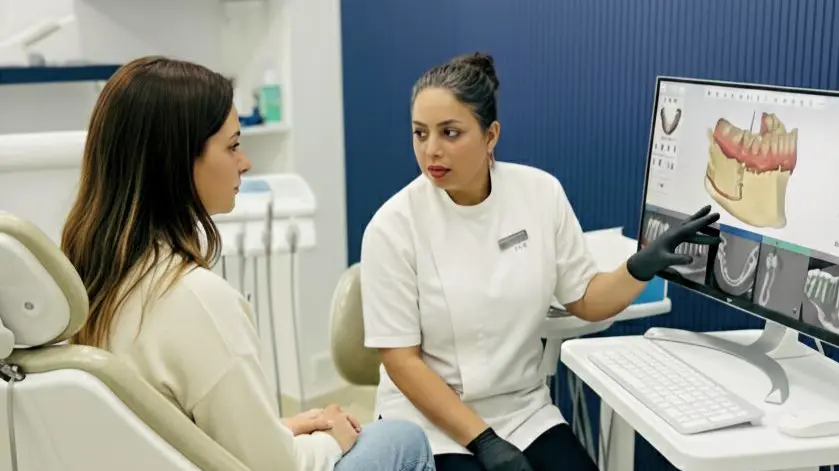
Priya had lost a lower molar in 2019 due to decay. She was told she needed an implant but decided to wait. She came to Center for Dental Implants & Esthetics in early 2024 — five years later — with a complaint of jaw pain and her dentist telling her the adjacent teeth had started tilting significantly.
CBCT imaging showed she had lost nearly 40% of the bone width at the extraction site. A bone graft was performed alongside the implant placement. Total treatment time was 8 months instead of what would have been 3–4 months had she acted in 2019. Her cost was also approximately 40% higher due to the additional grafting procedure required.
She now has a fully functioning implant. But her case is a clear example of why early replacement always makes sense.
Patient Questions — Answered Honestly
Ideally within 3 to 6 months for most cases. Some implants can be placed immediately at the time of extraction (immediate implants). The longer you wait beyond 6 months, the more bone is lost — which may require additional bone grafting procedures before an implant can be placed. Early action always makes treatment simpler and more cost-effective.
A dental implant is the best option for a missing back molar. Back teeth bear the highest chewing forces — up to 90 kg per square centimetre. An implant can handle this load. A bridge will work but requires grinding down healthy teeth. A removable partial denture in the back of the mouth can be unstable and uncomfortable for most patients.
Yes — and this is backed by research. Chronic gum disease and tooth loss are associated with higher cardiovascular risk. A long-term study in the BMJ (2019) found that people who lost two or more teeth in middle age had a 23% higher risk of cardiovascular disease. Poor chewing function also affects nutrition. Oral health is directly connected to overall systemic health.
The procedure is done under local anaesthesia, so you feel no pain during the surgery. Mild soreness and swelling for 2–3 days after is normal and manageable with standard pain medication. Most patients say it was far less uncomfortable than they had anticipated. In our clinic, we also follow a strict CBCT imaging protocol before every implant — this allows us to plan precisely and minimise trauma during surgery.
Yes — in most cases. Controlled diabetes is not a contraindication for dental implants. However, well-controlled blood sugar is essential before, during, and after surgery for proper healing. We require a mandatory blood test protocol at our clinic before any implant surgery. Uncontrolled diabetes significantly increases the risk of implant failure and infection. Your implantologist and physician should work together. Read more at diabetes and dental health.
Cost depends on the type of implant, the brand, and whether bone grafting is needed. At Center for Dental Implants & Esthetics, we use US FDA-approved implant systems from globally trusted brands. A single implant can range from approximately Rs. 25,000 to Rs. 90,000+ depending on the case complexity. We recommend a consultation and CBCT scan for an accurate treatment plan. You can also read our guide on the truth behind cheap implant offers in Gurgaon.
With proper care, a high-quality dental implant can last 25 years or more — often a lifetime. Studies show a 95–98% survival rate at 10 years. The crown on top of the implant may need replacement after 10–15 years due to wear, but the implant itself, once well-integrated into the bone, is highly durable. Regular dental check-ups and good oral hygiene are essential to maximise longevity.
Yes — a dental bridge and a removable partial denture are both non-surgical options. A bridge involves shaping the teeth on either side of the gap and fitting a false tooth between them. It is a reliable, fixed solution but does not prevent jaw bone loss. A removable partial denture clips onto remaining teeth and is the most affordable upfront option. Neither of these options, however, replaces the tooth root — which is what prevents bone loss. Only implants do that.
It is rarely too late — but it may be more complex. If significant bone loss has occurred, a bone grafting procedure may be needed first to rebuild the jaw bone before the implant can be placed. This adds time and cost. At our clinic, we use CBCT 3D imaging to assess available bone volume precisely and plan accordingly. Many patients who have been missing teeth for 5–10 years have successfully received implants after grafting. Book a consultation to find out your specific situation.
Conventional implants integrate into the cancellous (spongy) bone layer of the jaw. Basal implants anchor into the cortical (hard, outer) bone layer and are marketed as a solution for patients with severe bone loss. However, basal implants have a much higher failure rate and limited long-term research compared to conventional implants. We do not recommend them as a first choice. Read our detailed article on why to avoid basal dental implants.
Ready to Replace Your Missing Tooth?
Get a personalised treatment plan with a CBCT scan, a complete oral health assessment, and an honest cost estimate — at our clinic in Gurgaon.
Center for Dental Implants & Esthetics — Sector 51
#166, Sector 51 (Ambedkar Chowk), Close to Artemis Hospital, Gurgaon, Haryana 122003
Center for Dental Implants & Esthetics — Sector 74
R1–257, 2nd Floor, M3M Cornerwalk, Sector 74, Gurugram, Haryana 122004
You May Also Want to Read
Complete Guide to Dental Implants in Gurgaon
Everything you need to know about implant surgery — procedure steps, candidacy, cost, and what to expect at our Gurgaon clinic.
Read guide →6 Reasons to Be Cautious About Dental Bridges
Before choosing a bridge, read this honest guide on the limitations — including why healthy adjacent teeth are put at risk.
Read guide →Can You Get Implants With Bone Loss?
If you have been missing teeth for years, bone loss may have occurred. This guide explains your options — including bone grafting.
Read guide →Disclaimer: This page is for informational purposes only and does not replace professional dental consultation. Symptoms described may have multiple causes. Please visit a qualified dental professional for diagnosis and personalised treatment advice.

Dr. Jyoti Singh (MDS), Diplomate WCOI (Japan region) Member AAID (American Association of Implant Dentistry) stands as a beacon of excellence in implantology within Delhi NCR region. She is a BDS and MDS(Prostho) both from Maulana Azad Institute of Dental Sciences, where she secured top honors with all India rank 1 in PG entrance examination. Her extensive experience at esteemed institutions like Clove Dental and her own Center for Dental Implants & Esthetics since 2016, Dr. Singh embodies unparalleled expertise in dental implants. Boasting a wealth of 17+ years in dentistry and backed by 18 groundbreaking research papers in leading international journals (Google Scholar) and her ResearchGate profile, she epitomizes the pinnacle of proficiency and innovation in her field. She practices in Gurugram as your friendly dentist near me.