You Know Your Denture
Is Failing.
Now Find Out What Actually Changes.
You have heard about All-on-4. You are considering it. This page — by Dr Jyoti Singh, Prosthodontist & Implantologist with 17 years and 100+ full-mouth cases — gives you the full, honest clinical picture.
Consultation includes CBCT scan + exact treatment plan. Trusted by patients across Gurgaon, Delhi NCR and India.
⏳ Short on time? Send your OPG or dental photo on WhatsApp → Get Quick Implant Opinion
- Jaw bone shrinks after tooth loss — this is called bone resorption
- Dentures sit on gums, not in bone — so they lose grip as the ridge shrinks
- No relining or adhesive can stop the underlying bone loss
- This is why most dentures feel loose again within 4 to 5 years
Some Patients Have Started Eating Without Their Denture.
In 17 years of practice, this is where the denture journey ends for many — the denture has become so uncomfortable, they simply leave it out at home.
Most patients describe the same progression. It starts with mild movement. Then food gets under the denture. Then eating takes longer — 30 minutes, then an hour. Some patients begin leaving the table before the meal is finished because chewing has become tiring and embarrassing.
- →Denture moves while talking or laughing in public
- →Food gets stuck underneath — causes sore spots
- →Eating takes 30 to 60 minutes instead of normal time
- →Hard fruits, meat, crunchy food — completely avoided
- →Social eating causes constant anxiety about shifting
- →Adhesive use has increased — and still does not hold
“I see patients who have been managing with a loose denture for 5, 8, even 12 years. Nobody told them the bone was shrinking. They thought this was just how dentures are.”
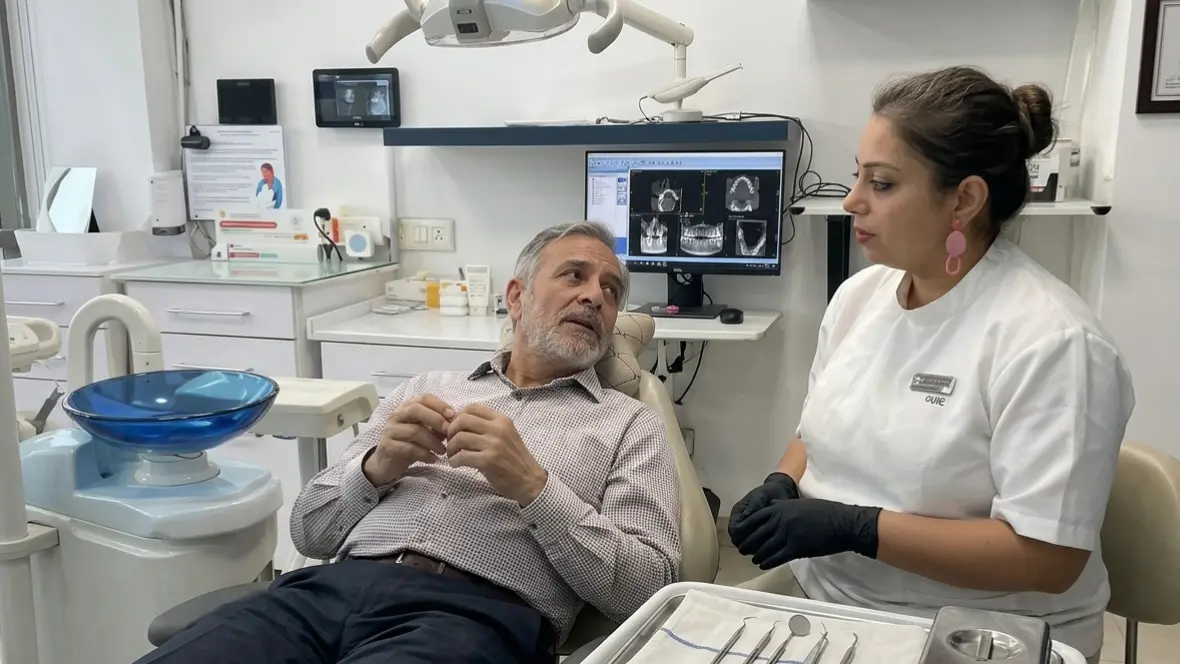
Center for Dental Implants & Esthetics, Gurgaon — every implant case starts with a 3D CBCT scan, not an estimate.
Stop managing. Start solving. One CBCT scan visit shows you exactly what your permanent options are.
Book Consultation →Your Denture Is Not Getting Worse. Your Jaw Bone Is Getting Smaller.
The denture has not changed. The bone it rests on has shrunk. This is called residual ridge resorption — and it happens in every person who loses teeth.
- →Year 1: Up to 25% bone width lost silently. No pain. No visible sign.
- →Year 4 to 5: Denture noticeably loose. Adhesive use begins. Most patients assume the denture has “stretched.”
- →Year 10 to 15: Bone is critically low. Gum becomes soft and mobile — called flabby tissue. Even a new denture cannot stay stable.
- Uncontrolled diabetes — accelerates resorption and slows healing
- Vitamin D deficiency — very common in Indian patients, reduces bone density
- Osteoporosis — reduces overall bone density, assessed on CBCT individually
The Denture Failure Loop — Why Relining Never Solves It
Most patients cycle through this multiple times. Each step feels like progress. None of them stop the bone loss.
Denture becomes loose
Bone has shrunk. The ridge no longer matches the denture shape.
Denture relined
Fit temporarily improved. Problem appears solved.
Bone continues shrinking
Relining did not stop resorption. Ridge keeps shrinking.
Gum becomes flabby tissue
Soft, mobile gum cannot support a stable denture regardless of fit.
New denture — same result
Even a perfect new denture rests on the same shrinking ridge. Becomes loose faster.
Loop repeats, bone worsens
Each cycle leaves less bone. Treatment becomes more complex and expensive.
- You are already adjusting your lifestyle around your teeth
- You are already avoiding foods you used to eat without thinking
- You are already thinking before you eat in public
- You are already compromising — every single day
This is not normal. You have just adapted to it.
- Relining gives temporary improvement — bone keeps shrinking underneath
- The only permanent solution is dental implants fixed into jaw bone
- Implants stop bone loss and provide stable, non-moving teeth
Is this your cycle? One CBCT scan ends it permanently. Sector 51 and Sector 74 Gurgaon clinics — both available for consultation.
WhatsApp for Consultation →Related: Why denture adhesive stops working | Loose denture fix options | Denture relining vs new dentures
What Exactly Changes — Subtle Improvements vs Complete Game Changers
Not every change is dramatic. Some are quiet daily improvements. Some are life-altering. Here is the honest breakdown.
- Yes — after healing, most foods including roti, fruits, and nuts become possible again
- Implants restore up to 95% of natural chewing force vs only 20% with dentures
- Patients regularly report eating foods they had avoided for years
Stop thinking about teeth while eating
The constant background monitoring — will it shift, is food getting under — disappears. You simply eat.
Eat what you want Key
Chewing goes from ~20% to 95% of natural teeth. Apples, nuts, chicken, roti. Foods avoided for years come back. (Fontijn-Tekamp et al, 2000)
Two-minute daily routine
No removal, no soaking, no adhesive. Brush like natural teeth. Forever.
Jaw bone stops disappearing Key
Implant transmits force into bone like a natural root. Resorption stops. Face structure preserved for life. (Branemark et al, 1985)
Speech becomes natural within days
Dentures alter certain sounds. Fixed teeth remove the careful tongue work needed to hold things in position.
Full taste returns Key
Upper denture plate covers the palate — blocking taste receptors. All-on-4 has no palate coverage. Food tastes richer within weeks. This is physiology, not expectation.
Social confidence returns
Laughing freely, sneezing without panic, talking at full volume. The constant vigilance of a removable denture stops.
Your face looks like you again Key
Bone loss collapses the lower face. Implants stop this permanently. Patients report looking years younger because bone support has returned.
“The most common thing patients say after All-on-4 is about taste. They say food has flavour again. The palate was covered for so many years they had forgotten what food actually tastes like.”
- Implants are fixed in bone — dentures sit on gums and become loose over time
- Implants preserve jaw bone — dentures allow bone to keep shrinking
- Implants restore near-natural chewing — dentures provide only 20% of chewing force
- Implants are the superior long-term solution for most patients
Dentures vs All-on-4 — Complete Comparison
Every row is based on clinical evidence. Game changer rows are where quality of life shifts most fundamentally.
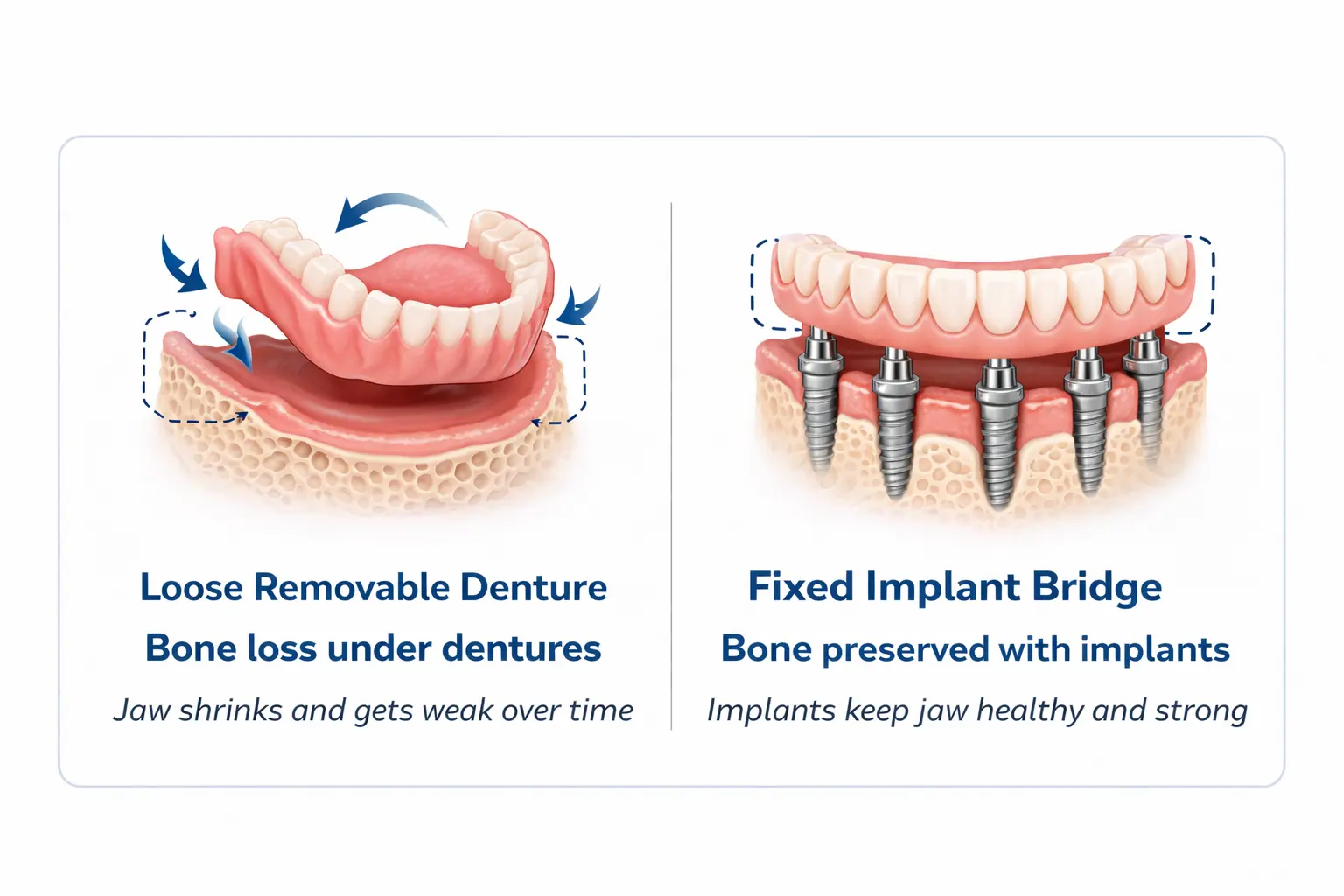
Loose removable denture vs fixed All-on-4 implant bridge — the difference is not just cosmetic. It is biological.
| What matters to you | Full Dentures | All-on-4 Implants |
|---|---|---|
| Fixed or removable? | Removable. Moves while eating and talking. | Permanently fixed to implants. Never moves. |
| Stops bone loss? Key | No. Bone keeps shrinking every year. | Yes. Implants transmit force to bone — resorption stops. (Branemark et al, 1977) |
| Chewing ability Key | ~20% of natural. Hard food, fibrous meat — difficult or impossible. | Up to 95% of natural within weeks. (Fontijn-Tekamp et al, 2000) |
| Taste sensation Key | Upper plate covers palate — dramatically reduces taste. | No palate coverage. Full taste from day one. |
| Daily maintenance | Remove nightly, soak, adhesive every morning. | Brush like natural teeth. No removal. No adhesive. |
| Facial structure Key | Progressive facial collapse as bone shrinks. | Bone maintained. Facial structure preserved permanently. |
| How long it lasts | 5 to 8 years. Relining every 2 to 3 years. | Implants 20+ years. Prosthesis 10 to 15 years. (Pjetursson et al, 2012) |
| Surgery needed? | No surgery. Ready in 1 to 2 weeks. | Outpatient, local anaesthesia. 2 to 3 hours. |
You have read the comparison. You already know which column you want.
Book Consultation →Also read: Implants vs dentures — full guide | Removable vs fixed teeth
The One Line Every Denture Patient Needs to Hear
“I wish I had done this at 60.“
83 years old. Full dentures for 15 to 20 years. Declined by two clinics — “too little bone.” A CBCT scan at our Gurgaon clinic showed available bone. All-on-4 placed successfully. Eating normally within three weeks. Her only regret: the years she had waited.
This patient was told she had too little bone by two other clinics. A 3D CBCT showed enough for All-on-4. A 2D X-ray cannot assess bone in 3D. Only a CBCT can. How 3D imaging changes what is possible.

Patients at Center for Dental Implants & Esthetics, Gurgaon — fixed teeth that do not move, eat, or embarrass.
Am I Suitable for All-on-4 Implants?
Based on 17 years of clinical practice. Not estimates — clinical reality.
- Around 98% of lower jaw cases can be treated with All-on-4
- 80 to 90% of upper jaw cases qualify with proper planning
- Patients with bone loss, controlled diabetes, or prior failed implants can often qualify
- A 3D CBCT scan is the only accurate way to determine suitability
Almost every patient qualifies for lower jaw All-on-4
- ✓Denser, more predictable bone
- ✓Even significant bone loss typically qualifies
- ✓10-year failure rate: 1.9% (Malo P et al, 2012)
Most patients qualify with proper planning
- →Softer, more variable bone — assessed on CBCT
- →Sinus lift or bone graft needed in some cases
- →Zygomatic implants available for depleted bone
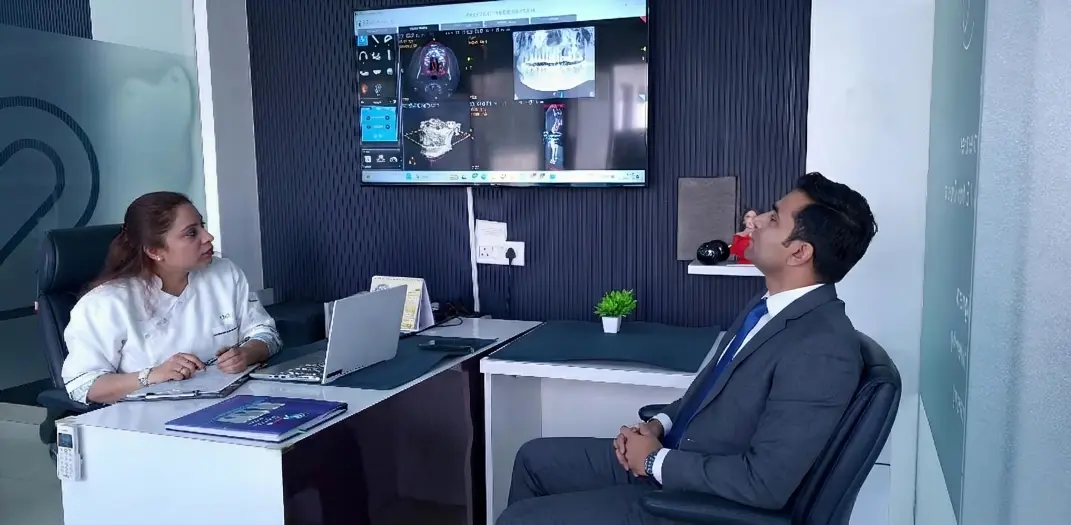
At Center for Dental Implants & Esthetics, Gurgaon — you see your jaw bone in 3D on screen before any decision is made. Patients who were told they had “no bone” have regularly qualified after this scan.
Special Situations — Still Possible
Controlled Diabetes
- ✓HbA1c below 7.5% is manageable
- ✓Mandatory blood tests before every case
- ✓Comparable implant survival in controlled diabetics (Mombelli A et al, 2012)
Severe Bone Loss
- ✓Zygomatic implants — anchored in cheekbone
- ✓Bone grafting rebuilds bone in select cases
Prior Failed Implants
- ✓Failure cause assessed and treated
- ✓Re-planned from new CBCT scan
- ✓Failed implant — what next?
Advanced Age
- ✓No upper age limit for implants
- ✓Question is general health, not age
- ✓Our oldest full-mouth patient: 83 years old
If a dentist has told you “not enough bone” without a 3D CBCT — that opinion is based on a 2D estimate. Many patients declined at other Gurgaon and Delhi NCR clinics received successful All-on-4 here after CBCT revealed adequate bone in the right locations.
Not sure if you qualify? Send your X-ray or dental photo on WhatsApp. Dr Jyoti’s team will give a preliminary opinion.
Check Eligibility on WhatsApp →What Happens If You Continue With Your Denture
A predictable, documented sequence. Not a scare tactic — a clinical reality.
Easiest time to act
Bone still manageable. All-on-4 straightforward. Lowest cost, fewest complications.
Diet restriction, sore spots
Bone loss meaningful. Gum becoming unstable. Complexity increases slightly.
Facial changes visible
Flabby tissue common. Bone graft may be needed. Cost and complexity increase.
Advanced techniques required
Standard All-on-4 may be insufficient. Zygomatic implants may be only option.
Why Most Denture Patients Delay — And What Actually Happens While They Wait
Three thoughts that delay the decision
- →“I will adjust with the denture for now.”
- →“Implants are too expensive right now.”
- →“I am probably too old for surgery.”
- →“What if it does not work?”
Real cost of each year of delay
- ✓Bone keeps shrinking — treatment becomes more complex
- ✓Cost increases as bone loss worsens
- ✓Eating becomes more restricted, not less
- ✓Options narrow — from 6 approaches to 2
“The most common thing patients say after All-on-4 is: ‘I should have done this 5 years earlier.’ Not one patient in 17 years has said: ‘I am glad I waited.’ Not one.”
— Dr Jyoti Singh, Center for Dental Implants & Esthetics, Gurgaon & Delhi NCRCost of All-on-4 Dental Implants in Gurgaon
No hidden figures. Here is exactly what All-on-4 costs at our Sector 51 and Sector 74 Gurgaon clinics.
- ✓Osstem / Adin — US FDA approved
- ✓3D CBCT scan included
- ✓Temporary fixed teeth — same day in most cases
- ✓Final zirconia or acrylic prosthesis
- ✓Post-surgical follow-up included
- ✓Nobel Biocare — creator of All-on-4, 20+ years of data
- ✓3D CBCT scan included
- ✓Immediate loading — fixed teeth same day
- ✓Final full-arch prosthesis included
- ✓Global Nobel Biocare implant warranty
- Bone grafting — All-on-4 reduces grafting need in most cases. If needed, cost increases
- Extractions — included in cost estimate at consultation
- One jaw or both — pricing above is per jaw, stated clearly at consultation
- Surgery: 2 to 4 hours per jaw under local anaesthesia
- Temporary fixed teeth: placed same day or within 3 to 5 days in most cases
- Soft diet for 4 to 6 weeks while bone heals
- Final permanent teeth: placed at 4 to 6 months after healing is confirmed
Get exact cost for your case — not an estimate. Cost confirmed after CBCT scan only. We never give a final number without your 3D data.
Call for Cost Consultation →Compare: Full mouth implants cost Gurgaon | All-on-4 Gurgaon full details | Denture cost Gurgaon
Dr Jyoti Singh — Prosthodontist & Implantologist, Center for Dental Implants & Esthetics, Gurgaon
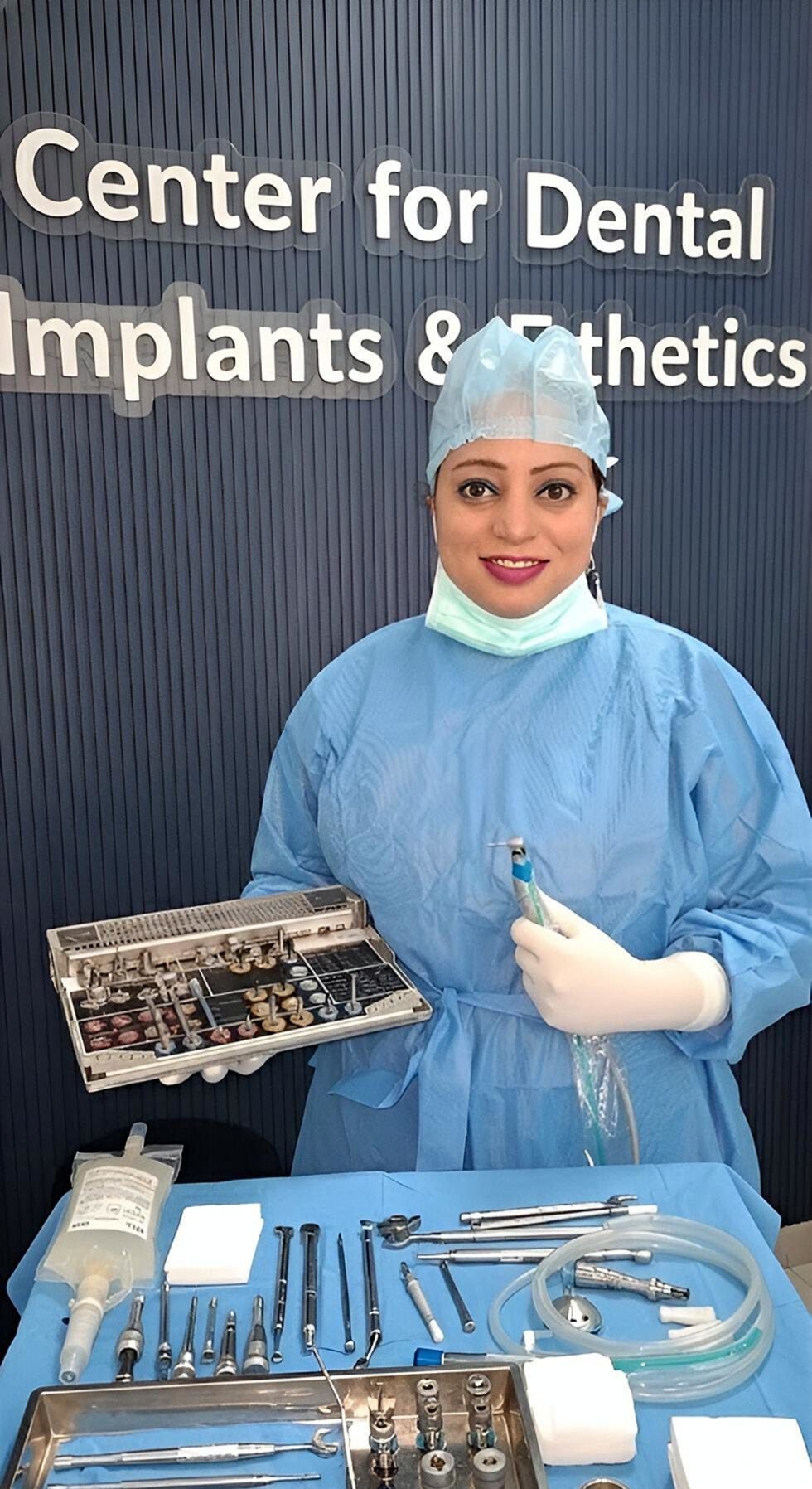
MDS Prosthodontics — MAIDS New Delhi | Diplomate WCOI Japan | Nobel Biocare Trained
“The most common thing patients say when they first sit down is: ‘I was told I cannot get implants.’ In 9 out of 10 cases, they can. The problem is that no CBCT scan was ever done. Without a 3D scan, you are guessing bone volume from a flat image. I never guess.”
- 🦷10,000+ implants placed over 17 years in Gurgaon
- 🏥100+ full-mouth All-on-4 cases — bone loss, diabetes, prior failures
- 📐Strict CBCT protocol — 3D imaging before every implant, no exceptions
- 🔬US FDA-approved systems only — Nobel Biocare, Straumann, Osstem, Zimmer, Adin
- 🩺Mandatory blood test protocol — HbA1c, CBC, Vitamin D, clotting before every procedure
We plan the prosthesis before we plan the implants. We decide where your teeth need to be for your face and bite first — then plan implants to support that outcome. The difference between a predictable result and a hopeful one.
- →Not every patient is suitable — medical and bone evaluation is essential first
- →Uncontrolled diabetes or very low Vitamin D may delay treatment until stabilised
- →Poor oral hygiene post-placement affects long-term success
- →This is exactly why a thorough evaluation comes before any decision
“I had been wearing dentures for 11 years. My lower denture was practically floating. Three clinics in Gurgaon told me I had no bone left. Dr Jyoti showed me on the CBCT exactly where my bone was. I had both jaws done with All-on-4 Nobel Biocare. I ate a paratha on day three.”— Patient, 63 years. All-on-4 both jaws. Full-mouth reconstruction 2023, Sector 51 clinic, Gurgaon.
Read more: Dr Jyoti Singh — best implantologist Gurgaon | Implantologist near me
Frequently Asked Questions
Honest answers. No sales language.
Yes, in most cases in a single surgical visit.
- Existing teeth or roots removed on surgery day if needed
- 4 implants placed immediately after
- Fixed temporary bridge placed same day in most cases
- Final prosthesis at 4 to 6 months after osseointegration confirmed
Not necessarily. In many cases, not at all.
- “Not enough bone” is only meaningful after a 3D CBCT — not a 2D X-ray
- All-on-4 was designed to work with reduced bone using angled implants
- Zygomatic implants or bone grafting available for more severe cases
- Many patients declined elsewhere received successful All-on-4 here after CBCT
Surgery is under local anaesthesia. You feel pressure — not pain — during the procedure.
- Only the anaesthesia injection is felt at the start
- Surgery takes 2 to 3 hours — most patients are surprised by comfort level
- Post-surgery discomfort: 2 to 3 out of 10 on pain scale
- Peaks at 24 to 48 hours, drops sharply after day 3
- 91% of patients report it was less painful than expected (Eli I et al, 2003)
Yes, if diabetes is controlled. HbA1c below 7.5% is the clinical threshold.
- Mandatory HbA1c, fasting glucose, CBC before every implant case
- If elevated, we coordinate with your physician before proceeding
- Post-surgical protocol adjusted for diabetic patients
- Vitamin D also screened — deficiency common in Indian patients (Mombelli A et al, 2012)
Implants: 20 to 25 years or a lifetime. Prosthesis: 10 to 15 years before needing replacement.
- Nobel Biocare All-on-4 at 10 years: 94.8% upper jaw, 98.1% lower jaw (Malo P et al, 2012)
- Titanium implant integrates permanently with bone
- Prosthesis replaceable without removing the implants
- Professional cleaning every 6 months significantly extends life
All-on-4: 4 implants, two angled — designed for reduced bone. All-on-6: 6 implants — for cases with good bone volume and higher bite forces.
- For most denture patients switching to fixed teeth, All-on-4 gives equivalent functional outcomes
- Correct choice determined by your CBCT scan — not by what sounds more comprehensive
Adhesive fills the growing gap between denture and gum. It cannot stop the gap from growing.
- Average bone loss under full denture: 0.5 to 1mm per year
- Over 3 to 5 years this completely changes the ridge profile
- Flabby tissue cannot hold a denture stable regardless of adhesive amount
- Only an implant in bone stops the shrinkage permanently
Almost never too late — our oldest full-mouth patient was 83 years old with 20 years of dentures.
- All-on-4 was designed for exactly the reduced-bone situation long-term denture wearers face
- Zygomatic implants and bone grafting available for more severe cases
- Earlier treatment = simpler procedure + lower cost. But “too late” is rarely the honest answer.
Get Your Implant Treatment Plan
in One Visit
Walk in with questions. Walk out with a 3D scan result, exact cost, and a complete timeline. No pressure. No hidden charges.
Most patients reach us after struggling with dentures for 5 to 10 years.
You can choose to skip those years.
Center for Dental Implants & Esthetics — Sector 51
#166, Sector 51, Ambedkar Chowk
Close to Artemis Hospital, Gurgaon 122003
Center for Dental Implants & Esthetics — Sector 74
R1-257, 2nd Floor, M3M Cornerwalk
Sector 74, Gurugram 122004
Pages You Will Want to Read Next
All-on-4 Implants in Gurgaon — Full Details
Complete procedure info, patient photos, cost breakdown at Center for Dental Implants & Esthetics.
Read more → Problem GuideWhy Your Denture Adhesive Has Stopped Working
The biological reason adhesive fails — and your permanent options in Gurgaon.
Read more → Cost GuideFull Mouth Implants Cost Gurgaon — Complete Breakdown
Transparent, itemised pricing for All-on-4, All-on-6, and full mouth reconstruction.
Read more →This page is for informational purposes only and does not replace professional dental consultation. Symptoms described may have multiple causes. Please visit a qualified dental professional for diagnosis and personalised treatment advice. Clinical data and research references cited are from peer-reviewed dental literature and used for educational purposes only.