- The Real Choice You Are Facing
- Quick Comparison – Implants vs Dentures
- Why Bone Loss Is the Biggest Hidden Risk
- How Each Option Affects Your Daily Life
- Cost Comparison – Short Term vs Long Term
- What Does the Treatment Actually Involve?
- Who Is a Good Candidate for Implants?
- Risks and What to Watch Out For
- What If You Need to Replace ALL Your Teeth?
- Myth vs Fact
- Frequently Asked Questions
The Real Choice You Are Facing After Losing Teeth
You lost a tooth. Or maybe more than one.
And now someone has told you — “Get dentures.” Or maybe, “You should think about implants.”
You are not sure what to do. That is completely okay.
In my clinical experience of placing over 10,000 dental implants, I have sat across from hundreds of patients in your exact situation. Confused. Worried about cost. Afraid of surgery. Not sure what will last.
My name is Dr. Jyoti Singh. I am a Diplomate of the World Congress of Oral Implantology (WCOI) and Nobel Biocare trained implantologist at the Center for Dental Implants & Esthetics (CDIE), Gurgaon. I want to help you make the right decision for your mouth, your life, and your budget — honestly.
Let me walk you through everything.
Quick Comparison – Dental Implants vs Dentures
Before we go deep, here is a simple side-by-side look. Read this slowly.
| Feature | ✓ Dental Implants | ⚠ Dentures |
|---|---|---|
| Feel | Feel like your own teeth | Feel foreign. Can feel loose. |
| Bone Preservation | Yes. Stimulates jaw bone. | No. Bone shrinks over time. |
| Eating | Eat all foods normally | Avoid hard & sticky foods |
| Slipping | Fixed. Does not move. | Can slip while eating or talking |
| Daily Care | Brush and floss normally | Remove, soak, and clean daily |
| Adhesive | Not needed | Often required |
| Lifespan | 20–25+ years, often lifetime | 5–10 years, then replace |
| Face Shape | Preserves facial structure | Face can look sunken over time |
| Success Rate | 95–98% (global data) | Depends on fit and bone |
| Initial Cost | Higher upfront | Lower upfront |
| Long-term Value | One-time investment | Cost adds up with replacements |
Now let us understand why each of these points matters for you.
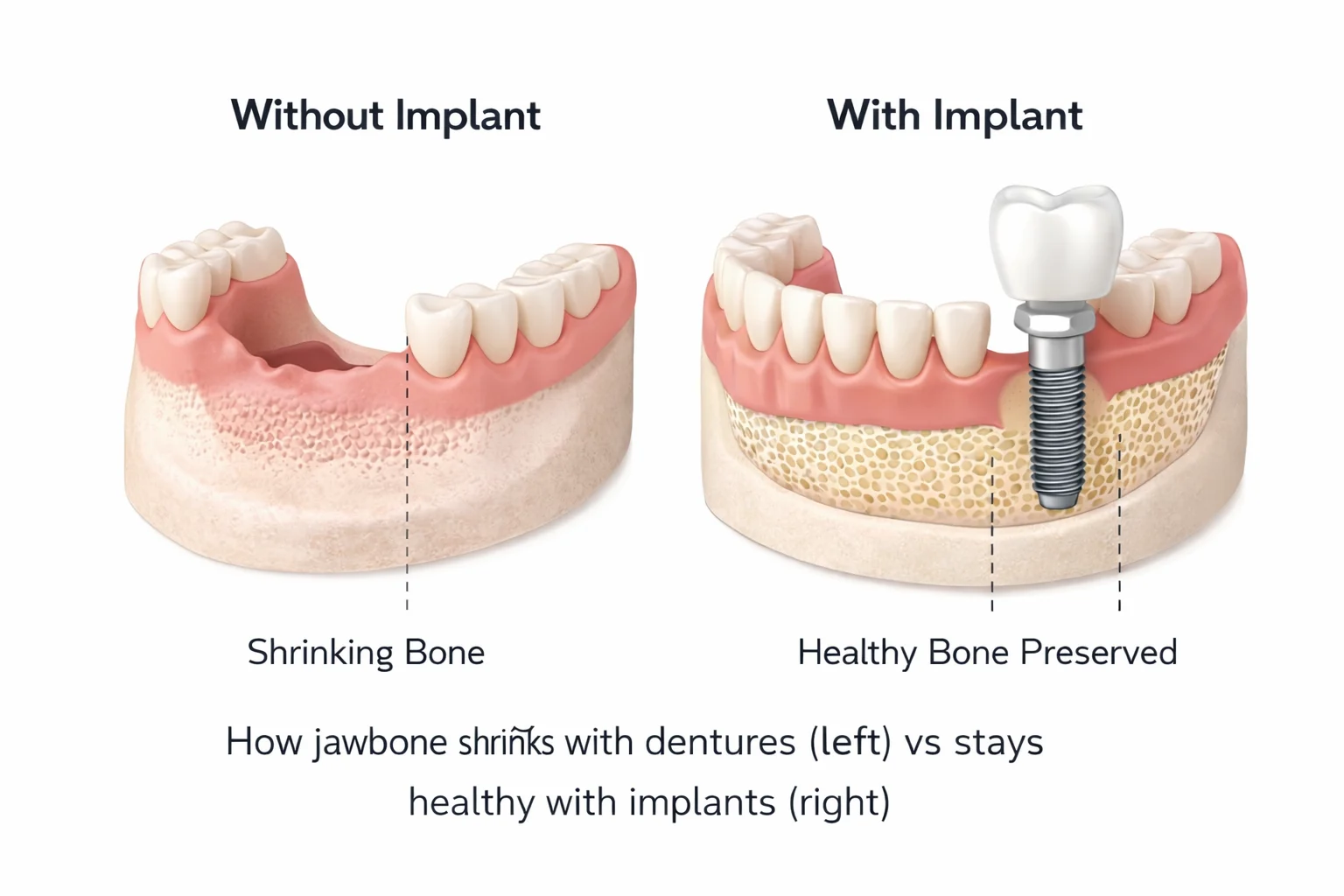
How jawbone shrinks with dentures (left) vs stays healthy with implants (right)
Why Bone Loss Is the Biggest Hidden Risk of Dentures
Most people focus on how teeth look. But here is what nobody tells you clearly:
When you lose a tooth, the jaw bone under it starts to disappear.
Think of it this way. Your jaw bone needs the tooth root to stay strong. The root stimulates the bone when you chew — like how walking keeps your leg muscles strong. Take away the root, and the bone starts to melt away. Dentists call this resorption.
What Happens Over Time with Dentures?
- The jaw bone shrinks — slowly but continuously
- Your face starts to look older and sunken (called the “denture face” look)
- The denture that fit you perfectly today will become loose in 2–3 years
- You will need to get it relined or remade. Again and again.
- Chewing becomes harder as bone reduces
In my clinical experience, I have seen patients who wore dentures for 10 years and lost so much bone that implants became very difficult to place. We had to do bone grafting first — which adds time and cost.
in the first year after tooth loss
in some areas after 3 years
globally (good candidates)
Source: Academy of Osseointegration / Published dental implant literature
How Implants Protect Your Bone
A dental implant is placed inside the jaw bone — exactly where the tooth root used to be. It is made of US FDA-approved medical-grade titanium. Over time, the bone grows around it. This is called osseointegration.
Once the bone locks onto the implant, it stays healthy. Your face shape is maintained. You look younger for longer. This is something no denture can do.
Want to understand bone loss in detail? Read: How Dental Implants Stop Jaw Bone Loss.
How Each Option Affects Your Daily Life
Let me be direct. Dentures are not comfortable for most people.
I am not saying this to scare you. I am saying this because patients tell me this every single day in my clinic.
- Wake up, put them in. Take out at night.
- Carry dental adhesive everywhere.
- Avoid peanuts, hard roti, raw carrots, sugarcane.
- Speech takes practice. They can slip mid-sentence.
- Gum sores are common early on.
- Fit gets worse every year.
- Brush and floss normally. Nothing to remove.
- Eat whatever you want — biryani, apple, corn.
- Speak clearly with zero fear of slipping.
- You forget they are even there.
- Smile in photos without worry.
- Confidence back. Life back.
One patient — a 58-year-old retired professor — came to us after 6 years with full dentures. He said: “Doctor, I have stopped going to dinner parties. I am embarrassed.” That broke my heart. We placed implants. Six months later, he came back smiling.
— Dr. Jyoti Singh, Center for Dental Implants & Esthetics, GurgaonCurious how implants actually work inside your mouth? Read: How Dental Implants Work – A Simple Guide.
Cost Comparison – Short Term vs Long Term
I know cost is a big concern. It always is. Let me be completely honest with you.
Dentures – Lower Upfront, More Expensive Over a Lifetime
| Expense | Approx. Cost (India) |
|---|---|
| Complete Denture (upper + lower) | ₹8,000 – ₹35,000 |
| Dental adhesive per month | ₹300 – ₹800 |
| Relining (every 2–3 years) | ₹2,000 – ₹5,000 |
| Replacement (every 5–10 years) | ₹8,000 – ₹35,000 |
| Total over 20 years (estimated) | ₹60,000 – ₹1,50,000+ |
Dental Implants – Higher Upfront, One Investment for Life
| Expense | Approx. Cost (India) |
|---|---|
| Single tooth implant (quality brand) | ₹25,000 – ₹80,000 |
| Full mouth implants (All-on-4 / All-on-6) | ₹2,50,000 – ₹8,00,000+ |
| Annual maintenance (cleaning, check-up) | ₹1,500 – ₹3,000 |
| Total over 20+ years (estimated) | One-time cost. No remake needed. |
At Center for Dental Implants & Esthetics, we use only US FDA-approved implants from brands like Nobel Biocare, Straumann, and Zimmer Biomet. These come with manufacturer warranties and decades of clinical research.
For a detailed cost breakdown: Dental Implant Cost in Gurgaon | Denture Cost in Gurgaon.
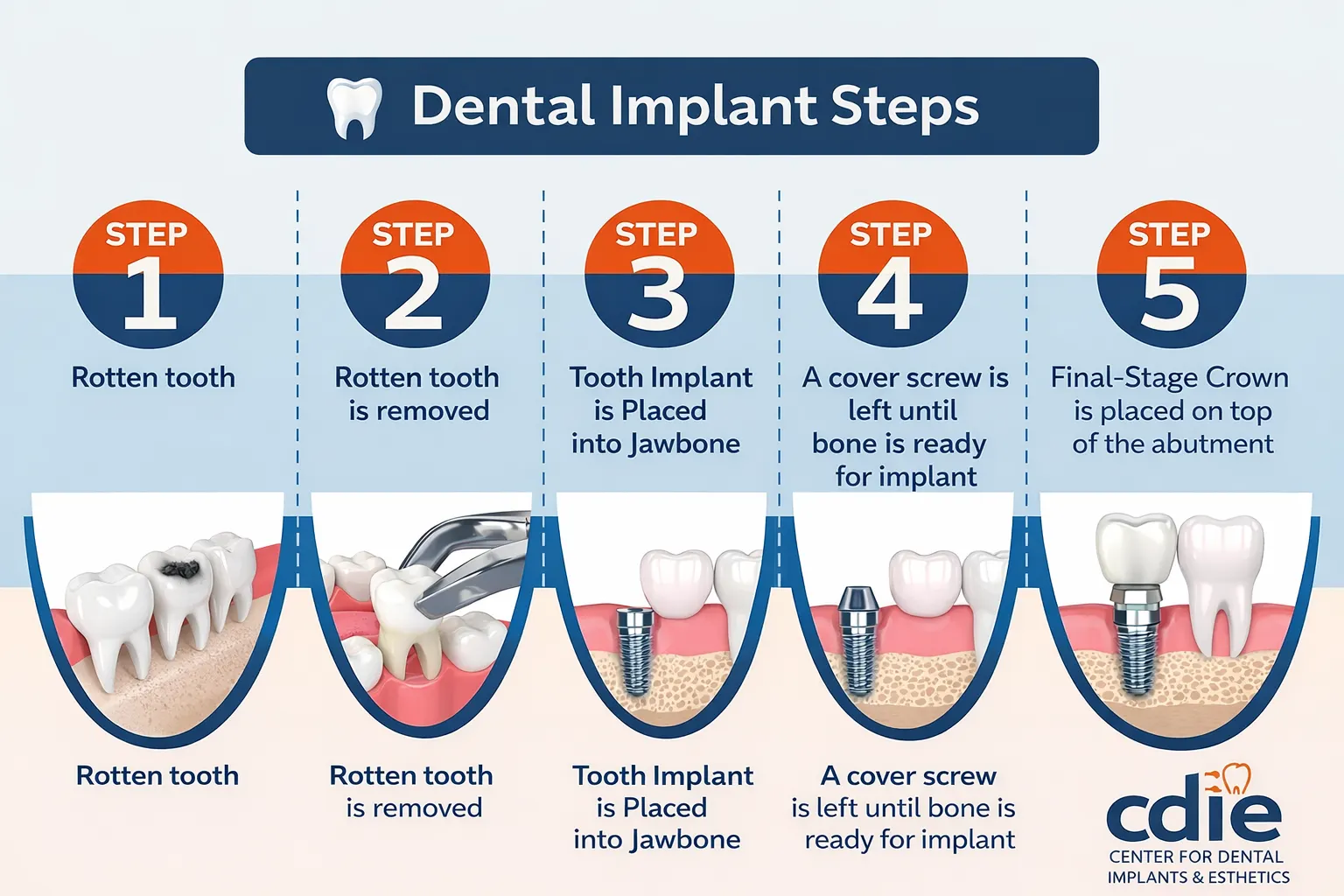
dental implant process: Extraction → Implant placement → Healing → Crown fitting
What Does the Treatment Actually Involve?
Dental Implant Procedure – Step by Step
At Center for Dental Implants & Esthetics, I follow a very strict protocol before placing any implant. I do not skip steps. Ever.
-
01
Consultation & CBCT Scan — We take a 3D CBCT scan (not just a flat X-ray) to see the exact bone quantity and quality. This tells us where to safely place the implant. I personally insist on this for every patient — no exceptions.
-
02
Blood Tests — We check blood sugar, haemoglobin, clotting time, and other markers. We do not proceed if your health is not ready. Your safety comes first.
-
03
Treatment Planning — Using CBCT data, we plan the exact angle, depth, and position of the implant — sometimes using digital guided surgery for maximum precision.
-
04
Implant Placement — Done under local anaesthesia. You feel pressure, not pain. The titanium implant (a small medical-grade screw) is placed into the jaw bone. Takes about 30–60 minutes.
-
05
Healing Phase (Osseointegration) — 3 to 6 months for bone to grow around the implant. You get a temporary tooth during this time so you are never without a tooth.
-
06
Crown Placement — A natural-looking zirconia crown is placed on top. This is your final tooth. Permanent. Beautiful. Done.
Learn more about what to expect: Dental Implant Healing Stages – What to Expect.
Denture Procedure – Step by Step
- 01Examination — Check remaining teeth and gum health.
- 02Impressions — Mold of your mouth is taken to make the denture.
- 03Trial Fitting — Wax trial to check bite and look.
- 04Final Fitting — Denture is delivered. Adjustments may be needed.
- 05Follow-up Visits — To check fit and adjust any sore spots.
Interested in immediate options? Read: How Immediate Dentures Are Made.
Who Is a Good Candidate for Dental Implants?
Most healthy adults can get implants. But not everyone. Here is a quick check.
- Are 18+ with fully grown jaw bones
- Have enough jaw bone (or can have a graft)
- Have controlled blood sugar
- Are a non-smoker or willing to quit
- Have healthy gums
- Are committed to good oral hygiene
- Uncontrolled diabetes (HbA1c must be below 7)
- Heavy smoking habit
- Significant bone loss (bone graft first)
- Certain medications like bisphosphonates
- Severe gum disease (treat first)
In my experience, even patients who were told “you cannot get implants” often can — with proper planning. Read: Can I Get Dental Implants with Bone Loss?
Important checks before surgery: Checks Before Dental Implant Surgery.
When Dentures Are the Right Choice
I am not against dentures. For some patients, they are the right answer — at least for now.
- Very elderly patients with multiple health conditions
- When budget makes implants impossible right now
- When bone is too severely compromised even with grafting
- As a temporary solution while planning for implants later
For multiple missing teeth, there is another great fixed option — implant-supported bridges, which are fixed and do not need full jaw coverage.
Risks – What to Watch Out For
I believe in being transparent. Every treatment has risks. Let me tell you both sides honestly.
Risks of Dental Implants
- Infection at the implant site (rare if protocol is followed)
- Implant failure — less than 5% in good candidates with quality implants
- Nerve sensitivity — extremely rare with CBCT-guided surgery
- Sinus issues — only for upper back teeth, manageable
- Peri-implantitis (gum disease around implant) — preventable with good hygiene
At Center for Dental Implants & Esthetics, our strict CBCT and blood test protocol significantly reduces these risks. We have never compromised on this. Read: Risks of Dental Implant Surgery – Full Guide.
Risks of Dentures
- Ongoing and progressive jaw bone loss
- Gum sores and irritation
- Speech problems
- Difficulty chewing — leading to nutritional deficiency over time
- Psychological impact — loss of confidence and social withdrawal
- Ill-fitting dentures that need frequent repairs
If you already have dentures becoming loose or uncomfortable: Why Well-Fitting Dentures Become Ill-Fitting Over Time.
What If You Need to Replace ALL Your Teeth?
If you are missing all or most of your teeth, you have more options than just full dentures.
| Option | What It Is | Best For |
|---|---|---|
| Full Dentures | Removable plastic teeth set | Budget-only situation |
| Implant-Supported Denture | Denture clips onto 2–4 implants | Better stability, still removable |
| All-on-4 Implants | Full arch fixed on 4 implants | Full teeth replacement – fixed |
| All-on-6 Implants | Full arch fixed on 6 implants | More stability, better load distribution |
Comparing All-on-4 and All-on-6? Read: All-on-4 vs All-on-6 – Which Is Right for You?
Want to understand implant-supported dentures? Read: Implant-Supported Dentures – How They Work.
Compare all tooth replacement options: All Ways to Replace a Missing Tooth.
Myth vs Fact – What You Hear vs What Is True
Dental implant surgery is very painful
Most patients say implant surgery is less painful than a tooth extraction. Local anaesthesia means you feel pressure, not pain. Mild soreness after is managed with normal painkillers.
Implants are only for young people
We have placed implants in patients in their 70s and 80s. Age is not the barrier — health is. If you are medically fit, age should not stop you.
Dentures are “good enough”
Dentures restore some function. But they do not stop bone loss. Over 10–15 years, progressive bone loss makes your face look much older. That is a real and measurable consequence.
Cheap implants are the same quality
Not all implants are equal. Brand, material, and design matter enormously. Read: Does Dental Implant Brand Matter?
Frequently Asked Questions – Implants vs Dentures
Real questions. Straight answers. No jargon.
Dental implants can last 20–25 years or even a lifetime with good oral hygiene. The implant itself (the titanium screw) rarely fails. Only the crown on top may need replacement after 10–15 years.
Dentures typically need relining every 2–3 years and full replacement every 5–10 years as the jaw bone shape changes underneath them.
No. The surgery is done under local anaesthesia — you will not feel pain. You may feel pressure and movement, but not pain.
After surgery, most patients experience mild soreness for 2–3 days, similar to a tooth extraction. Standard painkillers manage this well. Most patients return to normal work within 1–2 days.
Yes, in many cases you can — but it depends on how much bone remains. Long-term denture use causes bone loss. We first take a CBCT scan to assess bone quantity. If bone is insufficient, a bone graft is done first.
A single dental implant in Gurgaon typically costs ₹25,000 to ₹80,000 depending on the implant brand and case complexity. A complete denture set costs ₹8,000 to ₹35,000.
Implants are a one-time investment. Dentures cost money repeatedly. For exact pricing: Dental Implant Cost in Gurgaon | Denture Cost in Gurgaon.
Once fully healed — no restrictions at all. You can eat everything: hard foods, chewy foods, all normal Indian food. During the 3–6 month healing period, we advise soft foods to protect the healing site.
With dentures, many patients permanently avoid hard and sticky foods to prevent dislodging or breaking the denture.
Yes – if your diabetes is well-controlled. We check HbA1c levels before any implant surgery. If HbA1c is below 7 (or in some cases 7.5), implants can be placed safely with proper precautions.
Uncontrolled diabetes increases infection risk and implant failure rate. We always run full blood tests before surgery — not optional at CDIE.
Ready to Know What Is Right for You?
Every mouth is different. What worked for your neighbour may not be the right answer for you.
Come in. I will look at your scans, check your bone, and give you my honest clinical opinion. No pressure. No obligation. Just clarity.

Dr. Jyoti Singh (MDS), Diplomate WCOI (Japan region) Member AAID (American Association of Implant Dentistry) stands as a beacon of excellence in implantology within Delhi NCR region. She is a BDS and MDS(Prostho) both from Maulana Azad Institute of Dental Sciences, where she secured top honors with all India rank 1 in PG entrance examination. Her extensive experience at esteemed institutions like Clove Dental and her own Center for Dental Implants & Esthetics since 2016, Dr. Singh embodies unparalleled expertise in dental implants. Boasting a wealth of 17+ years in dentistry and backed by 18 groundbreaking research papers in leading international journals (Google Scholar) and her ResearchGate profile, she epitomizes the pinnacle of proficiency and innovation in her field. She practices in Gurugram as your friendly dentist near me.