Fluoride Treatment in Gurgaon
Stronger enamel. Fewer cavities. 10 minutes.
Professional fluoride treatment for children and adults — no drilling, no injections. Available same-week at both our Gurgaon clinics.
My child keeps getting cavities even with fluoride toothpaste — what is going wrong?
This is the most common question we hear. The short answer is that toothpaste and professional fluoride are not the same thing. Toothpaste works at a low concentration for less than two minutes, then it is rinsed away. Professional fluoride varnish is 15 times more concentrated and stays in contact with the enamel for several hours — pulling minerals back into weak spots and hardening the surface.
At CDIE we use fluoride varnish for children under 10, and a fluoride gel tray for older patients and adults. The choice depends on age, cavity history, and how cooperative your child is at the chair. The whole thing takes under 10 minutes and there is no drilling or injection at all.
Signs you or your child may need this:
- Cavities forming even with regular brushing
- Teeth sensitive to cold or sweet foods
- Visible white or chalky patches on enamel
- Currently wearing braces
- Dry mouth from medication
Scroll down to find cost, safety information, and how to book at either of our two Gurgaon clinics.
The children who come to us after a cavity scare are usually not here because of poor brushing. Their enamel type just needed more than toothpaste could give. Professional fluoride changes that.
— Dr. Jyoti Singh, MDS · Diplomate WCOI · 17+ years clinical experience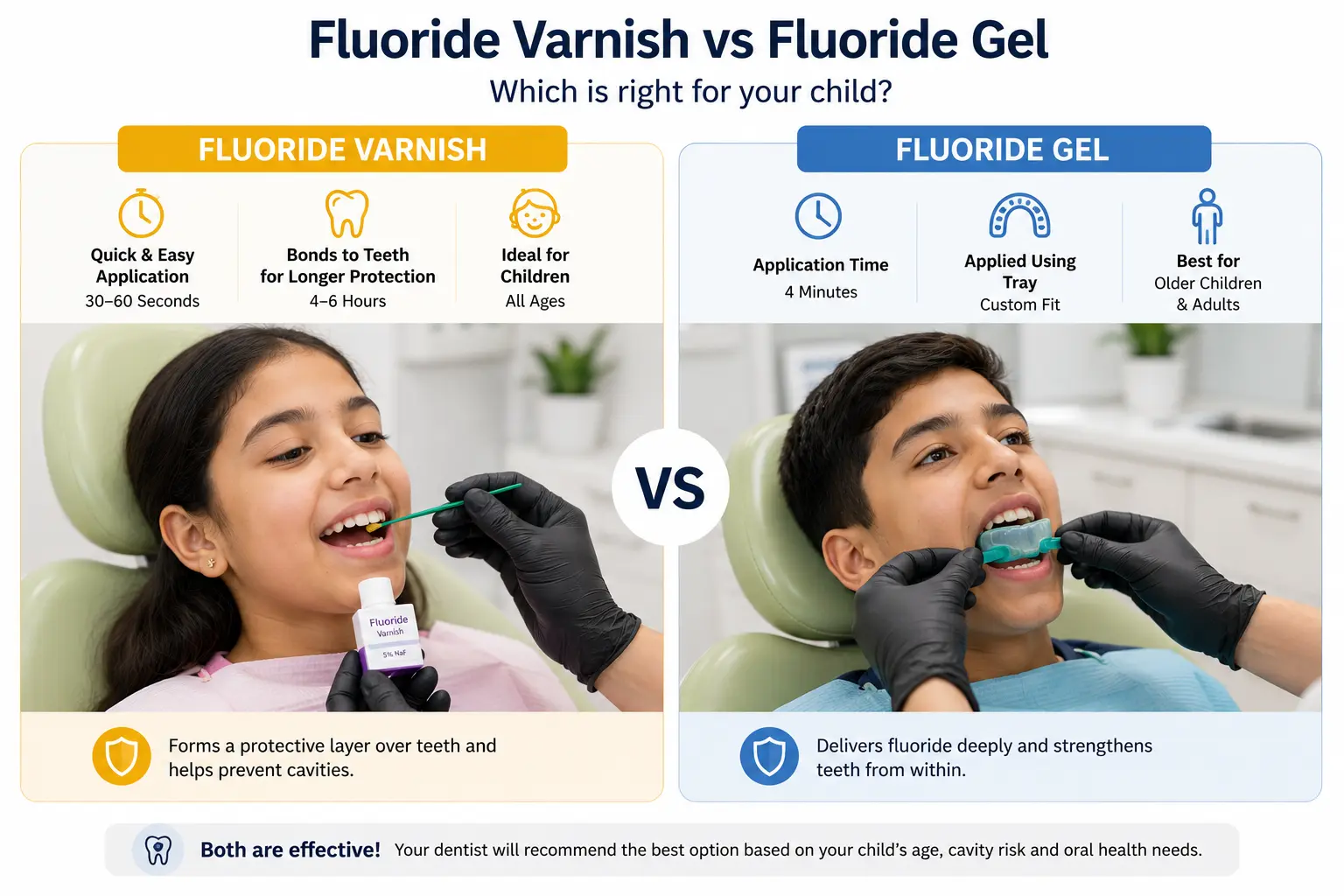
What is professional fluoride treatment and how does it actually work?
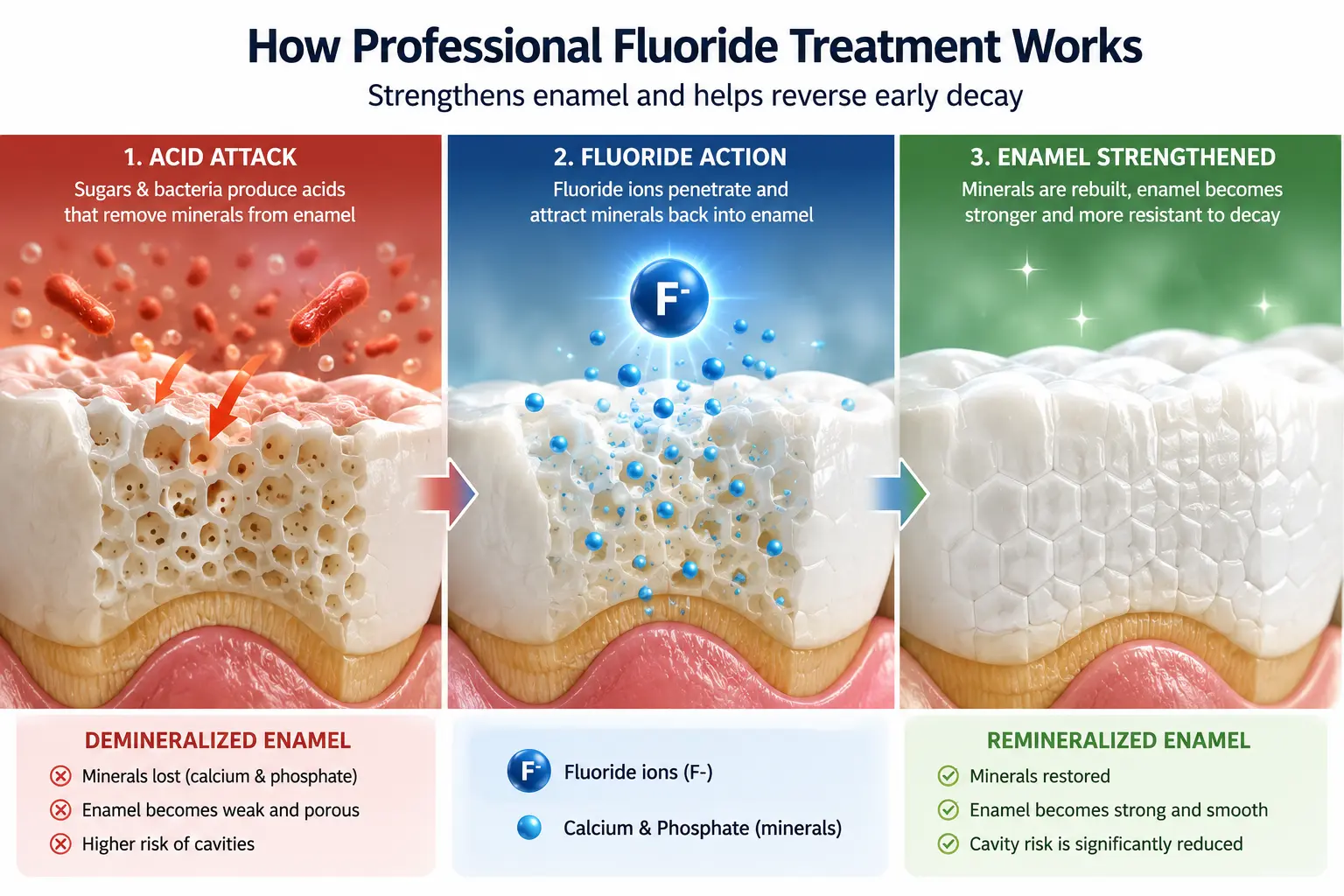
Fluoride toothpaste contains around 1,000 to 1,500 ppm of fluoride. Professional varnish contains 22,600 ppm — roughly 15 times more. When applied by a dentist, it clings to the enamel surface for hours and does something toothpaste simply cannot: it draws calcium and phosphate from saliva back into the tiny weak spots in the enamel, forming a harder, more acid-resistant crystal called fluorapatite.
This process is called remineralisation. Early white spot lesions — the chalky patches that appear on teeth before a cavity fully forms — can actually be reversed with fluoride if caught early enough. Once a cavity becomes a hole, fluoride cannot fix it. That is why regular professional applications matter.
Varnish or gel — which type do we use?
- Fluoride varnish is painted onto teeth with a small brush and sets within seconds. No tray required. Best for young children under 10 and patients who gag easily. Comes in strawberry and bubblegum flavours.
- Fluoride gel (APF 1.23%) sits in a tray for four minutes and delivers a slightly higher dose. Used for older children, teens, and adults with a moderate to high cavity risk.
- We choose the right type after examining your teeth and talking through your history. There is no one-size-fits-all answer.
Why professional fluoride and home fluoride are not the same
- Home fluoride toothpaste and rinses are maintenance — they slow the process of demineralisation day to day.
- Professional fluoride is the active intervention — it is applied at a clinical concentration and left on long enough to push minerals back into enamel.
- Think of it like the difference between a daily walk and a physiotherapy session. Both matter. They are not interchangeable.
- Patients with active cavity risk, braces, dry mouth, or exposed root surfaces need both.
According to the World Health Organisation, dental caries is the most common non-communicable disease worldwide. Clinical studies consistently show professional fluoride reduces cavity incidence by 30–40% compared to toothpaste alone — making it one of the highest-value preventive treatments available.
What happens during a fluoride treatment at CDIE — step by step
10 to 15 minutes total. No drilling. No injections. Children usually find it completely fine.
Examination and risk check
We look at existing cavities, enamel condition, diet habits, and cavity history to pick the right fluoride type and schedule for you.
Cleaning
Plaque is removed first so fluoride can reach the enamel directly. It cannot penetrate through a layer of biofilm.
Fluoride application
Varnish is brushed on in about 30 seconds. Gel sits in a tray for four minutes. No discomfort at all either way.
After-care instructions
No eating or drinking for 30 minutes. Avoid hard or sticky foods for the rest of the day. Skip brushing that evening so the fluoride can work overnight.
How often?
Low risk: once a year. Moderate risk: every six months. High risk (braces, dry mouth, frequent cavities): every three months.
Fluoride treatment for children in Gurgaon — when to start, how often, what to expect
The American Academy of Pediatrics recommends professional fluoride varnish from the time the first tooth appears — as early as six months. Most dentists in India recommend starting by age two or three and continuing every six months through the teenage years. If your child has already had cavities, we move to every three months.
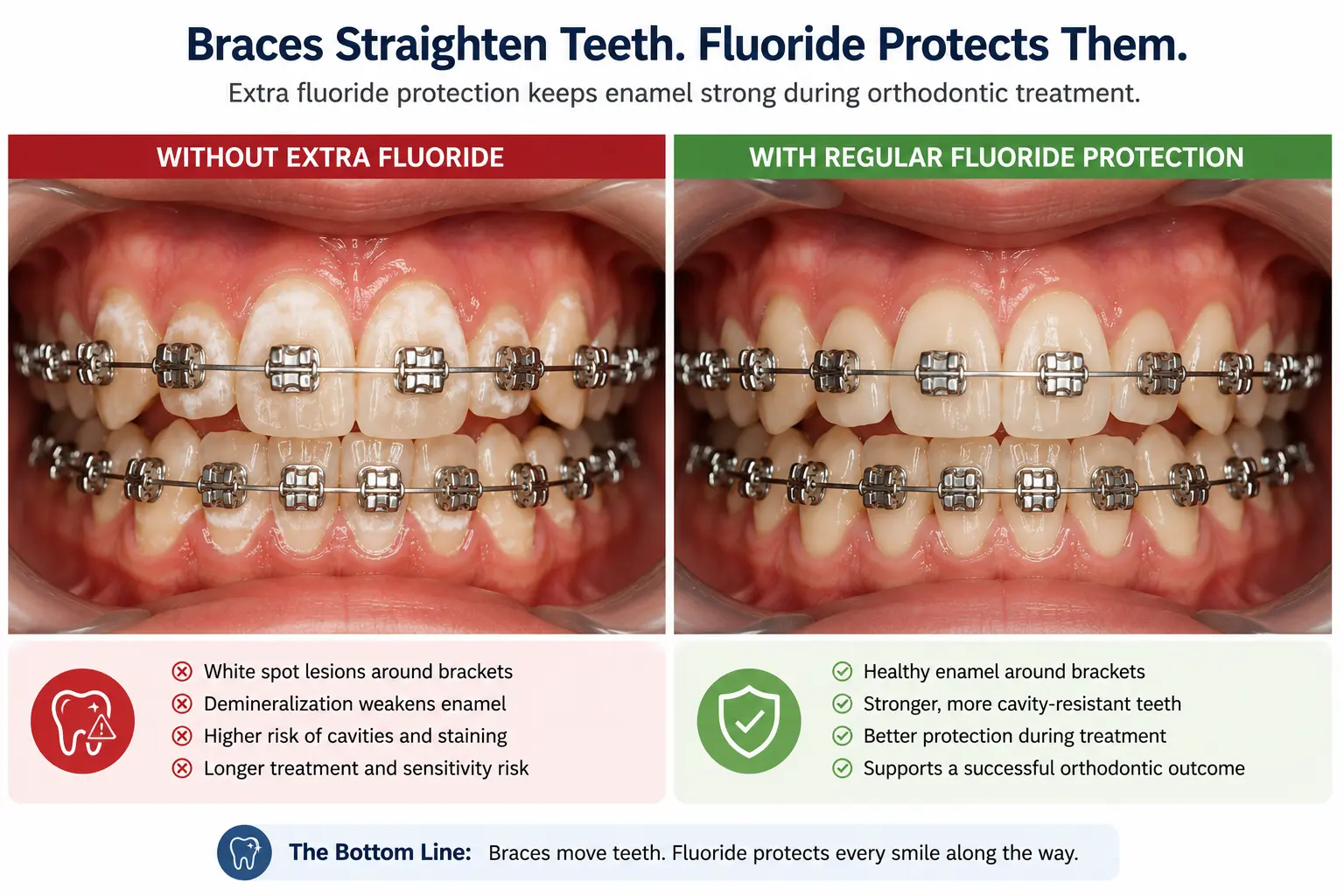
Children with braces are at especially high risk. Brackets create plaque traps around the enamel that are nearly impossible to clean fully. White spot lesions — permanent enamel marks — can appear within weeks, even after the braces come off. We see this regularly and it is entirely preventable.
Both our clinics in Sector 51 and Sector 74 are child-friendly, and the flavoured varnish makes it easy for younger children to cooperate.
First teeth emerging
Fluoride varnish on erupting teeth prevents early childhood caries — what many parents call baby bottle tooth decay.
Primary teeth fully in
Every six months. Strawberry or bubblegum varnish. Primary teeth matter — they hold space for permanent ones.
Mixed dentition phase
Critical stage. Permanent molars erupting at this age are highly vulnerable. Every three to six months depending on cavity risk.
Teens with braces
Brackets trap plaque and acid. Fluoride gel every three months is the standard protocol during active orthodontic treatment.
Do children with braces need extra fluoride?
Yes, without question. Brackets create grooves that hold plaque and acid against the enamel. Within just a few weeks, the enamel around each bracket can start to demineralise. We recommend:
- Professional fluoride varnish every three months during active treatment
- Daily fluoride mouth rinse (0.05% sodium fluoride) at home
- Prescription fluoride gel for higher-risk patients
If your child is undergoing braces treatment in Gurgaon, ask us about adding fluoride at their next visit — it takes five minutes and protects months of orthodontic work.
A cavity in a six-year-old is not inevitable. It is preventable.
Parents who come to us after their child’s first filling often say the same thing: “I didn’t know there was something we could have done before this.” There was. It cost less than a filling, took ten minutes, and involved no drilling at all.
Ask about fluoride for your childFluoride treatment for adults — it is not just for children
Most adults assume fluoride is a children’s thing. It is not. If any of the situations below apply to you, professional fluoride is clinically recommended regardless of your age.
Sensitive teeth
- Sensitivity to cold, heat, or sweet food usually means exposed dentinal tubules
- Fluoride varnish blocks those tubules and reduces sensitivity within a few days
- The effect typically lasts three to six months per application
- Also works well for sensitivity after scaling — ask us to apply varnish at the same visit
Dry mouth from medication
- Saliva is your natural cavity defence — it neutralises acids and supplies minerals to enamel
- Blood pressure, diabetes, allergy, and depression medications often reduce saliva significantly
- Without enough saliva, cavity risk roughly triples
- We recommend professional fluoride every three months for patients on these medications
Gum recession and exposed roots
- When gums pull back, the root surface is exposed — root enamel is softer than crown enamel
- Exposed roots are far more vulnerable to decay than normal tooth surfaces
- Adults over 50 with any visible gum recession should discuss fluoride at every check-up
- Fluoride varnish on exposed roots is one of the most effective protectives available
A note from our clinic on adult fluoride
We see a pattern regularly: patients in their 40s and 50s who had healthy teeth for decades suddenly developing multiple cavities within a year or two. They brush the same. They have not changed their diet. What changed is their medication.
Blood pressure medication, antihistamines, antidepressants, and diabetes medication are the most common causes. Dry mouth follows, and without saliva to neutralise acid and remineralise enamel, cavities develop quickly. Professional fluoride every three months combined with prescription-strength home gel significantly slows this down. It is not a complete substitute for saliva — but it is the most effective intervention we have.
Is fluoride treatment safe for children in India? What the evidence actually says.
The concern parents raise most often is fluorosis — the white marks or streaks that can appear on teeth. This is a completely valid concern, but there is an important distinction to understand. Dental fluorosis is caused by ingesting too much fluoride during the years when enamel is forming, usually from high-fluoride groundwater in certain regions of India. Professionally applied fluoride varnish is an entirely different thing — it is applied to the tooth surface in tiny quantities and is not swallowed.
Fluoride varnish causes fluorosis
Fluorosis is caused by ingesting too much fluoride during enamel development, typically from high-fluoride water. A professional varnish application uses under 0.5ml, stays on the surface, and is not swallowed.
The dose is controlled and safe
The Indian Dental Association and the World Health Organisation both endorse professional fluoride varnish from infancy. For children under six we use smaller amounts still. When applied correctly, there is no systemic risk.
Toothpaste is enough — clinic treatment is unnecessary
Toothpaste delivers 1,000–1,500 ppm for under two minutes. Professional varnish delivers 22,600 ppm and stays in contact with enamel for hours. The doses and durations are not comparable.
Toothpaste maintains — professional fluoride repairs
Daily brushing is maintenance. Professional fluoride is the active step needed when enamel is already weakening or cavity risk is elevated. Think of it as the difference between moisturising skin and treating a wound.
Adults do not need fluoride treatment
Adults with sensitivity, dry mouth, gum recession, or a history of cavities have just as much clinical need as children. Age is not a reason to skip this.
Fluoride is one of the best treatments for adult sensitivity
Fluoride varnish on exposed root surfaces and sensitive tubules is a well-established clinical treatment. The Indian Dental Association recommends it specifically for adults with gum recession.
What IDA and WHO say
- WHO lists fluoride among the most effective public health tools for reducing cavities globally
- IDA endorses professional fluoride varnish from infancy, used correctly by a trained dentist
- No evidence of systemic toxicity at recommended clinical doses
- Fluorosis risk in India is related to high-fluoride groundwater in specific districts — it is unrelated to clinical varnish application
- All fluoride products used at our clinics are BIS and dental-FDA approved

Dr. Jyoti Singh
MDS · Diplomate WCOI · 17 years clinical experience · Center for Dental Implants & Esthetics, Gurgaon
In 17 years, the children who start fluoride early almost never need the extensive restorative work we see in patients who started late. It is not a dramatic treatment — but the results over time are.
How much does fluoride treatment cost in Gurgaon?
Most clinics publish no price at all, or a vague range. Below is the full breakdown by treatment type. The cost depends on whether we use varnish or gel, the patient’s age, and whether it is combined with a cleaning appointment.
| Treatment type | For whom | What is included | Approx. cost |
|---|---|---|---|
| Fluoride varnish | Children under 10 | Brush-on varnish, post-care instructions | ₹800 – ₹1,200 |
| Fluoride gel (APF tray) | Older children, teens, adults | Tray selection, 4-minute gel, fluoride schedule | ₹1,000 – ₹1,500 |
| Fluoride bundled with cleaning | Adults — same visit | Ultrasonic clean + fluoride varnish or gel | ₹2,000 – ₹2,800 |
| High-risk protocol (3-monthly) | Braces, dry mouth, gum recession | Assessment + varnish + written risk plan | ₹800 – ₹1,200 per visit |
Fluoride vs the cost of what it prevents
- A single tooth-coloured dental filling in Gurgaon costs ₹1,500 – ₹3,500
- A root canal starts at ₹8,000 and needs a crown on top
- Two fluoride sessions a year for a moderate-risk child cost less than treating one cavity in most cases
- Fluoride treatment vs dental sealants — both are preventive. Sealants block the deep grooves in molars; fluoride remineralises all enamel surfaces. Many high-risk children benefit from both at the same visit.
- We think of fluoride as regular maintenance, the same as an oil change — not as a medical expense
How to prevent cavities in children — a plan that actually works
Fluoride treatment is the single most powerful tool available, but it works best as part of a plan. Here is how we approach preventive dentistry for children at CDIE.
Fluoride varnish or gel
- Remineralises weak spots before they become cavities
- Slows the growth of cavity-causing bacteria on the enamel surface
- Every three to six months depending on your child’s risk level
Dental sealants
- Thin coating over the deep grooves in back teeth
- Stops plaque building up in areas that are almost impossible to clean
- Most effective at ages six to eight when first permanent molars come through
Dietary guidance
- How often your child eats sugar matters more than the total amount
- Reducing between-meal snacking cuts the number of daily acid attacks significantly
- We give written dietary guidance — not just a verbal reminder to eat less sugar
Home fluoride routine
- Rice-grain amount of fluoride toothpaste for under-three-year-olds
- Pea-size amount for three to six-year-olds
- Fluoride mouth rinse for children over six who can spit reliably
- Prescription-strength gel for high-risk teens and adults
For families who want more detail on children’s dental care in Gurgaon, a cavity risk assessment is included at no extra charge when combined with a fluoride session.
Adults on medication do not have to accept rapid tooth loss as inevitable
Many patients develop multiple cavities within two years of starting medication that reduces saliva. Not because of poor brushing — because a physiological change removed their natural protection. Professional fluoride every three months combined with prescription home gel addresses this directly. It works, and it is significantly cheaper than treating the cavities that follow.
📞 Talk to us about adult fluorideQuick answers about fluoride treatment
- From the time the first tooth appears — as early as six months
- Most dentists in India recommend starting by age two or three
- Continue every six months through the teenage years
- Low risk: once a year
- Moderate risk: every six months
- High risk (braces, dry mouth, gum recession, frequent cavities): every three months
- Yes — applied in tiny amounts to the tooth surface, not swallowed
- Endorsed by the Indian Dental Association and the World Health Organisation
- Cavity risk from skipping it is far higher than any risk from the varnish itself
- No. Fluorosis is caused by ingesting excessive fluoride during tooth development — usually from high-fluoride groundwater
- Professionally applied varnish stays on the surface and is not swallowed
- There is no causal link between clinical varnish and fluorosis
- Fluoride varnish for children: ₹800 – ₹1,200
- Fluoride gel for adults: ₹1,000 – ₹1,500
- Combined with a cleaning appointment: ₹2,000 – ₹2,800
- Yes — particularly for tooth sensitivity, dry mouth from medication, gum recession, and braces
- Adults in their 40s and 50s on long-term medication benefit significantly
- There is no age beyond which fluoride stops being useful
- Varnish is painted on and sets in seconds — no tray, preferred for young children
- Gel sits in a tray for four minutes — slightly higher dose, better for older patients
- Both rebuild enamel at the mineral level. We choose based on age and cavity risk
Frequently asked questions about fluoride treatment in Gurgaon
Yes. Fluoride varnish is the standard of care from the time the first tooth appears — that is from around six months of age. The amount used is tiny (0.25 to 0.3ml), painted directly onto the teeth, and not swallowed. Both the Indian Dental Association and the American Academy of Pediatrics recommend it from infancy. The cavity risk from not doing it is significantly higher than any risk from the varnish itself.
Toothpaste at 1,000 to 1,500 ppm maintains the enamel. Professional varnish at 22,600 ppm actively repairs demineralisation, stays on enamel for several hours, and reaches areas that brushing misses. For children with moderate or high cavity risk, the clinical evidence clearly shows significant additional benefit from professional fluoride on top of regular brushing.
- Fluoride varnish for children under 10: ₹800 – ₹1,200
- Fluoride gel (APF) for older children, teens, adults: ₹1,000 – ₹1,500
- Combined with a cleaning or scaling appointment: ₹2,000 – ₹2,800
- Three-monthly high-risk protocol: ₹800 – ₹1,200 per visit
For comparison, a single tooth-coloured filling costs ₹1,500 to ₹3,500. A root canal starts at ₹8,000. Two fluoride sessions a year typically cost less than treating one cavity — and far less than the root canal that follows an untreated one.
Yes, reliably. Fluoride varnish blocks the exposed channels in dentine that cause sensitivity. Most patients notice a clear improvement within a few days of application. The effect typically lasts three to six months per session. If you are experiencing sensitivity after a scaling appointment, ask us to apply varnish at the same visit — it makes a significant difference.
No. Dental fluorosis is caused by ingesting excessive fluoride during the years when enamel is forming — roughly ages zero to eight. It occurs in districts where naturally occurring fluoride in groundwater is above 1.5mg per litre. Professionally applied varnish:
- Is applied to the surface only — not taken internally
- Is used in amounts too small to affect systemic fluoride levels
- Does not enter developing enamel through the surface application
The fluorosis risk you may have read about is a real concern for high-fluoride water regions in India — not for professional fluoride treatment at a dental clinic.
- No eating or drinking for 30 minutes after application
- Avoid hard or sticky foods for the rest of that day
- Skip brushing that evening — let the fluoride work overnight
- Resume normal brushing the following morning
Both are clinically effective. The choice depends on age and how cooperative the patient is at the chair.
- Varnish is preferred for children under 10, patients who gag easily, and anyone who needs a quick and comfortable application. It sets within seconds and requires no tray.
- Gel delivers a slightly higher dose and is preferred for older children, teenagers, and adults with moderate to high cavity risk. It requires four minutes in a tray.
Our dentist will recommend the right type after examining your child and discussing their history. You do not need to decide in advance.
Yes — we recommend it strongly. Saliva is the body’s primary defence against tooth decay. It neutralises acids, washes away food, and supplies minerals to enamel. Many medications reduce saliva significantly: blood pressure tablets, antihistamines, antidepressants, and diabetes medication are the most common examples. Without adequate saliva:
- Acid from bacteria stays on enamel much longer than normal
- Natural remineralisation slows or stops entirely
- Cavities can develop rapidly, even in adults who had healthy teeth for decades
For patients with medication-related dry mouth, we recommend professional fluoride gel every three months alongside a prescription home fluoride gel. Please mention your medications when you book — it helps us prepare the right protocol before you arrive.
We have two clinics in Gurgaon, both offering fluoride treatment with same-week appointments for most preventive procedures.
- Sector 51: #166, Sector 51 (Ambedkar Chowk), close to Artemis Hospital, Gurgaon 122003 — convenient for Golf Course Road and South City patients.
- Sector 74: R1-257, 2nd Floor, M3M Cornerwalk, Sector 74, Gurugram 122004 — convenient for New Gurgaon, Sector 56, and Cyber City.
WhatsApp us at +91 98716 31066 and let us know which area you are in — we will suggest the more convenient branch.
Book fluoride treatment in Gurgaon
10 minutes. Completely painless. One of the most cost-effective things you can do for your teeth — or your child’s.
🏥 Sector 51 Clinic
- 📍 #166, Sector 51 (Ambedkar Chowk), close to Artemis Hospital, Gurgaon 122003
- View on Google Maps
- Book appointment online
- Book via WhatsApp
🏥 Sector 74 Clinic
- 📍 R1-257, 2nd Floor, M3M Cornerwalk, Sector 74, Gurugram 122004
- View on Google Maps
- Book appointment online
- Book via WhatsApp
Related reading
Paediatric Dentist in Gurgaon
- Child-friendly dental care at both our clinics
- Behaviour management for anxious children
- Full preventive protocols including sealants and fluoride
Teeth Cleaning and Scaling in Gurgaon
- Why fluoride works better after a professional clean
- Combined cleaning and fluoride bundle — cost and timing
- Managing sensitivity after scaling with fluoride varnish
Dental Braces in Gurgaon
- Why braces patients need fluoride every three months
- Preventing white spot lesions during orthodontic treatment
- Braces options available at CDIE
This page is for information only and does not replace a dental consultation. Please visit a qualified dental professional for diagnosis and personalised treatment advice.