Denture Adhesive Not Working?
Here Is Why Your Dentures Keep Slipping
If the adhesive is failing by afternoon, the cream is not the problem. Your denture fit is. Find out what is really happening — and what can actually fix it permanently.
If you are applying denture adhesive every morning just to get through meals, your denture likely needs relining or implant stabilisation.
Why Is My Denture Adhesive Not Working?
If your denture adhesive is not working, the most common reason is that the denture no longer fits your gums properly.
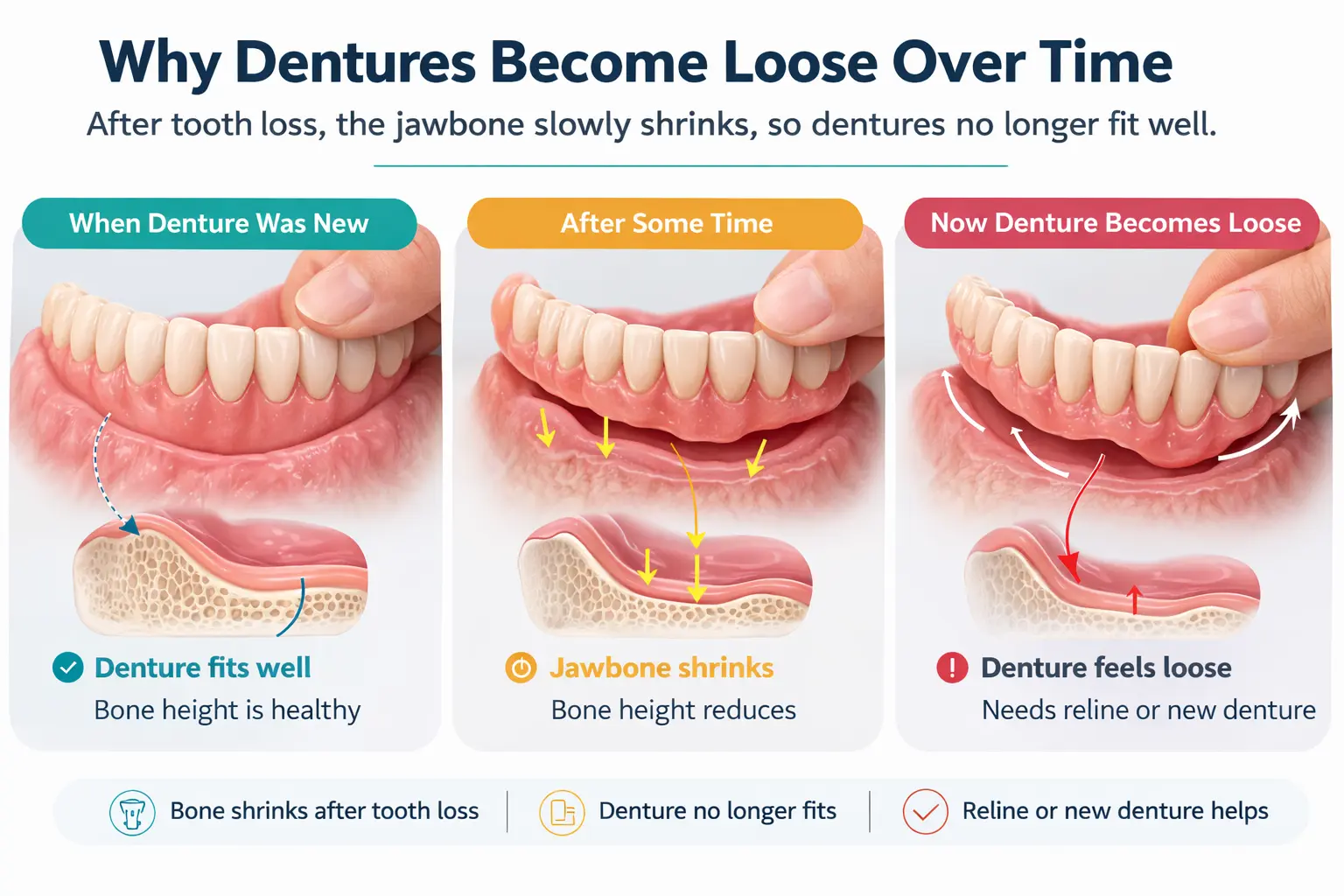
Denture adhesive can only fill a very small gap between the denture and the gum. When the jawbone shrinks after tooth loss, that gap becomes too large — and no adhesive can hold the denture securely.
- Jawbone shrinkage after tooth loss
- Denture base wear over time
- Changes in gum shape (soft tissue remodelling)
- Poor original denture fit
- Excess adhesive preventing proper seating
How Long Should Denture Adhesive Hold?
A well-fitting denture with a small amount of adhesive should hold securely for 8 to 12 hours with normal eating and speaking. If your adhesive is failing within 2 to 4 hours — or you need to reapply it during the day — your denture fit needs professional attention, not a different product.
Why Dentures Start Slipping and Moving While Eating
You put on the adhesive in the morning. By lunch, the denture is shifting. By dinner, you are pressing it back in place after every bite.
Sound familiar? You are not alone. Millions of denture wearers across India face exactly this — and most are told to just buy a better adhesive. That advice is wrong.
The adhesive is not the problem. The problem is denture fit.
Have you started avoiding eating out? Stopped laughing freely? That is how much loose dentures affect daily life. Here is what patients commonly experience when a denture stops fitting:
- Food slipping under the denture at every meal
- Words slurring or the denture clicking when you speak
- Sore, raw patches on the gums from constant friction
- Fear of the denture dropping while laughing or sneezing
- Quietly removing certain foods — bread, fruit, meat — from your diet
At Center for Dental Implants & Esthetics, we see denture patients every week from across Gurgaon and Delhi NCR who have been struggling for months — sometimes years — with a problem that has a real solution.
- Most bone loss happens in the first 3 to 6 months after a tooth is removed — before most patients even notice their denture is getting loose.
- The alveolar ridge (the bone your denture sits on) can lose up to 50% of its width within the first 12 months after tooth loss — with two-thirds of that reduction happening in the first 3 months alone. (ScienceDirect / Schropp et al.)
- A separate review confirms horizontal bone loss of 29 to 63% and vertical bone loss of 11 to 22% after just 6 months. (PubMed Systematic Review)
Why Does Denture Adhesive Stop Working After Years of Use?
Adhesive works by filling the thin space between your denture base and your gum. When that space is small and even, adhesive holds well. When the gap grows — because your jaw has changed — no adhesive on earth can bridge it reliably.
Why does the jawbone shrink after tooth loss?
- Bone needs stimulation from tooth roots to stay dense and full.
- When teeth are removed, that stimulation stops completely.
- The body slowly reabsorbs the bone — reducing the gum ridge height year by year.
- This is called bone resorption (reh-SOR-pshun) — it is a normal biological process, but it silently destroys your denture fit.
Jawbone Resorption — The Silent Cause
Your jawbone starts shrinking the moment a tooth is removed — and it never stops on its own. Research in the Journal of Prosthodontics confirms denture wearers lose an average of 0.5 to 1 mm of bone height per year. A denture made five years ago is now sitting on a jaw that has measurably changed shape. This bone shrinkage process is explained in detail in our guide on why dentures become loose over time.
Most common causeDenture Base Wear
The acrylic base of your denture wears down slowly with every bite. Even a 0.5 mm difference between the denture base and your gum creates enough gap for movement and clicking during eating.
Happens in every dentureGum Tissue Remodelling
Gum tissue reshapes over time, completely independent of bone. Most patients are never told this. After 3 to 4 years without a denture check, the soft tissue contour has usually changed enough to create noticeable instability.
Often overlookedPoor Original Denture Fit
Some dentures never fit correctly from day one. Rushed impressions or inadequate adjustments at the time of fitting create small gaps that compound over years into full instability.
Starts early, worsens slowlyToo Much Adhesive — Making Things Worse
Using more adhesive does not improve the hold — it often makes the fit worse. Thick layers prevent the denture from seating correctly, creating uneven pressure on the gums and reducing sensory feedback.
Counter-intuitive but true- Jawbone is shrinking slowly after tooth loss (bone resorption)
- Denture base has worn from years of daily use
- Gum tissue has remodelled since the denture was made
- Original denture fit was never precise enough
- Too much adhesive is masking the problem and making pressure worse
Why the Lower Denture Is Harder to Keep in Place
The lower jaw loses bone 2 to 3 times faster than the upper jaw — and it has far less surface area for the denture to grip. Unlike the upper denture which uses suction against the palate, the lower denture sits on a narrow ridge with the tongue and cheeks pressing against it constantly. This is why most patients complain about the lower denture first. (PubMed Reference)
- Adhesive is designed to work on gaps of less than 0.5 mm.
- After just 5 years of wearing dentures, the gap is often 2 to 3 mm — far beyond what any adhesive can seal.
- If your adhesive fails within 3 to 4 hours, the gap is already too wide for any product to bridge reliably. Relining or implant support is the only real answer at that stage.
- This is why switching adhesive brands almost never solves the problem.
Why Your Denture Keeps Falling Out When Eating
Most patients wait far too long before asking for help. They assume slipping is just part of having dentures. It is not.
These signs mean your denture has stopped fitting correctly and needs professional attention:
- Denture rocks, slides, or moves — even on soft foods like rice or dal
- Food gets trapped underneath the denture with every meal
- You need adhesive every single morning without exception
- Sore spots, ulcers, or raw patches on your gums that do not heal
- Clicking or clacking sounds when you speak or chew
- Denture drops slightly when you laugh, cough, or yawn
- You use your tongue or cheek muscles to hold the denture in place — without even realising
- You have stopped eating certain foods — fruits, rotis, meats — to avoid embarrassment
If three or more of these apply to you, your denture fit needs professional assessment — not a stronger adhesive.
“All dentures slip a bit — it is normal.”
A well-fitting denture should stay firmly in place during eating and speaking with minimal or no adhesive.
Is It Safe to Use Denture Adhesive Every Day?
How long should denture adhesive hold?
- A well-fitting denture with a small amount of adhesive should hold for 8 to 12 hours.
- If your adhesive fails within 2 to 4 hours, the problem is denture fit — not the product brand.
- If you need to reapply adhesive during the day, your denture needs professional attention.
Occasional use of a zinc-free adhesive is generally safe. Relying on it every single day for months or years is a different matter entirely.
Think of denture adhesive like a folded tissue under a wobbly table leg. It steadies things briefly. But the table is still wobbly — and the tissue will fail again. The wobbly leg needs to be fixed, not padded.
Long-Term Side Effects of Daily Denture Adhesive Use
Zinc Toxicity Risk
Older adhesive formulas contained zinc. In 2010, the US FDA flagged case reports linking excessive zinc ingestion to rare nerve damage. Most modern adhesives are now zinc-free — but daily reliance should still be avoided.
Masking a Worsening Problem
While you use adhesive, the jawbone continues to resorb. The fit problem gets quietly worse every month — and your options narrow the longer you wait.
Gum Tissue Pressure Damage
Thick adhesive layers create uneven pressure between denture and gum, damaging soft tissue and causing chronic soreness that most patients assume is unavoidable.
Nutritional Impact
Patients managing unstable dentures quietly eliminate hard and chewy foods. A diet lacking raw vegetables, fruits, and protein has real long-term health consequences — especially for older patients.
- When a patient tells me they are using adhesive more than twice a week just to get through the day, I treat that as a clinical sign — not a product problem.
- It tells me their denture fit needs professional attention.
- Adhesive dependency is a symptom. A poorly fitting denture is the diagnosis.
- The longer you wait, the more the jawbone changes — and the more limited your treatment options become.
Not Sure If Your Denture Needs Relining or Replacing?
A 20-minute assessment at our Gurgaon clinic gives you a clear answer — and a plan for dentures that actually stay in place.
Best Solutions for Loose Dentures in Gurgaon — From Temporary Fix to Permanent
There are four real options for fixing a loose denture — from a quick adjustment to a lifetime solution. The right choice depends on how worn your denture is and how much your jawbone has changed.
What is denture relining?
- Relining is when a dentist adds fresh material to the inner surface of your existing denture.
- This reshapes it to match your current gum contour — restoring the close fit.
- It is the simplest way to tighten a loose denture without making a completely new one.
- Most relines need to be repeated every 2 to 3 years as the jaw continues to change.
- Adhesive needed?Sometimes still needed
- Stops bone loss?No
- Lasts2–3 years
- Best forMild looseness, limited budget
- Full guide →
- Adhesive needed?Occasionally
- Stops bone loss?No
- Lasts5–7 years
- Best forDenture older than 5 years
- Reline vs New — compare →
- Adhesive needed?None required
- Stops bone loss?Yes — partial
- Lasts10–15+ years
- Best forActive lifestyle, significant instability
- Adhesive needed?None — ever
- Stops bone loss?Yes — full
- LastsLifetime with care
- Best forPermanent fixed solution
- Full guide →
Implant-Supported Dentures vs Loose Dentures — What Actually Changes
Patients who switch to implant-supported dentures almost universally say the same thing: “I wish I had done this years ago.”
Implants solve the root cause — not the symptom. Here is what actually changes when you move from adhesive-dependent dentures to an implant-supported solution:
The denture clips onto implants or is permanently fixed. Nothing shifts during meals or conversation.
Conventional denture wearers average only 20 to 30% of their natural bite strength. Implants give it back.
Implants stimulate the jaw, slowing or stopping the resorption that makes all dentures fail. Research shows up to 80% of bone loss prevented vs traditional dentures. (AAID)
A firmly anchored prosthesis does not shift when you speak, sneeze, or laugh.
Patients report higher self-confidence in social situations within weeks of treatment.
Repeated relines, replacement dentures, and years of adhesive purchases often cost more over 10 years than implants upfront.

A 2023 systematic review in the Journal of Prosthetic Dentistry found patient satisfaction with implant overdentures consistently 30 to 40% higher than with conventional removable dentures across quality-of-life metrics.
“Implants are only for younger patients with healthy bones.”
Most patients in their 60s and 70s are suitable candidates. Bone assessment and a proper treatment plan determine eligibility — age alone does not.
Reviewed by a Specialist — Not a General Dentist

Dr. Jyoti Singh
MDS Prosthodontics & Implantology
Center for Dental Implants & Esthetics, Gurgaon
In my clinical experience at Center for Dental Implants & Esthetics —
- The most common reason adhesive fails is jawbone resorption — the slow jaw shrinkage that begins the moment a tooth is removed. Most patients are never told this when they receive their first denture.
- We always assess bone health, gum changes, and bite alignment before recommending anything. We do not push implants if relining is the right answer.
- Our in-house teeth setting means we control fabrication quality directly — your denture fit is as precise as possible from day one.
A patient came to us after 3 years of daily adhesive use. Her lower jaw had lost significant bone — something no one had diagnosed. We placed two implant-supported overdentures. She has been completely adhesive-free for 14 months.
This is what becomes possible when the real problem is properly identified.
Full credentials: cdieindia.com/best-implantologist/
Loose Denture Treatment in Gurgaon — Two Specialist Clinics
Center for Dental Implants & Esthetics operates two specialist clinics in Gurgaon — both led by the same prosthodontist, serving patients from across Delhi NCR.
Sector 51 — Near Artemis Hospital
- Center for Dental Implants & Esthetics
- #166, Sector 51, Ambedkar Chowk
- Close to Artemis Hospital, Gurgaon 122003
Sector 74 — M3M Cornerwalk
- Center for Dental Implants & Esthetics
- R1-257, 2nd Floor, M3M Cornerwalk
- Sector 74, Gurugram 122004
Frequently Asked Questions — Denture Adhesive & Loose Dentures
Denture adhesive stops working because your denture no longer fits correctly. Here is why:
- After tooth loss, the jawbone shrinks slowly — a process called bone resorption.
- As the bone changes shape, a gap develops between your denture base and your gum surface.
- Adhesive can only bridge a very small gap. Once too wide, no product will hold reliably.
- Switching adhesive brands will not fix a fit problem — a dental assessment is needed.
For a well-fitting denture with a small amount of adhesive:
- It should hold securely for 8 to 12 hours with normal eating and speaking.
- If adhesive fails within 2 to 4 hours, your denture fit is inadequate — not the adhesive brand.
- If you need to reapply adhesive during the day, book a denture assessment soon.
- Manufacturers advertise up to 12 hours — but this is only realistic on a well-fitting denture.
Occasional daily use of a zinc-free adhesive is generally considered safe. However:
- Long-term daily dependence means your denture fit is inadequate and getting worse.
- Some older adhesive formulas contained zinc — the US FDA flagged rare nerve damage cases in 2010.
- Always use zinc-free adhesives and check the label before buying.
- If you are using adhesive every single day, seek a professional denture review — do not wait.
- Daily adhesive use is a clinical sign, not a product preference.
Yes — through a process called denture relining. Here is what that means:
- A dentist adds new material to the inner surface of your existing denture.
- This reshapes it to match your current gum contour — restoring the close fit.
- Relining works well when the denture structure is still sound.
- If the denture is older than 7 years or structurally worn, replacement is usually better.
- See our full comparison: denture relining vs. new dentures.
The best solution depends on your bone condition and how worn your denture is:
- Denture reline — for mild looseness in a structurally intact denture
- New dentures — if your denture is older than 5 to 7 years
- Implant-supported overdenture — to eliminate adhesive permanently with 2 to 4 implants
- All-on-4 / All-on-6 — for a fully fixed, permanent, non-removable solution
- A consultation at Center for Dental Implants & Esthetics (Sector 51 or Sector 74) will give you a clear, honest recommendation.
Yes — here is how:
- Implant-supported dentures use 2 to 4 titanium implants as anchors in the jaw.
- Your denture clips onto these implants and does not move during eating or speaking.
- No adhesive is needed — at all.
- For All-on-4 or All-on-6 patients, the prosthesis is permanently screwed in — never removed.
- Implants also preserve the jawbone — preventing the bone loss that makes all dentures fail over time.
Cost depends on the treatment required:
- Denture reline: typically ₹3,000 to ₹8,000 depending on type
- New complete dentures: typically ₹15,000 to ₹40,000 per arch
- Implant overdenture: depends on number of implants — personalised quote at consultation
- All-on-4 / All-on-6: see our full mouth implants page
- Full cost guide: Gurgaon denture cost page
The lower jaw presents specific challenges for denture stability:
- The lower jaw loses bone 2 to 3 times faster than the upper jaw after tooth loss.
- The upper denture uses suction against the palate — giving it a wider contact surface.
- The lower denture sits on a narrow ridge with the tongue and cheeks pressing constantly.
- Even a small amount of bone loss on the lower jaw creates noticeable instability.
- This is why implant overdentures for the lower jaw have such transformative results.
Dentures need regular professional review even when they seem comfortable:
- A professional denture check is recommended at least once a year.
- The jawbone changes shape year on year — a comfortable denture today may be loose next year.
- Annual checks allow for early relining or adjustment before major instability develops.
- Patients who skip reviews for 3 or more years often find fit has degraded significantly.
- Reviews at Center for Dental Implants & Esthetics include bone health and gum assessment.
Book a Loose Denture Consultation in Gurgaon
Whether you need a reline, new dentures, or want to explore implant-supported options — we give you an honest assessment and a clear plan. No pressure. No upselling.
Sector 51 — Near Artemis Hospital
- Center for Dental Implants & Esthetics
- #166, Sector 51, Ambedkar Chowk
- Gurgaon, Haryana 122003
Sector 74 — M3M Cornerwalk
- Center for Dental Implants & Esthetics
- R1-257, 2nd Floor, M3M Cornerwalk
- Sector 74, Gurugram 122004
Read Further
How to Fix Loose Dentures — Every Option Explained
From a simple reline to full mouth implants — this guide breaks down every solution with honest pros, cons, and costs so you can decide with confidence.
Read the Complete Guide →Denture Relining vs. Getting New Dentures
Not sure whether to reline your existing denture or start fresh? This side-by-side comparison covers cost, process, outcomes, and what your dentist will look for.
Compare Your Options →Full Mouth Dental Implants in Gurgaon
Explore All-on-4 and All-on-6 — the permanent alternative to loose dentures and daily adhesive. Covers procedure, cost overview, and who is a good candidate.
Explore Implant Options →This page is for informational purposes only and does not replace professional dental consultation. Symptoms described may have multiple causes. Please visit a qualified dental professional for diagnosis and personalised treatment advice.