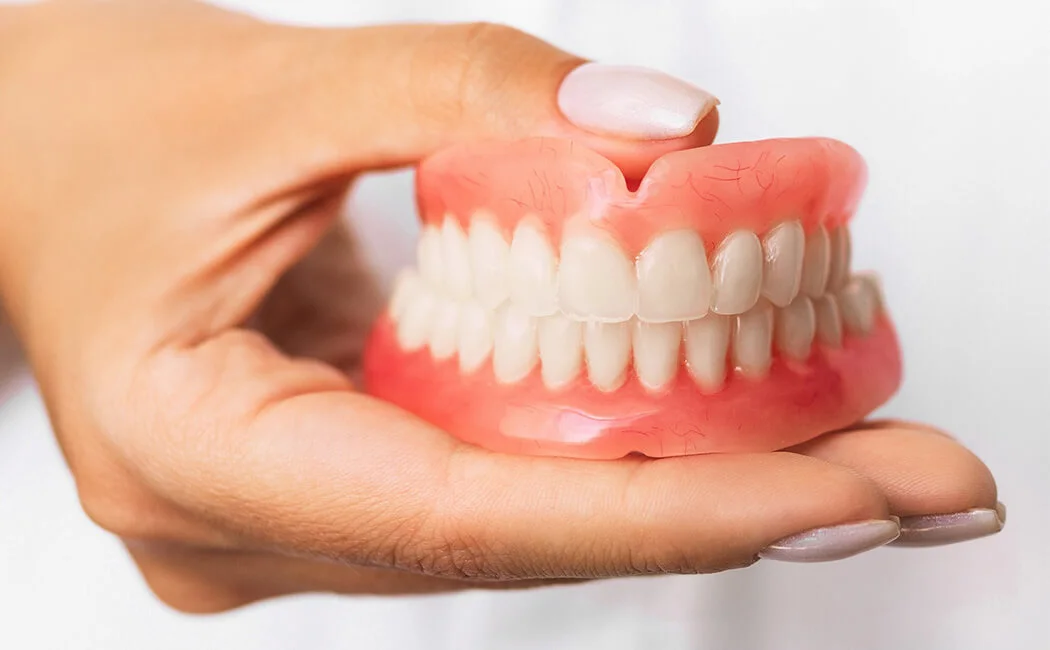
Denture Relining vs New Dentures
Which One Do You Really Need?
Your dentures felt perfect when they were new. Now they slip, click, and need adhesive daily. This guide explains why — and what to do next.
Serving Sector 51 · Sector 74 · Golf Course Road · Nirvana Country · South City · DLF Phase 5 · Golf Course Extension · Dwarka Expressway
My Dentures Have Become Loose Again. What Should I Do?
You are not imagining it. Dentures that fit well when they were first made often become loose within 1–3 years. This is one of the most common complaints I see at our clinics in Gurgaon.
Most patients come in with the same story.
- The dentures were fine for the first year or two
- Then the clicking started while eating
- Then slipping in public — embarrassing moments
- Then the adhesive stopped lasting through meals
This is not bad luck. It happens because of jawbone resorption — the bone underneath your gums slowly shrinks after teeth are removed.
Jawbone can shrink 20–25% in the first year after tooth loss if no implants are placed. Over many years, this loss can reach 40–60% of the original bone width. (Source: Atwood DA, Journal of Prosthetic Dentistry)
As the bone shrinks, your gums change shape. Your denture was made for the old shape. So it no longer fits.
Many patients we see in Gurgaon — particularly from South City 1, Nirvana Country, and Golf Course Extension Road — come in with dentures that were made 5–8 years ago at a clinic that has since closed or changed hands. They have no records, no follow-up, and nobody to call. If this sounds familiar, bring your denture in. We can assess it and tell you exactly where you stand.
Denture Relining vs New Dentures: Which Should You Choose?
Denture relining reshapes the inside surface of your existing denture so it fits your gums again. New dentures replace the entire denture — base, teeth, and bite — when the old one is worn, cracked, or no longer fixable.
Choose Relining When
- Denture is still in good condition
- Teeth are not worn down or chipped
- Base is not cracked
- Looseness is the only problem
- Denture is less than 5–7 years old
Choose New Dentures When
- Denture teeth are worn flat
- Base is cracked or fractured
- Bite has collapsed
- Denture is more than 7–10 years old
- Multiple relines done, looseness returns fast
| Your Situation | Best Option |
|---|---|
| Denture fits poorly but teeth and base still good | Denture relining |
| Denture teeth worn flat, hard to chew | New dentures |
| Denture base cracked or broken | New dentures |
| Denture more than 7–10 years old | New dentures |
| Already relined twice, looseness returning quickly | Consider implant-supported dentures |
| Flexible / Valplast or PEEK denture has become loose | New dentures (cannot be relined) |
According to prosthodontic clinical guidelines, dentures typically require replacement every 5–10 years due to bone and gum changes. Relining can improve fit temporarily for 1–3 years but does not stop the underlying bone loss process. (American College of Prosthodontists)
What Is Denture Relining?
Relining is a relatively simple procedure that improves the fit of your existing denture — without making a completely new one.
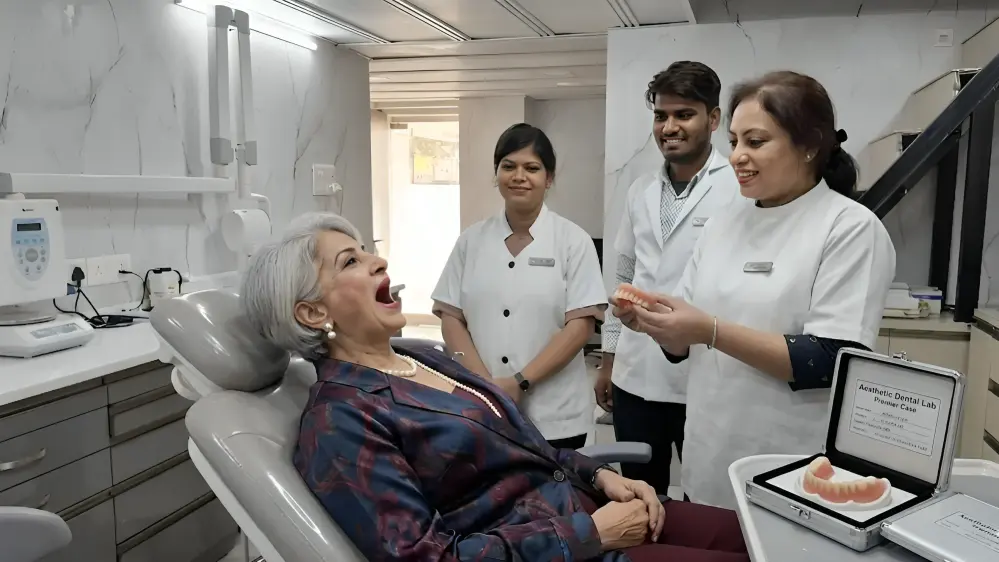
The inside surface of your denture — the part that touches your gums — is reshaped by adding new material. This brings the denture back into closer contact with your gum tissue, improving grip, reducing rocking, and making it more comfortable to wear.
The outer surface (the visible teeth and pink gum area) is not changed. If your denture teeth still look fine and the base is not cracked, relining is often the right first step.
Soft Denture Reline
- A flexible, cushion-like material is placed inside the denture
- Comfortable on tender or sore gums
- Usually done immediately or as a temporary measure
- Needs to be redone every few months
- Good for patients after recent extractions
Hard Denture Reline
- Hard acrylic material is added to the denture base
- More durable and long-lasting than soft reline
- Done in clinic or sent to dental lab (1–2 visits)
- Lasts 1–3 years with proper care
- The most common type of reline for stable cases
When Denture Relining Works Well
Relining is a smart, cost-effective solution in the right situation. Here is when it is genuinely the right choice.
Relining is ideal when:
- Your denture is less than 5–7 years old
- The denture teeth are not worn down or chipped
- The denture base (the pink part) is not cracked or broken
- Looseness is the only complaint — the bite and teeth arrangement are still correct
- You want a faster and more affordable fix before considering other options
Relining does not change the teeth, the bite, or the appearance of the denture. If those are still good, relining is a perfectly reasonable choice — not just a “cheap fix.”
When You Actually Need New Dentures
Sometimes relining is not enough. Knowing the signs helps you make the right decision without wasting money on a temporary fix.
Relining only improves the fit. It cannot fix problems with the denture itself. If your denture has any of the signs below, a reline will not help.
You need new dentures when:
- The denture teeth are worn flat — you are chewing on plastic, not tooth surfaces
- The denture base has cracks or fractures
- Your bite has collapsed — the front teeth no longer meet properly
- Your face has changed shape — sunken cheeks or lip support loss that the denture no longer compensates for
- The denture is more than 7–10 years old
- Multiple relines have already been done and looseness returns quickly
- You are experiencing persistent pain or pressure sores despite adjustments
Most dentures require replacement every 5–10 years due to changes in the bone and gum tissue underneath. Multiple relines can extend this, but cannot replace the need for a properly fitting new denture eventually. (Source: American College of Prosthodontists)
For dentures in Gurgaon, we always do a thorough clinical assessment before recommending a reline versus a new denture. We check bone condition, denture teeth wear, base integrity, and facial support — so you get the right recommendation, not just the more expensive one.
Denture Relining vs New Dentures
Use this table to understand the key differences at a glance. Your dentist will advise which is right after examining your denture and gums.
| Factor | Denture Relining | New Dentures |
|---|---|---|
| What changes | Inner surface of existing denture only | Entire denture — base, teeth, bite, fit |
| Number of visits | 1–2 visits | 4–6 visits over 2–4 weeks |
| Cost | Significantly lower | Higher investment |
| Lifespan of result | 1–3 years | 5–10 years |
| Fixes worn teeth | No | Yes |
| Fixes collapsed bite | No | Yes |
| Fixes loose fit | Yes | Yes |
| Restores facial support | No | Yes (if well designed) |
| Best for | Denture under 7 years old, only looseness | Old, worn, or cracked dentures |
| Which denture types qualify | Acrylic complete & partial only | All types — acrylic, flexible, cast, PEEK, BPS |
Cost Comparison: Relining vs New Dentures in Gurgaon (2026)
Here is what patients typically pay at our Gurgaon clinics. Costs are per jaw unless specified. For the complete pricing across all denture types, see our full denture cost in Gurgaon guide.
| Treatment | Cost at CDIE, Gurgaon | Visits | Lasts | Best When |
|---|---|---|---|---|
| Soft Reline per jaw |
₹3,000 – ₹4,000 | 1 visit | 3–6 months | Sore gums, recent extractions, temporary fix |
| Hard Reline per jaw |
₹8,000 – ₹12,000 | 1–2 visits | 1–3 years | Denture under 7 yrs, teeth still in good shape |
| New Acrylic Complete Denture both jaws |
₹30,000 – ₹32,000 | 3–4 visits | 5–8 years | Old or worn denture, collapsed bite |
| New Ivoclar Complete Denture both jaws |
₹45,000 | 4–5 visits | 7–10 years | Better appearance, harder teeth |
| New BPS Complete Denture both jaws · flagship |
₹60,000 | 5–6 visits | 8–12 years | Best fit, most natural, longest lasting |
Reline and new denture prices are at Center for Dental Implants & Esthetics, Gurgaon (2026). New denture prices shown are for complete dentures. For partial denture costs and all other types, see our full denture cost guide.
How Long Do Dentures and Relines Last?
One of the most common questions we hear: “How long will this last?” Here is the honest answer for each option.
| Denture Type or Treatment | Average Lifespan | Key Factor |
|---|---|---|
| Soft reline | 3–6 months | Temporary — for sore gums or recent extractions |
| Hard reline | 1–3 years | Depends on rate of bone loss underneath |
| Acrylic complete denture | 5–8 years | Teeth wear down; bone changes reduce fit over time |
| Ivoclar / premium denture | 7–10 years | Harder teeth, better resistance to wear |
| BPS complete denture | 8–12 years | Best fit accuracy; stays comfortable longest |
| Implant-supported denture | 10–15+ years | Implants preserve bone — slows the change in gum shape |
All lifespans are averages. Individual results depend on bone density, oral hygiene, and how often the denture is reviewed by a specialist.
Important to Know
Not All Dentures Can Be Relined
Check which type you have before booking a reline appointment.
Cannot Be Relined
Flexible / Valplast Denture
- Soft nylon material
- Does not bond with reline acrylic
- New denture is the only option
Most common type patients don’t know about.
Cannot Be Relined
PEEK Polymer Denture
- Digitally milled in one solid piece
- Surface incompatible with acrylic
- Must be remade from scratch
Different Fix Needed
Implant-Retained Denture
- Clips on implants, not gums
- Looseness = worn clips or locators
- Clips replaced, not the denture base
Cannot Be Relined
Cracked Acrylic Base
- Reline material cannot seal cracks
- Crack will spread and reline fails
- New denture needed
Dr Jyoti Singh: Patients with flexible dentures are often surprised that relining is not possible. Nobody told them this when the denture was made. If your flexible denture has become loose — a cast metal or acrylic denture will serve you much better going forward.
Why Do Dentures Keep Becoming Loose?
We covered jawbone shrinkage briefly above. Here is the full picture — because most patients are never told how significant this really is.
When your teeth were removed, the bone lost its reason to stay strong. It slowly shrank. Your denture was made for the original shape — so as the bone changed year by year, the fit got worse.
The critical point: this does not stop. Even after a reline, the bone continues to shrink. Every reline buys you time. None of them stop the process.
Long-term denture wearers can lose 40–60% of jawbone width over many years of wearing conventional dentures. This is why patients who have worn dentures for 15–20 years often have very different facial appearances compared to earlier photos. (Source: Carlsson GE, Journal of Prosthetic Dentistry)
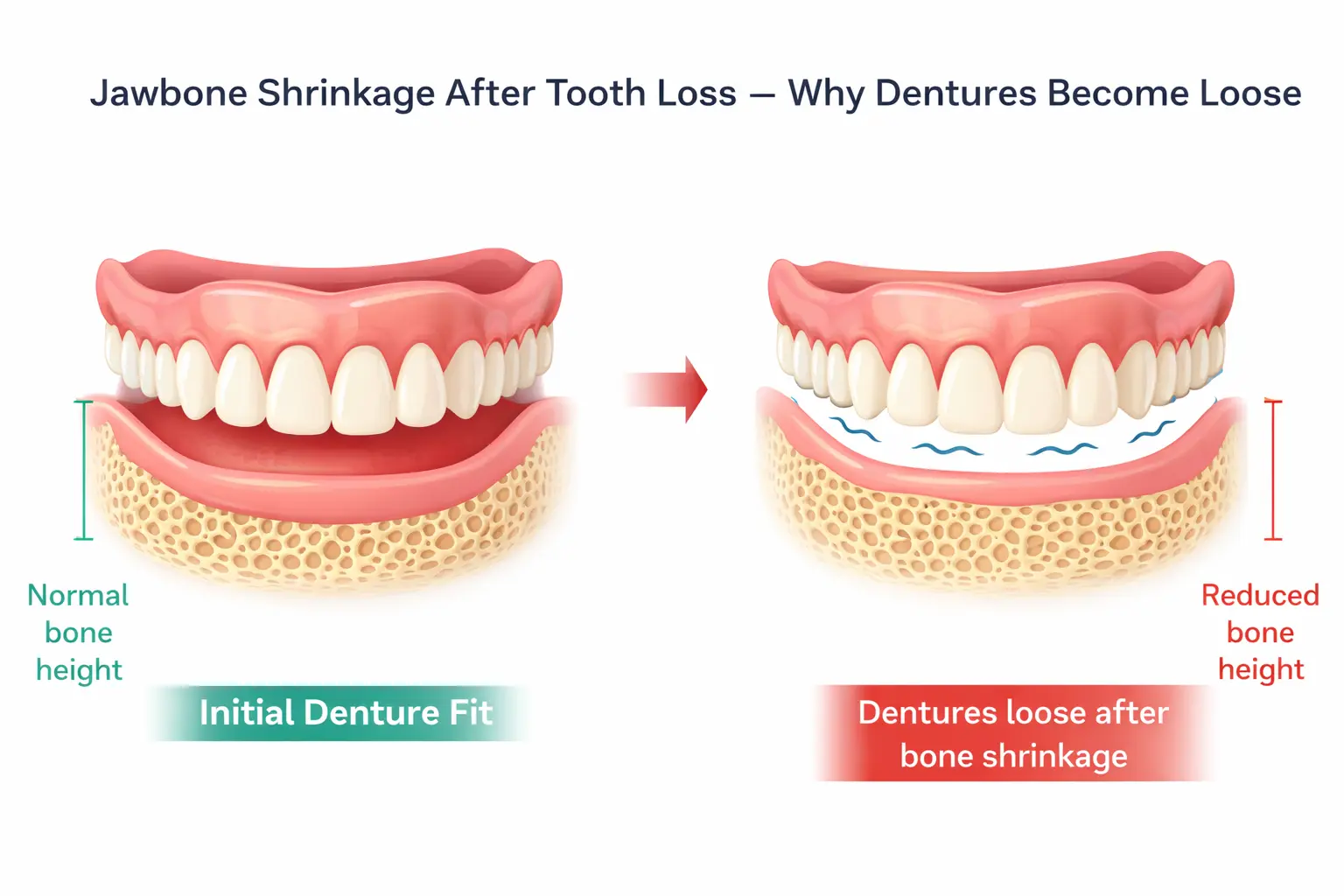
Bone shrinkage continues over years — this is why dentures loosen repeatedly even after relining.
This is the fundamental limitation of any conventional denture, whether basic acrylic or premium BPS. All of them sit on top of the gums. None of them stop bone loss.
Relining and new dentures manage the symptom (poor fit). Only implants address the underlying cause (bone loss) by anchoring into the bone and preventing further shrinkage.
“My dentures became loose because the dentist made them badly.”
Even a perfectly made denture becomes loose over time. The bone underneath shrinks regardless of denture quality. This is a biological process, not a craftsmanship failure.
“Better adhesive will solve my loose denture problem.”
Adhesive only manages the symptom temporarily. It does nothing for the underlying fit problem. Daily adhesive dependence is a sign you need a clinical assessment.
When Patients Consider Implant-Supported Dentures
Not everyone needs implants. But if your dentures have become loose multiple times, the conversation is worth having.
Many patients arrive having relined the same denture 2–3 times over 6–7 years.
Each reline stays comfortable for a shorter time than the last. The bone has shrunk further. At some point, relining stops giving good results.
This is when implant-supported dentures are worth considering. Instead of resting on gums, the denture snaps onto 2–4 implants in the jawbone. It does not slip. It does not rock.
What patients say after switching to implant dentures:
- “I can eat an apple for the first time in years”
- “I do not have to think about my dentures when I am talking”
- “No more adhesive — not a single tube in the house”
- “I feel confident at the dinner table again”
- “My face looks fuller — I did not expect that”
Implant Overdenture
- 2–4 implants placed in the jaw
- Denture clips or snaps onto implants
- Removable for cleaning
- Dramatically better stability than conventional denture
- Stops bone loss in implant areas
All-on-4 Fixed Implants
- 4 implants support a full arch of fixed teeth
- Not removable — behaves like natural teeth
- Maximum chewing strength and stability
- Best long-term bone preservation
- Ideal for patients with significant bone loss
Denture Relining & Replacement at Center for Dental Implants & Esthetics, Gurgaon
We see patients from across Gurgaon for denture assessments, relines, new dentures, and implant planning — including many who have had disappointing results elsewhere.
Center for Dental Implants & Esthetics has two specialist clinics in Gurgaon — Sector 51 near Artemis Hospital, and Sector 74 at M3M Cornerwalk. Between the two, most of New Gurgaon is within a 10–15 minute drive.
Most patients in Gurgaon see a general dentist for denture problems. At our centre, dentures are handled by an MDS Prosthodontist — a specialist trained specifically in tooth replacement. That difference matters for complex cases.
Which clinic is closer to you?
Sector 51 Clinic
Near Artemis Hospital, Ambedkar Chowk
- South City 1 & 2
- Sector 46, 47, 48, 49
- Sushant Lok
- DLF Phase 1, 2, 3, 4
- Nirvana Country
- Golf Course Road
Sector 74 Clinic
M3M Cornerwalk, Sector 74
- Golf Course Extension Road
- Sector 57, 58, 65, 67
- Tata Primanti
- DLF Phase 5
- Dwarka Expressway
- Palam Vihar

Dr Jyoti Singh — MDS Prosthodontist
In 17+ years as a prosthodontist, I have treated thousands of denture patients. I trained at Maulana Azad Institute of Dental Sciences (MAIDS), New Delhi. A large part of my practice is helping patients frustrated with poorly fitting dentures — and guiding them to the right solution, whether that is a reline, a new denture, or an implant-supported option.
What we do for denture patients at our Gurgaon clinics:
- Full denture assessment — check fit, teeth, bite, gum health, bone levels
- Soft and hard denture relining
- Denture repairs — cracks, broken teeth, fractures
- New complete and partial dentures — from basic acrylic to premium BPS
- Implant overdentures — snap-on dentures stabilised with implants
- All-on-4 fixed full arch rehabilitation for complete tooth loss cases
Looking for Denture Relining Near You in Gurgaon?
Both our clinics are easily accessible from most parts of New Gurgaon. No long drives across the city.
From South City 1 & 2
10 min to our Sector 51 clinic near Artemis Hospital. Easy access via Sohna Road.
From Nirvana Country
10–12 min to Sector 51 clinic. Many of our long-term denture patients live in this area.
From Golf Course Extension
8–10 min to our Sector 74 clinic at M3M Cornerwalk. Free parking available in the mall.
From DLF Phase 5
12 min to Sector 74 clinic. Accessible via Southern Peripheral Road.
From Dwarka Expressway
Sector 74 clinic is the closest — 10 min from Sectors 102–115 areas.
From Sushant Lok / Sector 46–49
Sector 51 clinic is your nearest option — under 10 min from most of these sectors.
Frequently Asked Questions
These are the questions most denture patients ask us. Clear, direct answers — no guessing.
A hard denture reline typically lasts 1–3 years, depending on how much further bone loss occurs and how well the denture is maintained. A soft reline lasts considerably less — usually a few months — and is generally used as a temporary measure or for patients with very sore gum tissue.
After relining, the bone underneath continues to change. This is why relining is not a permanent solution. Most patients need the denture relined again or replaced entirely after the lifespan runs out.
Yes — but only if the denture itself is structurally sound. Dentures with cracked bases, severely worn teeth, or collapsed bites cannot be adequately fixed with a reline alone. The reline improves internal fit, but if the denture has structural problems, those remain.
Very old dentures (10+ years) are often not suitable for relining. The acrylic material degrades over time and may not bond well with new reline material. In these cases, a new denture gives far better and more reliable results.
No — the relining procedure itself is not painful. The dentist takes an impression of your current gum shape using the existing denture, and the new material is added in the clinic or at the lab. No injections, no drilling, no discomfort during the process.
After the reline, there may be a brief adjustment period — perhaps a day or two — while you get used to the slightly different fit. Occasionally minor pressure spots develop and need a small adjustment visit. Overall it is one of the most straightforward dental procedures.
At Center for Dental Implants & Esthetics, Gurgaon, a soft reline costs ₹3,000–₹4,000 per jaw and a hard reline costs ₹8,000–₹12,000 per jaw. Compare this to new complete dentures starting at ₹30,000 for both jaws — the saving is significant when your denture is still structurally sound.
See our cost comparison table above for a full side-by-side, or our detailed denture cost guide for all types. We always give a clear written estimate before starting any treatment.
Most well-made dentures need replacement every 5–10 years. However, this varies depending on the quality of the original denture, how well it was maintained, and how much bone loss has occurred in the meantime.
Some patients on a tight budget manage 12–15 years with multiple relines. The result is usually a denture that is merely functional, not comfortable or natural-looking. If quality of life is the priority, replacing at 7–8 years gives significantly better results.
Over-the-counter denture liners from chemists are not the same as a clinical reline. They provide very temporary, uneven cushioning and often make the bite worse because no impression was taken of your actual gum shape.
Regular use of home reline materials can also mask the real problem — allowing bone loss to continue without you realising how serious it has become. A professional reline at a clinic uses a proper impression and appropriate dental materials designed for the purpose.
Slipping while talking is a classic sign of an upper denture that has lost retention or a lower denture that is unstable. For the upper denture, relining often helps significantly — good fit creates natural suction that holds the denture in place during speech.
For lower dentures, the situation is more complex. Lower dentures have almost no natural suction because the tongue takes up space. Even a perfectly relined lower denture has limited stability. This is why patients with loose lower dentures benefit most from implant stabilisation — even just 2 implants make a dramatic difference.
Ignoring a loose denture has real consequences. The pressure from an ill-fitting denture is uneven — concentrated in wrong areas of the gum. This accelerates bone loss in those areas, making the problem progressively worse and future treatment more difficult.
Sore spots develop. Eating becomes painful. Hard foods get avoided. Over time, nutrition can suffer. The embarrassment of an unstable denture also leads to social withdrawal — something patients rarely mention but feel deeply.
Getting the fit fixed early always leads to better outcomes.
BPS (Biofunctional Prosthetic System) dentures are a premium denture system that uses a more sophisticated measurement process — capturing jaw movements, muscle positions, and functional biting patterns rather than just static impressions.
The result is a denture that fits better during actual function — eating, speaking, laughing. Standard acrylic dentures can be excellent in skilled hands, but BPS consistently delivers higher retention, stability, and esthetics — especially for patients with difficult anatomy. They are available at our centre. See our full denture types guide for more information.
If you have already had two relines and looseness is returning quickly, there are two realistic paths.
Option 1: New dentures made from scratch. These will fit your current gum shape properly — a fresh start.
Option 2: An assessment for implant-supported dentures. Even 2 implants on the lower jaw can transform stability dramatically. We assess bone condition with a CBCT scan and advise honestly on what is feasible.
Get Your Dentures Assessed at Our Gurgaon Clinics
Not sure whether you need a reline or new dentures? The only way to know is a proper clinical assessment. We check your denture, gums, bone, and bite — and give you an honest recommendation.
Sector 51, Gurgaon
Center for Dental Implants & Esthetics#166, Sector 51, Ambedkar Chowk
Near Artemis Hospital
Gurgaon 122003
Sector 74, Gurgaon
Center for Dental Implants & EstheticsR1-257, 2nd Floor, M3M Cornerwalk
Sector 74, Gurugram 122004
You May Also Want to Read
Why Are My Dentures Loose?
A complete guide to causes of loose dentures and all available treatment options — from relining to implants.
Read: Loose Dentures & Permanent Fixes →All Denture Types in Gurgaon
Compare acrylic, flexible, cast metal, PEEK, and BPS dentures — honest pros and cons for each type.
Read: Dentures in Gurgaon →Implant-Supported Dentures
How 2–4 implants transform an unstable denture into a fixed, confident smile. Who qualifies and what to expect.
Read: Implant Supported Dentures →This page is for informational purposes only and does not replace professional dental consultation. Symptoms described may have multiple causes. Please visit a qualified dental professional for diagnosis and personalised treatment advice.