
Root Canal & Crown — Gurgaon
Do You Need a Crown After Root Canal?
When a Tooth Cap Is Necessary
Root canal saves your tooth.
A crown protects it — for life.
Skip the crown and you may lose the tooth all over again.
Complete Guide
Want to understand all dental crown options, costs and materials in one place?
Understanding the Problem
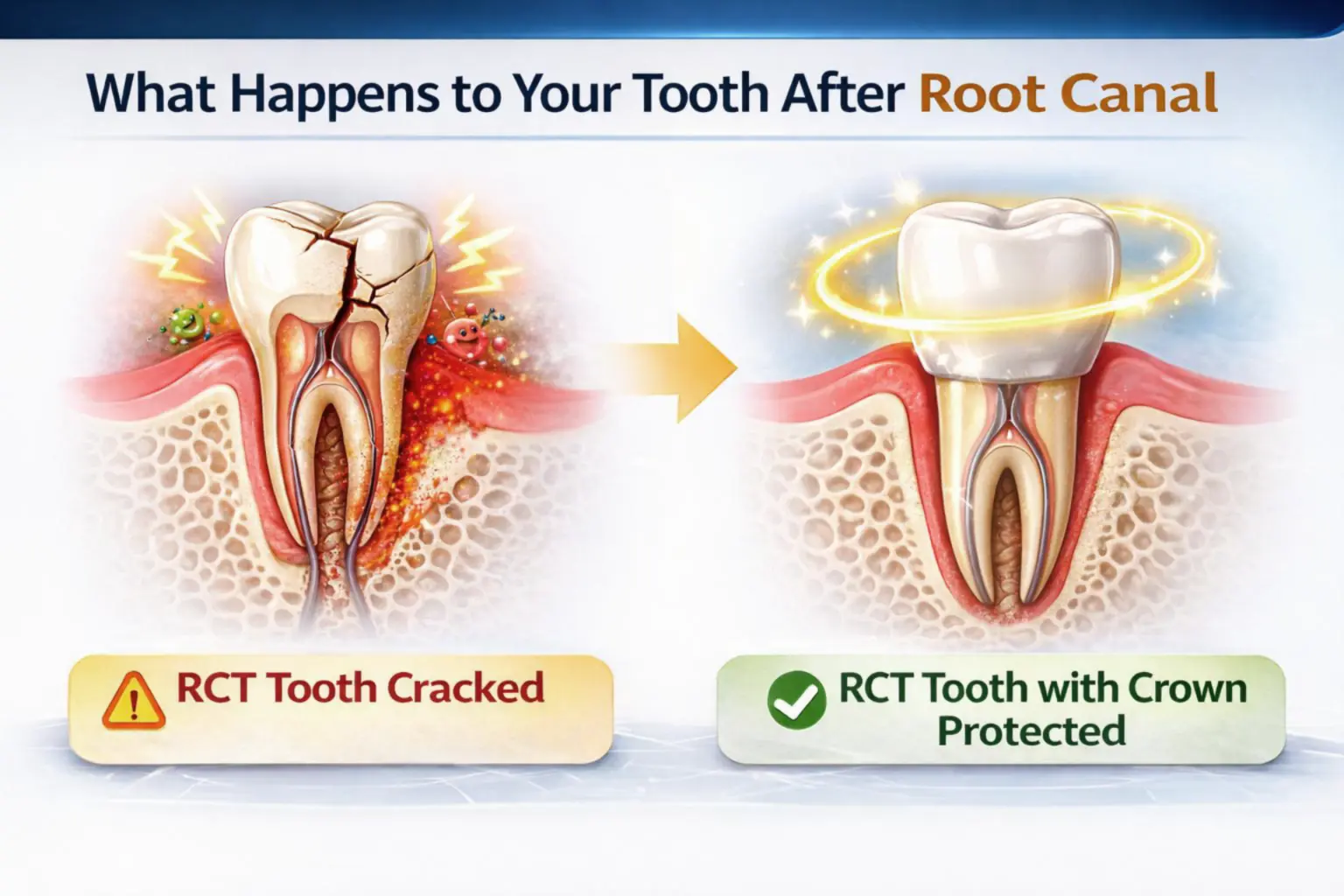
What Happens to Your Tooth After Root Canal?#
A root canal treatment removes the infected pulp inside your tooth. The pulp is the living core — the nerve, blood vessels, and connective tissue that keep the tooth hydrated and strong.
Once the pulp is removed, the tooth is no longer alive. It still sits in place. It still looks like a tooth. But something fundamental has changed inside it.
The tooth becomes brittle
Without blood supply, the tooth stops receiving moisture and nutrients. The dentinal tubules — tiny channels inside the tooth — dry out. Over time, the tooth loses its flexibility and becomes fragile. Not soft. Brittle. Like dry chalk.
A fresh twig bends before it breaks. A dry dead twig snaps with no warning.
Your root canal treated tooth is that dry twig. It looks fine. But one hard bite — a piece of ice, a crunchy roti crust — and it can crack all the way down to the root.
This is not scare tactics. This is basic endodontic science — well documented and agreed upon across dental specialties.
“Patients feel relieved after root canal — the pain is gone. They often think the tooth is ‘fixed.’ But the crown is actually the second half of the treatment. Without it, the tooth is vulnerable. I see cracked RCT teeth regularly in clinic. Almost all of them could have been saved with a crown placed on time.”
— Dr. Jyoti Singh | Prosthodontist & Implantologist | Center for Dental Implants & Esthetics, Gurgaon
When Is It Mandatory?
Do You Always Need a Crown After Root Canal?#
Short answer: for back teeth — almost always yes. For front teeth — it depends on how much tooth structure remains.
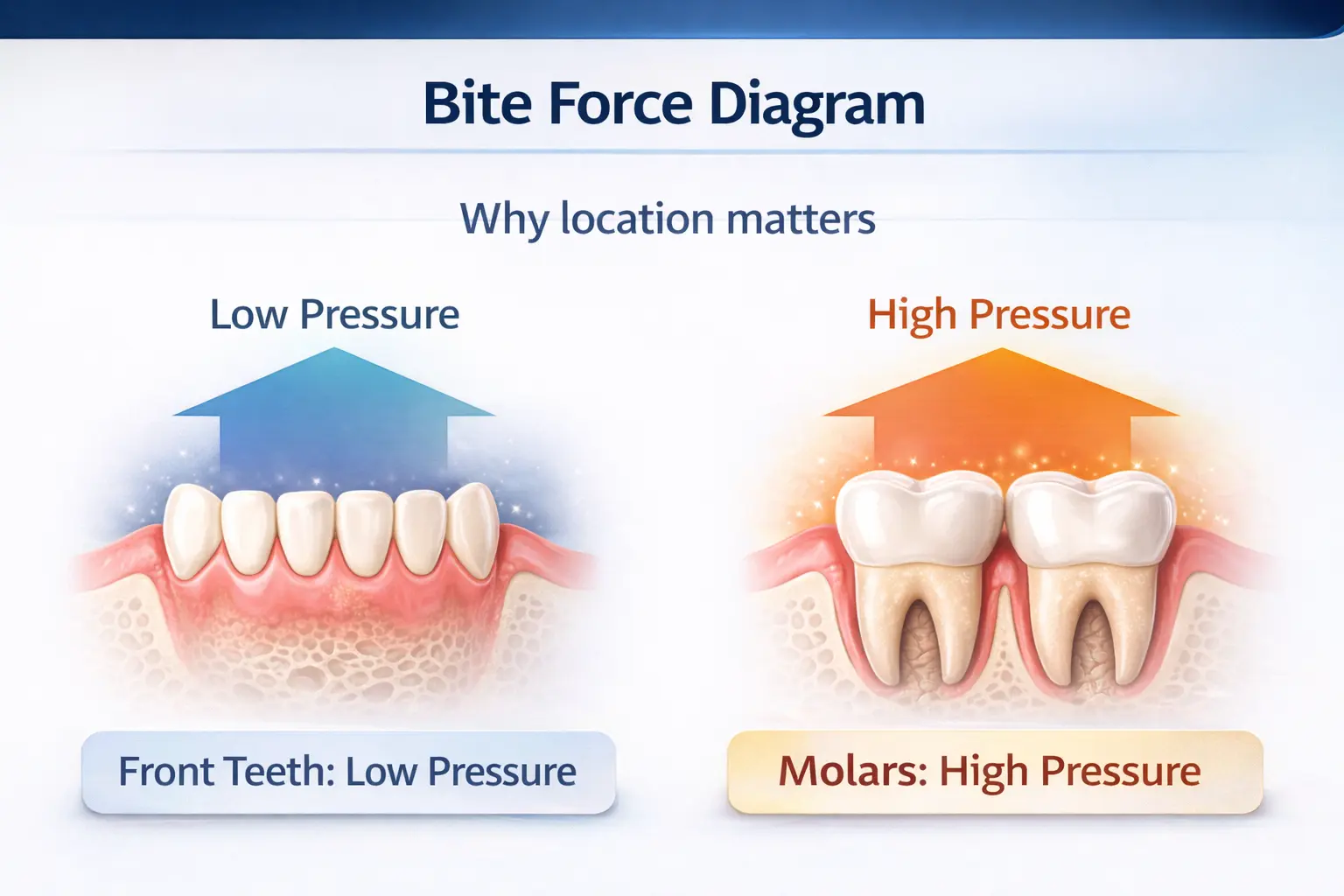
Why location matters so much
Back teeth (molars and premolars) absorb the majority of your chewing force — estimates from occlusal load studies put this at up to 80% of total bite pressure. A brittle, root canal treated molar without a crown is at very high risk of fracturing under normal daily chewing.
Front teeth are mainly for biting, not grinding. Chewing load is much lower. If the tooth structure is largely intact and only a small access cavity was made during RCT, a well-placed composite filling may sometimes be enough. But even then, most dentists prefer a crown for long-term protection.
| Tooth Type | Crown Recommendation | Why |
|---|---|---|
| Molar | Always recommended | Highest chewing load. Fracture risk is very high without crown. |
| Premolar | Strongly recommended | Significant lateral force during chewing. Crown extends tooth life greatly. |
| Front tooth | Case by case | Lower chewing force. Filling may suffice if structure is intact. Cosmetic crown often preferred. |
A root canal treated molar without a crown is 6x more likely to fracture than one protected with a crown. That single statistic is why your dentist keeps bringing it up — and they are right to.
What About Crown After Root Canal on a Front Tooth?
Front teeth — incisors and canines — take far less chewing load than back teeth. If a front tooth had a small access cavity and most of the natural tooth structure is still intact, a well-placed composite filling may be enough.
But there are situations where a crown is still the better choice for a front tooth after RCT:
- Significant tooth structure lost — large decay, old filling, or fracture before RCT
- Discolouration — root canal treated front teeth can darken over months; a crown (especially Emax) restores natural colour
- Cosmetic concern — patient wants the tooth to match the rest of the smile perfectly
- Canine (corner tooth) — takes more lateral bite load than incisors; crown is usually preferred
- Profession or appearance demands — doctors, teachers, professionals who need a perfect-looking smile
For front tooth crowns, Emax or High Transluscent zirconia is the material of choice — it mimics the natural light transmission of enamel better than any other material. The result is a crown that is virtually indistinguishable from a natural tooth.
Relevant: How We Decide Between RCT, Crowns and Full Mouth Reconstruction
Clinical Honesty
When Dentists Do NOT Recommend a Crown After Root Canal
Root canal treated teeth usually need crowns. But a good dentist does not recommend a crown blindly. There are specific situations where a crown may not be immediately necessary.
A thorough clinical evaluation always looks at:
- How much natural tooth structure remains — walls, cusps, thickness
- Which tooth — front vs back, bite load considerations
- Patient’s overall treatment plan — orthodontics, reconstruction, or implant planned
- Cosmetic needs — does colour or shape need correction
Front Tooth — Minimal Damage
- RCT access opening was very small
- Most natural tooth still intact
- Front teeth carry far less chewing force than molars
- A strong composite filling may be clinically sufficient
- Dentist will monitor for discolouration or weakening
Tooth Already Has Full Coverage
- Tooth already has a crown, veneer, or full restoration
- The existing crown is intact and fits well
- In these cases the access point is simply sealed
- A new crown may not be needed immediately
- Evaluation still recommended every 6 months
Temporary Treatment Phase
- Patient is mid-way through orthodontic treatment
- Full mouth reconstruction is being planned
- Tooth is being evaluated for future implant
- A temporary filling or temporary crown is placed instead
- Final crown placed once the overall plan is complete
Exceptionally Strong Tooth Structure
- Rare — but possible in specific cases
- Tooth walls remain thick and intact post-RCT
- Access cavity was very conservative
- Dentist may recommend monitoring instead of immediate crown
- Any change in symptoms or structure → crown immediately
“In our practice, we occasionally leave front teeth without crowns when the tooth structure is strong and the bite is favourable. But molars almost always receive crowns — they carry the highest chewing load and the risk of fracture without a crown is simply too high to leave to chance.”
The decision is always individual. That is why a proper clinical exam matters — not a general rule applied to everyone.
— Dr. Jyoti Singh | Prosthodontist & Implantologist | Center for Dental Implants & Esthetics, Gurgaon
Understand all your crown options: Dental crowns in Gurgaon — materials, types and costs explained
What Could Go Wrong
What Happens If You Don’t Get a Crown After Root Canal?#
Most patients who lose a root canal treated tooth — did not lose it because the root canal failed. They lost it because they skipped the crown.
01. Tooth Fracture
- Most common outcome of skipping a crown
- Brittle tooth cracks under normal chewing pressure
- Often felt as sudden sharp pain while eating
- Small cracks can sometimes be repaired
02. Tooth Splits to Root
- Crack extends below the gum line
- Tooth cannot be saved at this point
- Extraction becomes the only option
- Then you need an implant or bridge — far more expensive
03. Root Canal Failure
- Without a crown, the access cavity leaks over time
- Bacteria re-enter the cleaned canals
- Infection returns — sometimes silently
- You may need a re-root canal treatment
04. Tooth Loss
- End result if fracture or re-infection is not caught early
- You then need a dental implant or dental bridge
- Total cost is far higher than getting the crown on time
- Read more: consequences of missing teeth
Related: Root Canal Treatment in Gurgaon | Re-Root Canal Treatment Gurgaon
Choosing the Right Crown
Best Type of Crown After Root Canal#
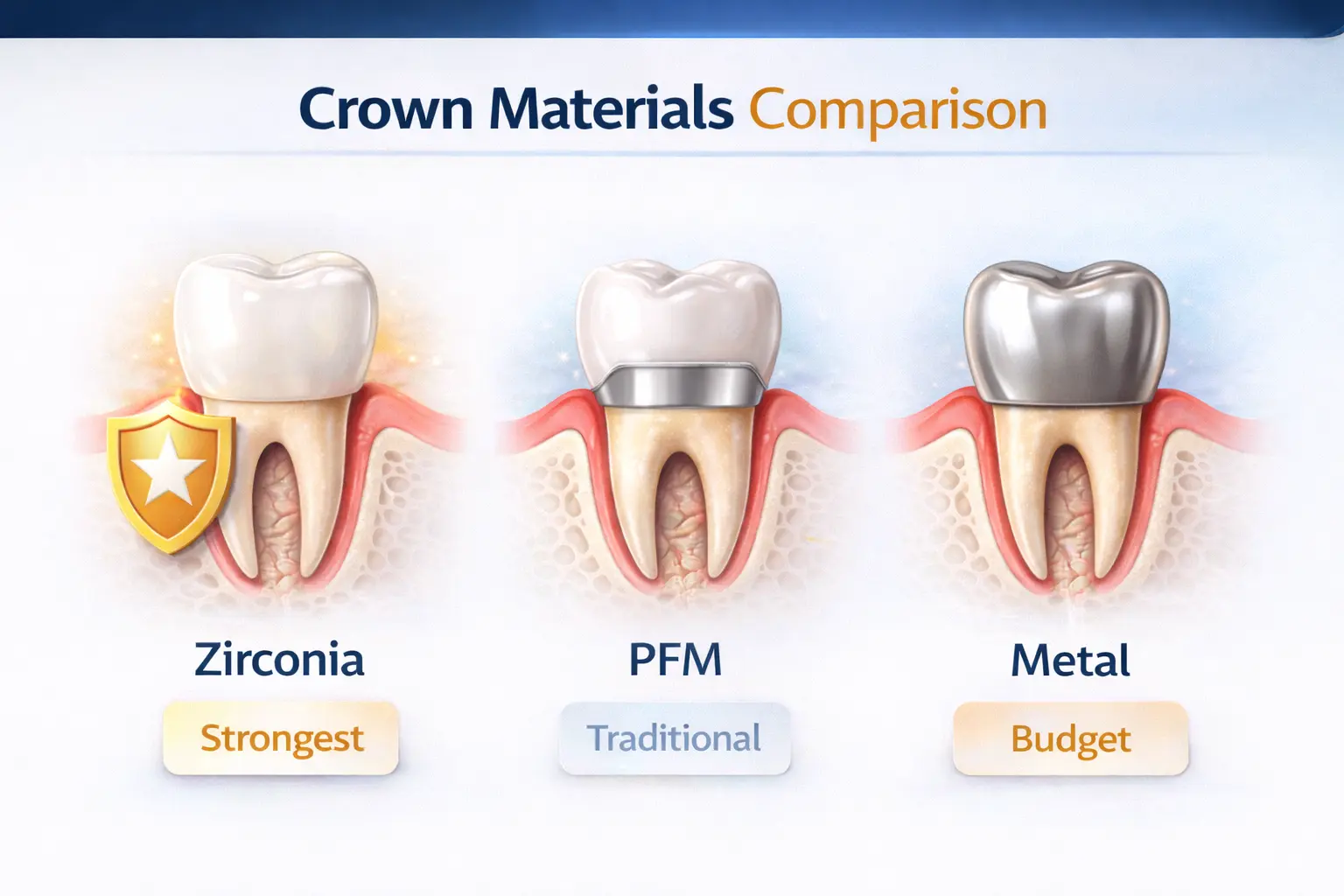
Not all crowns are equal. The right choice depends on which tooth it is, how much natural tooth remains, and your budget. Here are the main options:
Most Recommended
Why 80% of Crowns After RCT Are Zirconia Today
- Strongest material — handles molar bite force without chipping
- Metal-free — no grey line at gum, no allergy risk, safe for MRI
- Tooth-coloured — indistinguishable from natural teeth
- Lasts 15–20+ years — best long-term value for an RCT tooth
- Recommended by Dr. Jyoti Singh for all posterior teeth after root canal
Zirconia Crown
- Strongest option available
- Tooth-coloured — looks completely natural
- No metal allergy risk
- Best for molars and premolars
- Long lifespan — 15 to 20+ years with care
PFM Crown
- Porcelain fused to metal — traditional and reliable
- Good strength for back teeth
- Can show a grey metal line at gum over time
- Lower cost than zirconia
- Good option on a tighter budget
Emax Crown
- All-ceramic — best aesthetics available
- Ideal for front teeth after RCT
- Excellent light transmission — looks like a real tooth
- Slightly lower strength than zirconia
- Not ideal for heavy bite pressure areas
| Crown Type | Best For | Strength | Aesthetics |
|---|---|---|---|
| Zirconia | Molars, premolars | Excellent | Very good |
| PFM | Back teeth, budget | Good | Moderate |
| Emax | Front teeth | Moderate | Excellent |
For a complete guide to all crown types, materials and what suits you best: Dental Crowns in Gurgaon — Complete Guide
Not sure which material to choose? Read: Which dental crown is best — a direct comparison to help you decide.
Also helpful: Zirconia crown in Gurgaon — materials, cost and what to expect at our clinic.
Why Timing Matters
Why Dentists Prefer Crown Immediately After Root Canal
Getting a crown placed promptly after root canal is not just a preference — it is a clinical standard. Here is why every dentist will push you to book that crown appointment without delay.
Protects a Weakened Tooth
- RCT tooth loses moisture and structural flexibility
- Crown covers all surfaces — holds the tooth together
- Without it, normal chewing can crack the tooth
Restores Chewing Strength
- Crown restores the tooth to full functional strength
- You can eat normally — including on that side
- Without crown, patients often unconsciously avoid that side
Seals Root Canal from Bacteria
- The temporary filling placed after RCT leaks within weeks
- Bacteria re-enter the cleaned canals
- Crown seals the tooth completely — no bacterial pathway
Prevents Fracture and Tooth Loss
- Most RCT teeth lost — were lost due to delayed crown, not failed RCT
- A fracture below the gum line means extraction
- Crown placed on time = tooth protected for 15–20 years
High Fracture Risk
- Brittle tooth unprotected
- Temporary filling leaks in weeks
- Bacteria can re-enter canals
- One hard bite can split tooth to root
- May need extraction + implant
Protected for 15–20 Years
- Full tooth coverage on all sides
- Bacteria sealed out completely
- Normal chewing restored immediately
- Lifespan of 15–20+ years with care
- Tooth saved — no implant needed
What to Expect
Crown After Root Canal — Step by Step#
Getting a crown after root canal is a straightforward process. It usually takes two appointments over 1–2 weeks.
Tooth Preparation
- Dentist reshapes the tooth to make space for the crown
- Usually painless — tooth has no nerve after RCT
- Amount removed depends on crown type chosen
Scan or Impression
- Digital scan or putty impression taken of your tooth
- Sent to the dental lab to custom fabricate your crown
- Usually takes 3–7 working days
Temporary Crown
- A temporary crown placed while you wait
- Protects the tooth in between appointments
- Avoid sticky foods with temporary crown on
Final Crown Placed
- Crown checked for fit, bite, and colour
- Permanently cemented in place
- Tooth is now fully protected
Ideally, a crown should be placed within 2–4 weeks after completing root canal treatment. The longer you wait, the higher the fracture risk. Some teeth crack within days of RCT completion. Do not delay.
Also useful: Dental crowns in Gurgaon | Pain After Root Canal Treatment — What Is Normal
Transparent Pricing
Crown After Root Canal Cost in Gurgaon#
Crown costs vary depending on the type of crown, the tooth being treated, and the clinical complexity. Here is a general overview.
| Crown Type | Approximate Cost Range | Best Suited For |
|---|---|---|
| PFM Crown | ₹4,000 – ₹8,000 | Back teeth, budget-conscious cases |
| Zirconia Crown | ₹8,000 – ₹18,000 | All teeth — strongest and most natural |
| Emax Crown | ₹10,000 – ₹20,000 | Front teeth — best aesthetics |
- Type of crown material — zirconia and Emax cost more than PFM
- Which tooth — molars require stronger, more durable crowns
- Condition of the tooth — extensive damage may need a post and core before the crown
- Lab quality — imported vs domestic zirconia blocks vary in price
- At Center for Dental Implants & Esthetics, we always discuss cost transparently before starting
For detailed pricing: Teeth Cap Cost in Gurgaon | Dental Crowns in Gurgaon — Full Guide
Zirconia pricing: Zirconia crown cost in Gurgaon | Not sure which crown to pick? Which dental crown is best — compare all options.
Also see: Root Canal Treatment Cost in Gurgaon
“A patient came to us with a broken molar. Six months earlier, she had a root canal done at a clinic near her home. The dentist advised a crown. She delayed it because she was busy. The tooth split all the way to the bone. We had to extract it. She then needed an implant — which cost her nearly 8 times what the crown would have cost. This is the most preventable dental problem I see.”
At Center for Dental Implants & Esthetics, we follow a strict protocol: we do not consider a root canal treatment complete until the crown is placed. We remind, we follow up, and we make sure our patients understand why.
— Dr. Jyoti Singh | 17+ years experience | MAIDS, Delhi | Diplomate WCOI (Japan Region)
Common Misconceptions
Myths vs Facts — Crown After Root Canal#
Patients delay crowns for many reasons. Most of those reasons are based on myths. Let us clear them up.
The tooth is dead after root canal. There is no nerve. It does not need protection.
Dead does not mean indestructible. A dead tree trunk still falls. A tooth without a nerve is structurally vulnerable — it fractures under bite pressure without a crown protecting it.
A good filling after RCT is enough. Crown is the dentist pushing extra treatment.
A filling seals the cavity. A crown protects the entire tooth. Research consistently shows that a filling alone after RCT on a back tooth leads to significantly higher fracture rates. This is not upselling — it is dentistry done right.
Crown will damage the natural tooth underneath.
A small amount of tooth is shaped to make room for the crown. But the crown itself is what holds the tooth together. Without it, the tooth is at far greater risk of fracturing and being lost entirely.
I can wait six months — the tooth feels fine right now.
An RCT tooth feels nothing — no nerve means no warning pain. It can fracture silently and suddenly. Waiting is exactly what makes the tooth break. The absence of pain is not an indication that it is safe.
See also: Root Canal Treatment in Gurgaon — what the procedure actually involves, start to finish.
Frequently Asked Questions
Crown After Root Canal — Patient Questions Answered
For back teeth — yes, almost always. Molars and premolars take the heaviest chewing load and are at very high risk of fracturing without crown protection after RCT.
- Molars: crown is mandatory
- Premolars: crown is strongly recommended
- Front teeth: assessed case by case — sometimes a filling is sufficient if tooth structure is largely intact
The American Association of Endodontists recommends full coverage restoration for all posterior (back) teeth after root canal.
Ideally within 2 to 4 weeks of completing root canal treatment.
- Do not wait more than 4–6 weeks without a crown on a back tooth
- A temporary filling placed during RCT is not designed to last — it leaks and wears down quickly
- The sooner the crown is placed, the lower the risk of fracture or re-infection
For front teeth with minimal damage — sometimes yes. For back teeth — very unlikely long-term.
- Studies show significantly higher fracture rates in uncovered posterior teeth after RCT
- Some teeth survive a year or two — then crack suddenly and are lost
- The risk is not worth it when a crown is a one-time investment that lasts 15–20 years
Yes — for most cases, zirconia is the best all-round choice.
- Strongest material currently available for dental crowns
- Tooth-coloured — aesthetically superior to metal or PFM
- No metal, no allergy risk, no grey gum lines over time
- Ideal for molars and premolars where strength matters most
- For front teeth, Emax may look slightly better due to translucency
See: Zirconia crown in Gurgaon — materials, cost and what to expect
Yes — without exception. The molar is the most vulnerable tooth after RCT.
- Molars absorb the heaviest bite forces in the mouth
- A brittle, unprotected molar will crack eventually — the only question is when
- Once a molar cracks to the root, it must be extracted
- You then face the cost and process of an implant or bridge
- A crown on a molar is almost always the most cost-effective long-term decision
In most cases, no — there is a short waiting period involved.
- The crown is custom fabricated in a dental lab — this takes a few days
- Your dentist will place a temporary crown in the meantime
- Some clinics with in-house CAD/CAM milling machines can place a same-day crown in select cases
- Your dentist will advise what is appropriate based on your tooth and clinical situation
Visit your dentist as soon as possible — do not ignore it.
- The tooth underneath is now exposed and vulnerable to fracture
- Bacteria can re-enter the root canal and cause infection
- Avoid chewing on that side until the crown is replaced
- In most cases the crown can be re-cemented if it is undamaged
- Read: My Tooth Cap Came Off — What to Do
No — crown placement after root canal is generally painless.
- The nerve has already been removed during RCT
- Tooth preparation involves reshaping — no pain since there is no nerve
- Local anaesthesia may be used as a precaution for sensitive gum tissue
- Most patients find crown fitting comfortable and quick
A well-placed zirconia or Emax crown can last 15–20 years or more.
- PFM crowns typically last 10–15 years
- Longevity depends on oral hygiene, bite habits, and material quality
- Avoid using the crown to crack ice, hard nuts, or chewing pen caps
- Regular check-ups every 6 months help catch issues early
For back teeth: crown is always better. For front teeth with minimal damage: filling may sometimes suffice.
- A filling seals the opening made during RCT — it does not protect the tooth from fracture
- A crown encases the entire tooth — protecting it from all sides under bite pressure
- Multiple studies confirm crowns significantly outperform fillings for long-term tooth survival after RCT
- Compare materials: GIC vs Composite Fillings
Protect Your Root Canal Tooth Before It Breaks
A crown placed on time saves your tooth for 15–20 years. Delayed, and you may need an implant instead. Book a consultation at Center for Dental Implants & Esthetics, Gurgaon — today.
Most crowns after root canal are placed within 2–3 weeks.
Delaying increases fracture risk.
Center for Dental Implants & Esthetics
#166, Sector 51 (Ambedkar Chowk), Close to Artemis Hospital, Gurgaon, Haryana 122003
Center for Dental Implants & Esthetics
R1-257, 2nd Floor, M3M Cornerwalk, Sector 74, Gurugram, Haryana 122004
Explore Further
Dental Crowns in Gurgaon — Complete Guide
All crown types, materials, costs and what to expect — explained in full. The one page to read before choosing your crown.
Dental Crowns Guide →Root Canal Treatment in Gurgaon
Everything about the root canal procedure itself — signs you need one, what happens during treatment, recovery, and cost at our clinic.
Root Canal Treatment →What Happens If You Lose the Tooth?
If a tooth is eventually lost after skipping the crown, you have options. This page explains implants, bridges, and the real cost of waiting too long.
Missing Tooth Consequences →This page is for informational purposes only and does not replace professional dental consultation. Symptoms and conditions described may have multiple causes. Please visit a qualified dental professional for diagnosis and personalised treatment advice. Cost ranges mentioned are approximate and subject to clinical evaluation.