
Endodontics — Center for Dental Implants & Esthetics
Early Signs of
Root Canal Infection
Your tooth may already be infected — even without severe pain. Learn the warning signs before damage becomes serious.
See the Warning Signs ↓But by then, infection has already spread deep inside the tooth — sometimes into the surrounding bone.
Catching it early is the difference between a simple root canal and losing the tooth entirely.
This page explains the early, easy-to-miss signs of a root canal infection — written for patients who want honest, evidence-based information, not just generic advice.
What Is a Root Canal Infection?
Inside every tooth is a soft tissue called the dental pulp — it contains nerves, blood vessels, and connective tissue. When bacteria reach this space, an infection begins.
- → Deep cavities — the most common cause. Decay eats through enamel and dentine until it reaches the pulp.
- → Cracked or fractured teeth — even a hairline crack can let bacteria in.
- → Trauma to the tooth — a blow during sports or an accident, even years earlier.
- → Repeated dental work on the same tooth — multiple fillings over years can weaken pulp health.
- → Old, leaking fillings — if the seal fails, bacteria seep underneath.
This is exactly why early signs are so important to recognise. The infection does not wait for you to feel it.
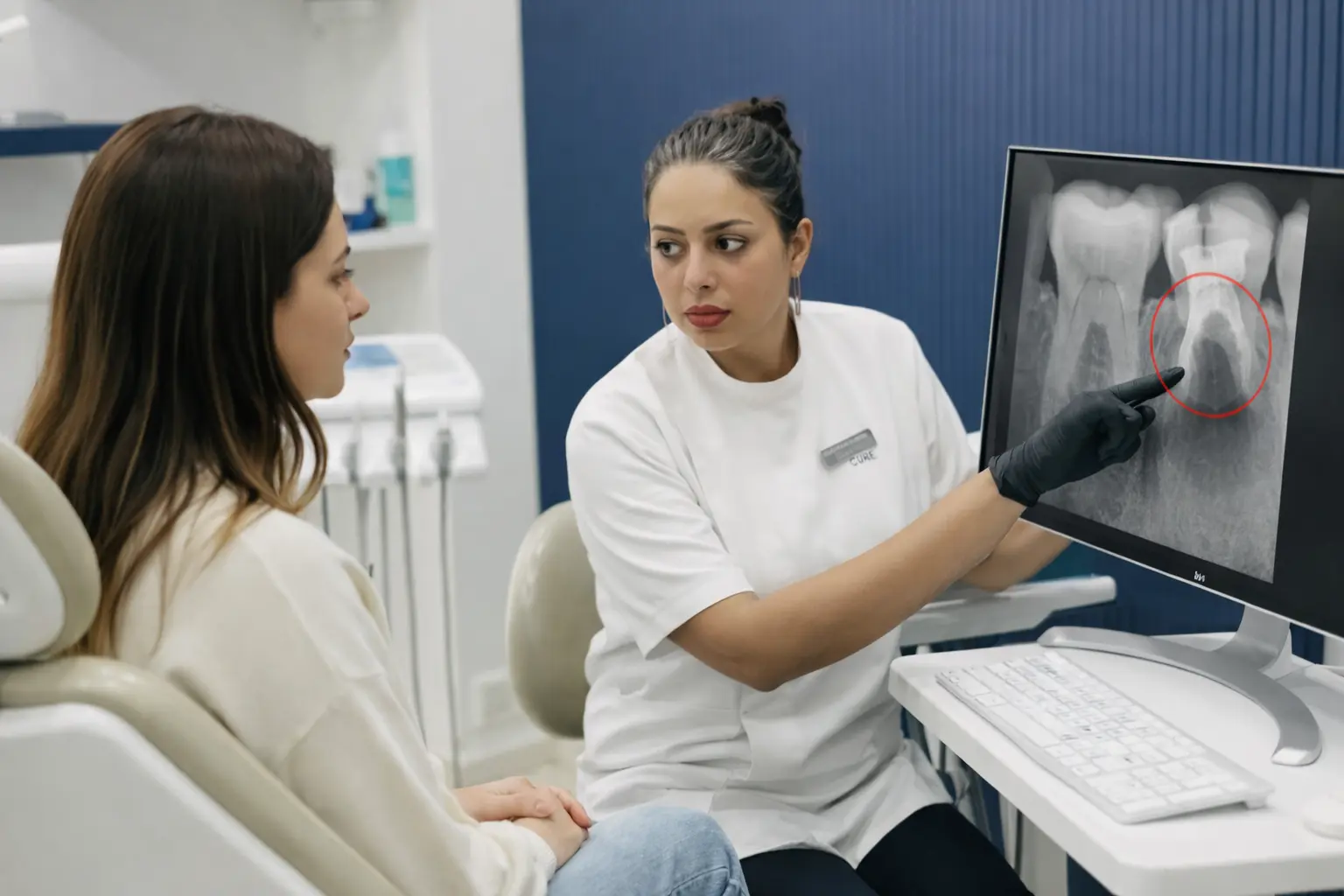
A dental X-ray can reveal infection around the root tip — often before any pain begins.
7 Early Warning Signs of Root Canal Infection
These symptoms appear before severe pain begins. If you notice even one or two of these, book a dental evaluation — do not wait for it to get worse.
Sensitivity That Lingers
Normal tooth sensitivity disappears in 1–2 seconds. If cold or hot food causes pain that lasts 10–15 seconds or more, the nerve is already inflamed.
- Worse with cold drinks
- May radiate up the jaw
- Does not fully disappear
Dull, Constant Toothache
Not sharp pain — a mild background ache that is easy to dismiss. Patients often notice it:
- While chewing
- First thing in the morning
- When clenching teeth
Tooth Feels “High” When You Bite
Inflammation at the root tip pushes fluid around the tooth, making it feel slightly raised compared to other teeth when biting down.
This is often one of the very first signs patients notice — and almost always ignore.
Gum Swelling Near One Tooth
A small tender bump or swelling in the gum — right next to one specific tooth — can mean infection is tracking from the root to the surface.
Sometimes this looks like a small pimple on the gum. It may come and go.
Tooth Turning Grey or Dark
As the nerve begins to die, the tooth changes colour. It may look slightly darker, grey, or yellowish compared to adjacent teeth.
This happens gradually. Most patients notice it in photos before they notice it in the mirror.
Bad Taste or Smell in Mouth
A persistent bad taste that brushing does not fix can indicate an abscess slowly draining. The taste is often described as bitter, metallic, or sour.
This is a sign the infection is already leaking from around the root.
Pain That Wakes You at Night
When you lie down, blood pressure in the head increases slightly — this amplifies pulp inflammation and is why early root canal pain often wakes patients at night.
If you are taking pain medication just to sleep, do not delay further.
Symptoms Patients Ignore for Months
In over 17 years of clinical practice, the pattern is consistent — patients come in with a serious abscess and say “but it wasn’t that bad a few months ago.”
A patient came to us at Center for Dental Implants & Esthetics with a tooth that had been “slightly sensitive” for eight months. She had been ignoring a mild ache while chewing. By the time she visited, the infection had spread to the surrounding bone. She still kept the tooth — but the treatment was significantly more involved than it would have been eight months earlier. Early detection changes everything.
— Dr. Jyoti Singh, MDS | Diplomate WCOI | 10,000+ proceduresThe most frequently ignored early signs:
- ! Occasional sensitivity — “it comes and goes, so it can’t be serious”
- ! Mild chewing discomfort — dismissed as a food particle or sore gum
- ! Gum tenderness near one tooth — attributed to aggressive brushing
- ! History of deep filling in the same tooth — old fillings can fail slowly
- ! Previous dental trauma — a blow to the tooth years ago can cause delayed pulp death
- ! Slight tooth colour change — easy to miss until quite advanced
Can a Root Canal Infection Start Without Any Pain?
Yes — and this is one of the most important things to understand about tooth infections.
“If my tooth doesn’t hurt badly, there is no infection.”
A nerve that has completely died (pulp necrosis) no longer sends pain signals. The infection continues growing — silently — in the bone around the root tip.
This condition — pulp necrosis (the dental pulp inside the tooth has died) — is surprisingly common. Patients may only notice:
- → Gradual tooth darkening
- → Mild on-and-off swelling in the gum
- → Bad taste that does not go away
- → Nothing at all — found on routine X-ray
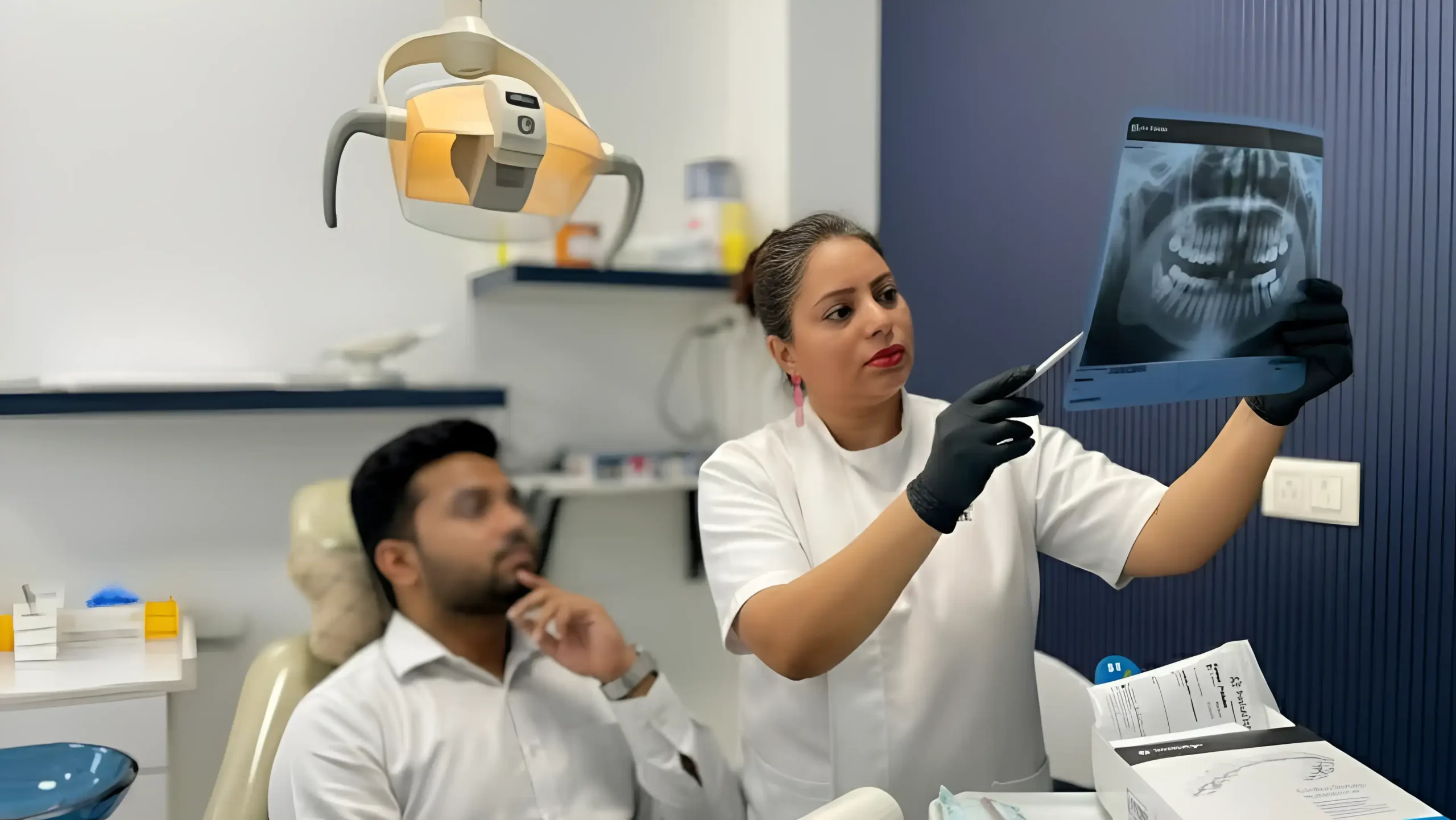
X-ray imaging gives a complete view of infection — often revealing problems.
How Dentists Detect Root Canal Infection Early
Early infection does not always announce itself. Experienced dentists use a combination of tests to find it before it becomes serious.
-
01
Clinical Examination
Checking for swelling, gum tenderness, and tooth response to pressure. A tooth that is tender when tapped — even without spontaneous pain — suggests periapical inflammation.
-
02
Cold / Thermal Test
A small amount of cold stimulus is applied to the tooth. If response is exaggerated or lasts more than 10 seconds, the nerve is likely inflamed. If there is no response at all, the nerve may already be dead.
-
03
Periapical X-Ray
The standard test for detecting bone changes at the root tip. A dark shadow around the apex indicates infection has spread to the bone.
-
04
CBCT 3D Scan (when needed)
For complex cases, curved roots, or when standard X-ray is unclear, a CBCT scan provides a detailed 3-dimensional picture of infection extent, root anatomy, and surrounding structures.
At Center for Dental Implants & Esthetics, CBCT imaging is used routinely for root canal treatment planning when clinically indicated — ensuring no surprises during treatment.
Early Infection vs Advanced Infection
Understanding the difference helps you act at the right time.
| Feature | Early Infection | Advanced Infection |
|---|---|---|
| Pain level | Mild, dull, or none | Severe, throbbing |
| Swelling | Mild gum tenderness | Visible facial swelling |
| Bone damage | Minimal or none | Significant, may be irreversible |
| Treatment complexity | Simpler root canal | Longer, multiple visits |
| Success rate | 90–95% | Lower, case dependent |
| Risk of tooth loss | Very low | Significantly higher |
| Recovery time | 1–2 days | Longer, may need antibiotics |
Why Acting Early Saves the Tooth
The biology of tooth infection works against delay. Here is what actually happens when you wait.
- → Bone dissolves faster than it regrows. Once infection destroys bone around the root, the body can regenerate some — but not all — of what was lost.
- → Abscess can spread. Dental abscesses have — in rare but documented cases — spread to the jaw, neck, and airway. This is a medical emergency.
- → Adjacent teeth are at risk. Chronic infection from one tooth can affect the health of neighbouring teeth and supporting bone over time.
- → Root canal success rates drop. Extensive bone damage before treatment significantly reduces long-term tooth survival rates.
In my experience, patients who come in at the first sign of sensitivity almost always keep their teeth. The ones who wait — hoping it will resolve on its own — face more complex treatment. Tooth infections do not self-resolve. The pulp chamber is a closed, sealed space. Bacteria inside it have nowhere to go except deeper.
— Dr. Jyoti Singh, MDS | Maulana Azad Institute of Dental Sciences | Center for Dental Implants & Esthetics, GurgaonRoot Canal Infection — Patient Questions Answered
These are the real questions patients search for — answered directly.
When the nerve inside a tooth dies completely (called pulp necrosis), it can no longer send pain signals. The infection continues spreading into the surrounding bone — silently. This is why routine dental X-rays matter even when nothing hurts. A dark shadow at the root tip on an X-ray is the first sign most patients ever see of an infection they did not know they had.
Some people go weeks or months with mild symptoms before an acute flare-up. Others develop a rapidly expanding abscess within days. The problem is you cannot predict which path your infection will take. Dental infections have caused serious complications when left untreated — including spread to the jaw bone and, in rare cases, the airway. If you have symptoms, see a dentist within 1–2 days.
Normal sensitivity to cold disappears within 1–2 seconds. If sensitivity lasts 10 seconds or more, or if it is disproportionately intense, the nerve is likely inflamed — a condition called irreversible pulpitis. This does not always mean you need a root canal immediately, but it does mean you need a professional evaluation soon.
Antibiotics can reduce swelling and stop infection from spreading to nearby structures. But the source of infection is inside the tooth — a space antibiotics cannot penetrate effectively. Without removing the infected pulp tissue (root canal treatment) or extracting the tooth, the infection will return once antibiotics are stopped. This is a very common misconception that leads to repeated cycles of antibiotics without resolution.
Patients describe it as: a dull ache while chewing, a slight twinge with hot or cold food, or a sense that the tooth feels different when biting. It may come and go over days or weeks. The sharp, throbbing, sleepless-night pain is a late sign — not an early one. Acting on the mild early symptoms is how you avoid the severe late ones.
It can happen due to deep infection, trauma, or prolonged inflammation. Because the nerve is dead, there is often no pain. Signs that may indicate pulp necrosis include: tooth discolouration (grey or dark), a bad taste in the mouth, occasional gum swelling near one tooth, and an absence of response to cold testing. A dental X-ray will typically show a shadow at the root tip confirming the diagnosis.
When infection or inflammation builds up around the root, it creates pressure in the ligament that holds the tooth in its socket. This makes the tooth feel slightly raised — as if it is sitting higher than adjacent teeth. The sensation is subtle but real. If you notice one tooth consistently feeling different when you bite down, have it evaluated.
Once bacteria reach the apex (tip) of the root, they begin dissolving the bone around it. On an X-ray, this appears as a dark shadow (periapical radiolucency). Initial bone involvement can occur within 4–8 weeks of pulp death in some patients. With chronic low-grade infection, it may take longer — but the damage is cumulative. Every week of delay adds to bone loss that cannot always be fully recovered.
With proper anaesthesia, most patients describe the sensation as similar to having a filling done. The procedure removes the source of pain — it does not cause it. Post-procedure soreness typically resolves within 1–3 days. The pain people associate with root canals is usually the pre-treatment infection, not the treatment itself. Read our guide on painless root canal treatment in Gurgaon for more details.
Noticed Any of These Warning Signs?
Early evaluation at Center for Dental Implants & Esthetics includes clinical examination, dental X-ray, and CBCT when required. Most early cases can be resolved with a single-visit root canal.
Center for Dental Implants & Esthetics
#166, Sector 51 (Ambedkar Chowk)
Close to Artemis Hospital
Gurgaon, Haryana 122003
Center for Dental Implants & Esthetics
R1-257, 2nd Floor, M3M Cornerwalk
Sector 74, Gurugram, Haryana 122004
You May Also Find These Helpful
Complete Guide to Tooth Infection Symptoms
Everything from early warning signs to abscess — understand what your tooth is trying to tell you before it becomes an emergency.
Read: tooth infection symptoms →Signs You Need Root Canal Treatment
A detailed checklist of clinical and visible signs that indicate root canal treatment is necessary — and what happens if you delay.
Read: signs you need root canal →Painless Root Canal Treatment in Gurgaon
Worried about pain? Understand how modern root canal treatment works, what anaesthesia is used, and what recovery looks like at our Gurgaon clinics.
Read: painless root canal Gurgaon →Disclaimer: This page is for informational purposes only and does not replace professional dental consultation. Symptoms described may have multiple causes. Please visit a qualified dental professional for diagnosis and personalised treatment advice.

Dr. Jyoti Singh (MDS), Diplomate WCOI (Japan region) Member AAID (American Association of Implant Dentistry) stands as a beacon of excellence in implantology within Delhi NCR region. She is a BDS and MDS(Prostho) both from Maulana Azad Institute of Dental Sciences, where she secured top honors with all India rank 1 in PG entrance examination. Her extensive experience at esteemed institutions like Clove Dental and her own Center for Dental Implants & Esthetics since 2016, Dr. Singh embodies unparalleled expertise in dental implants. Boasting a wealth of 17+ years in dentistry and backed by 18 groundbreaking research papers in leading international journals (Google Scholar) and her ResearchGate profile, she epitomizes the pinnacle of proficiency and innovation in her field. She practices in Gurugram as your friendly dentist near me.