
Is Root Canal Really Painful?
The Truth About Painless RCT in Gurgaon
Most people dread root canal treatment because of old stories. The truth? With modern technique and proper anaesthesia, the procedure itself is often no more uncomfortable than a routine filling.
Is Root Canal Treatment Painful? The Honest Answer.
This is the question every patient asks before sitting in the chair. It deserves a straight answer.
The pain you feel before RCT — that throbbing, sleepless toothache — is far worse than the procedure itself. In my 17 years of clinical practice, the majority of patients lean back in the chair and say, “That’s it? I was worried for nothing.”
The fear is real. The pain during a properly administered root canal treatment is not.
Spontaneous toothache, sensitivity to heat, sleepless nights — this is the real pain from an infected pulp.
With proper local anaesthesia, most patients feel only mild pressure. Significant pain during RCT is not acceptable and is avoidable.
A 2022 survey published in the Journal of Endodontics found that over 70% of patients rated their actual RCT experience as significantly less painful than anticipated. Fear, not the procedure, is the bigger problem.
Why Does Root Canal Have Such a Scary Reputation?
The painful reputation of RCT dates back decades, when anaesthetic options were limited and techniques were crude. Patients experienced real discomfort back then, and those stories passed through families. That history stuck.
Modern dentistry has changed everything:
- Advanced local anaesthetics now work even on severely infected, acidic tissues that once resisted numbing
- Computer-controlled injection systems make the injection itself near-painless
- Rotary nickel-titanium instruments reduce procedure time from 2–3 hours to under 90 minutes
- Intraosseous anaesthesia provides instant, deep numbing in difficult cases
- Apex locators measure root length precisely — preventing over-instrumentation that caused old-style post-procedure pain
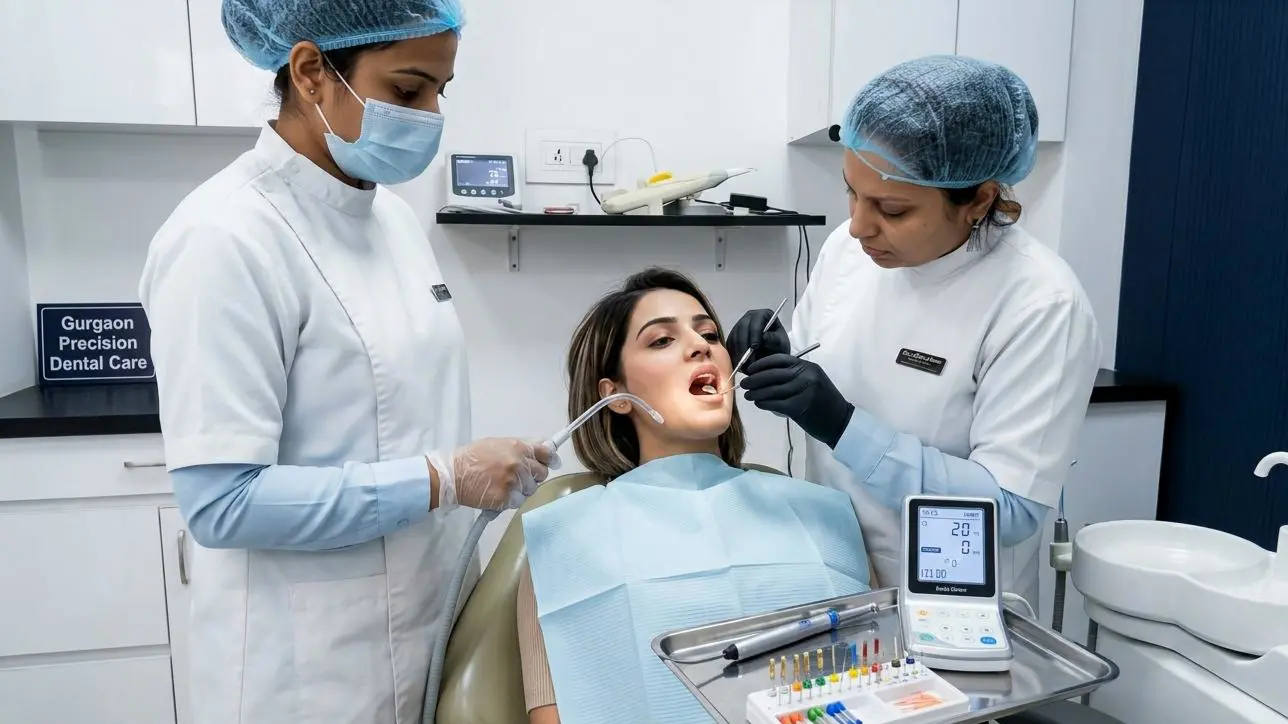
The gap between how people imagine RCT and what actually happens today is enormous. If your last experience was painful at any clinic, it was not because RCT is inherently painful. It was because anaesthesia was not managed well enough.
How We Ensure You Feel Nothing: Our Anaesthesia Protocol
Anaesthesia is the foundation of a painless root canal. Here is exactly what happens at Center for Dental Implants & Esthetics before we touch your tooth:
Topical (Surface) Anaesthetic First
Before any injection, a numbing gel is applied directly to the gum. This desensitises the surface so the needle causes no more sensation than a light touch — often nothing at all.
Slow, Controlled Injection
We use lignocaine with adrenaline, delivered very slowly with fine-gauge needles. Fast injections cause pressure pain. We never rush this step. For lower molars, we use articaine — a newer anaesthetic that diffuses through bone more effectively.
Supplemental Techniques for Difficult Cases
Severely infected teeth sometimes resist standard blocks because the tissue pH changes during infection. In these cases we use intraosseous injection (anaesthetic directly into bone) or intrapulpal injection for instant, complete numbness. You will not proceed until you are fully numb.
Confirmation Before Starting
We confirm you are numb before beginning. You are asked to signal — not to silently endure. If any discomfort occurs during treatment, we stop, reassess, and add more anaesthesia. Pain during RCT is a signal to pause, not push through.
If You Have Had a Painful RCT Before — Here Is Why
In most cases of painful root canal treatment, the tooth was not adequately numb when the procedure began, or supplemental techniques were not used when the standard block was insufficient. This is a management failure, not an inherent property of the procedure. At Center for Dental Implants & Esthetics, we do not proceed until complete anaesthesia is confirmed. This is our standard — not an exception for nervous patients.
Pain After Root Canal Treatment: What is Normal and What is Not
Once the anaesthesia wears off — typically 2–4 hours after the procedure — some soreness is completely normal. This is post-procedure inflammation, not a sign something went wrong. It is far less intense than the toothache that brought you in.
Normal for 2–4 Days After RCT
- Mild tenderness when biting on the treated tooth
- Slight sensitivity in the gum around the tooth
- Dull aching that responds well to paracetamol or ibuprofen
- Slight pressure sensation inside the tooth
Call Your Dentist If You Have
- Severe, escalating pain beyond 5–6 days that is getting worse, not better
- Visible swelling on the cheek or jaw
- Fever above 38°C — this suggests spreading infection
- The temporary filling falls out before your crown appointment
Pain Management Tips
- Take ibuprofen 400mg and paracetamol 500mg together (if no allergy) — more effective than either alone for dental pain
- Do not wait for pain to peak before taking the first dose — take it as the anaesthesia starts wearing off
- Avoid hard, crunchy, or sticky food on the treated side until the crown is placed
- Warm saline rinses twice daily help the gum heal faster
- Sleep with your head slightly elevated the first night to reduce throbbing
For a detailed guide, see our article on pain management after root canal treatment.
Root Canal Pain: Myths vs. Facts
Much of what people believe about root canal pain is simply not accurate. Here is a clear comparison:
| What People Believe | What the Evidence Shows |
|---|---|
| Root canal is among the most painful dental procedures | Studies show it is rated no more painful than a filling by patients who have had both. (Journal of Endodontics, 2022) |
| You will definitely be in severe pain during RCT | With adequate anaesthesia including supplemental techniques, 95%+ of patients can be made completely comfortable. |
| The pain after RCT is unbearable for days | Mild soreness for 2–3 days is normal. Severe post-procedure pain is uncommon with modern instrumentation. Standard OTC painkillers manage it well. |
| My friend had a painful RCT, so mine will be too | Your friend’s experience reflects how well anaesthesia was managed by that specific dentist — not an inherent property of the procedure. |
| It is better to just extract the painful tooth | Extraction removes the pain but creates bone loss, shifting teeth, and the need for an implant or bridge costing 3–5 times more than saving the tooth. |
| Painless RCT is just marketing — all RCT hurts the same | Painless RCT is the same procedure done with comprehensive anaesthesia management, modern instruments, and a dentist who never proceeds until the patient is fully numb. The difference is real. |

For more on common misconceptions, read: 8 Myths About Root Canal Treatment Debunked.
Our Approach to Painless Root Canal Treatment
A Word from Dr. Jyoti Singh
I graduated from Maulana Azad Institute of Dental Sciences (MAIDS), one of the most respected dental institutions in India. In over 17 years and more than 10,000 cases at our clinics in Gurgaon, I still see patients walk in gripping the armrests before we have even touched them.
Fear of root canal treatment is understandable. It comes from real experiences — usually at a time when anaesthesia management was not as comprehensive, or with a dentist who did not take the time to ensure complete numbness.
What I tell every patient at Center for Dental Implants & Esthetics: the tooth that is hurting you today is in much more pain than the procedure that will fix it. And that procedure, done properly, should cause you no meaningful pain at all.
Our protocol is non-negotiable: rubber dam isolation in every case, apex locator to measure canal length precisely, rotary instrumentation, CBCT for complex anatomy, and a strict rule — we do not start the cleaning phase until you confirm you cannot feel anything. I am a Diplomate of WCOI (Japan Region) and Nobel Biocare trained.
If you are nervous, tell us. We will explain every single step before it happens. You are in control.
Frequently Asked Questions: Is Root Canal Painful?
Every question here is one our patients ask before sitting in the chair.
No — not with modern anaesthesia and technique. The procedure is performed under local anaesthesia, so you should feel no pain during it. You may feel mild pressure or vibration, but not pain. What is painful is the infected tooth before treatment. After RCT, mild soreness for 2–4 days is normal and managed with standard pain relief.
In most cases, the tooth was not adequately numb when the procedure began. Severely infected teeth resist standard anaesthetic blocks because the tissue pH changes during infection. The solution is supplemental techniques — intraosseous or intrapulpal injection. A dentist who does not use these when needed will have patients in pain. This is a skill and protocol gap, not a property of root canal treatment itself.
With topical anaesthetic applied first and a slow, controlled injection technique, the injection causes minimal sensation — most patients describe it as a slight pressure, not pain. The injection is usually the moment patients are most anxious about, and it is almost always far less than they expected.
Tell your dentist immediately. You should never silently endure discomfort. A good dentist will stop, assess, and administer additional anaesthesia before continuing. If a dentist tells you to “just bear it,” that is not acceptable practice. At Center for Dental Implants & Esthetics, we do not proceed until you are completely comfortable.
Mild tenderness when biting and dull aching for 2–4 days is completely normal — and far less intense than the toothache that brought you in. Standard over-the-counter painkillers manage it well for most patients. Severe, escalating pain beyond 5–6 days is unusual and should be reviewed by your dentist.
Yes — consistently. The throbbing, spontaneous pain of an infected pulp is typically rated 7–9 out of 10 by patients. The procedure itself, under proper anaesthesia, is rated 1–2 out of 10. Root canal treatment is what ends the severe pain, not what causes it.
It is real — but it refers to how the procedure is done, not a different procedure. Painless RCT means thorough anaesthesia management including supplemental techniques, modern rotary instruments, precise apex locator measurement, and a dentist committed to not starting until the patient is fully numb. Any well-trained clinic should deliver this as standard practice.
Tell your dentist before the appointment begins. When the dentist knows you are anxious, they adapt — explaining each step before doing it, checking in more frequently, moving at your pace. Knowing you can raise your hand to pause at any point gives real control. Most anxious patients finish their RCT and say the anticipation was the hardest part.
Lower back molars are statistically the most challenging to anaesthetise because the standard nerve block for the lower jaw can be less reliable. This is well-known in dentistry — and why lower molars most often need supplemental techniques. In experienced hands, every tooth can be made comfortable regardless of position.
Yes, in most cases. Local anaesthesia does not affect your concentration or reflexes — only your sense of feeling in the numbed area. You will have numbness in your lip, cheek, or tongue for 2–4 hours, but you can drive normally. If you were given a sedative (uncommon for standard RCT), arrange for someone to take you home.
Stop Living With Toothache. Book Your Appointment Today.
If you have been putting off treatment because of fear, come in for a consultation first. We will assess your tooth, answer every question, and give you an honest plan — no pressure, no surprises.
Close to Artemis Hospital,
Gurgaon, Haryana 122003
Sector 74, Gurugram,
Haryana 122004
8 Myths About Root Canal Treatment
Still worried? Go through the most common myths patients carry into the clinic and what modern evidence actually says. Knowledge is the most effective painkiller.
Read: Debunking Root Canal Myths →Pain After Root Canal: Recovery Tips
A detailed guide on what to expect in the days after your RCT, which medicines work best, and the warning signs that mean you should call your dentist.
Read: Post-RCT Recovery Guide →Root Canal Treatment in Gurgaon
Our complete service page covering procedure details, candidacy, technology used, and what the full RCT experience looks like at Center for Dental Implants & Esthetics.
Read: RCT at Our Gurgaon Clinic →
Dr. Jyoti Singh (MDS), Diplomate WCOI (Japan region) Member AAID (American Association of Implant Dentistry) stands as a beacon of excellence in implantology within Delhi NCR region. She is a BDS and MDS(Prostho) both from Maulana Azad Institute of Dental Sciences, where she secured top honors with all India rank 1 in PG entrance examination. Her extensive experience at esteemed institutions like Clove Dental and her own Center for Dental Implants & Esthetics since 2016, Dr. Singh embodies unparalleled expertise in dental implants. Boasting a wealth of 17+ years in dentistry and backed by 18 groundbreaking research papers in leading international journals (Google Scholar) and her ResearchGate profile, she epitomizes the pinnacle of proficiency and innovation in her field. She practices in Gurugram as your friendly dentist near me.