
Different Types of Dentures and Their Cost in India — Complete Guide
Which denture type is best for you? What does it cost? What lasts longer? Everything answered — in plain language.
This guide reflects real patient cases seen daily at our Gurgaon clinics — including new dentures, loose dentures, relining, and complex full-mouth cases.
Why Choosing the Right Type of Denture Matters
If you are missing teeth, you are not alone. According to the Indian Journal of Dental Research, over 25 crore Indians are missing at least one tooth. Many wait too long before doing something about it.
But here is what most people do not know. There is not just one type of denture. There are six different types — each built for a different situation. Choose the wrong one and you will face loose fit, discomfort, and extra cost later.
This guide will walk you through every type — what it is, who it is for, how much it costs in India, and which one actually works long term. If you are specifically looking for treatment options near you, you can explore our detailed guide on dentures in Gurgaon.
In India, many people call dentures removable teeth or nakli daant. Whatever you call them, the technology has changed a lot. The denture your grandfather wore and the precision denture available today are very different things.
| Type | Best For | Removable? | Cost Range (India) | Longevity |
|---|---|---|---|---|
| Complete Denture | All teeth missing | Yes | ₹8,000–₹35,000 | 5–8 years |
| Partial Denture | Some teeth missing | Yes | ₹5,000–₹25,000 | 5–7 years |
| Flexible Denture | Few teeth missing | Yes | ₹12,000–₹30,000 | 4–5 years |
| BPS Precision Denture | Demands high quality | Yes | ₹35,000–₹80,000 | 8–12 years |
| Immediate Denture | Same day after extraction | Yes | ₹10,000–₹30,000 | Temporary/1 yr |
| Implant-Supported Overdenture | Long-term stability | Clip-in/out | ₹1,20,000–₹3,00,000 | 15–20+ years |
Complete Dentures — For Those With No Teeth Left
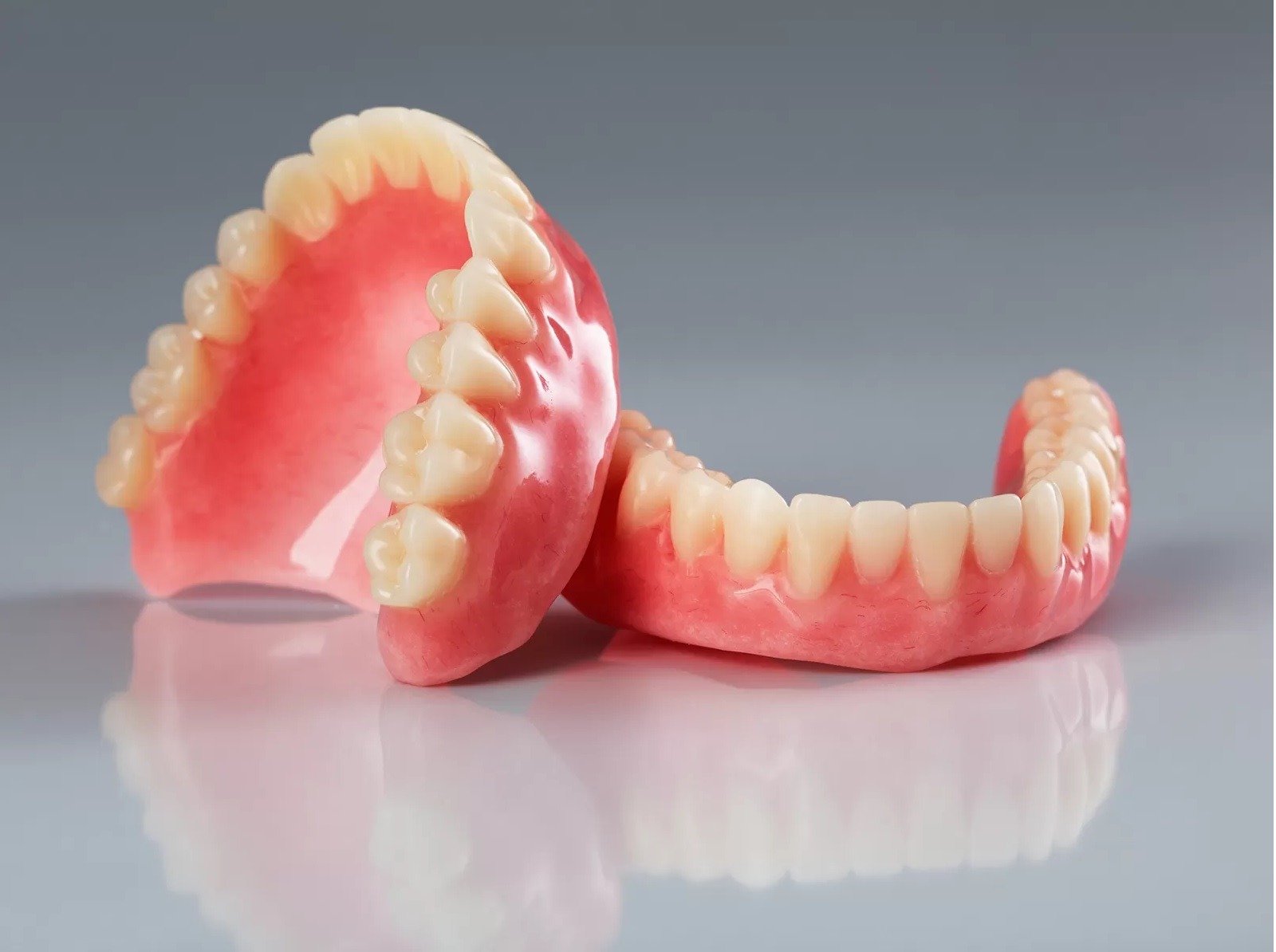
A complete denture replaces all the teeth in one jaw — upper, lower, or both. It sits directly on your gums and is held in place by suction and the shape of your mouth.
This is the most traditional and affordable option. But it takes adjustment. Most patients take 4 to 8 weeks to get comfortable chewing and speaking clearly.
What to expect with a complete denture
- Made from acrylic resin teeth on a pink acrylic base
- Upper denture has full palate coverage — more stable
- Lower denture is harder to keep stable (less bone surface)
- Needs denture adhesive in early weeks for many patients
- Needs a reline (refitting) every 2–3 years as gums shrink
- Must be removed at night and kept in water
Conventional vs Immediate Complete Denture
A conventional denture is made after your gums have fully healed — usually 8 to 12 weeks after extractions. This gives a much better fit.
An immediate complete denture is ready on the day of extraction. You are never without teeth. But it needs adjustments frequently as healing changes the shape of your gums.
The lower jaw has much less bone surface than the upper. This is why lower full dentures are almost always harder to keep stable. Many patients with lower full dentures benefit significantly from 2 implants to anchor the denture. (Source: Journal of Prosthodontics, 2022)
Who is a good candidate?
- All teeth missing in one or both jaws
- Looking for the most affordable option
- Okay with a removable appliance
- Willing to allow 6–8 weeks for the jaw to heal before final denture
What is denture relining and when is it needed?
Relining means adding new material to the inside of your denture so it fits the changed shape of your gum. It is not a new denture. It is a refitting of the one you already have.
Most complete denture wearers need a reline within 1–3 years of first wearing the denture. After extractions, your jaw bone changes shape fastest in the first year. After that, bone loss continues slowly but steadily throughout your life.
A reline costs much less than a new denture. But if the denture base is old and worn, a new one gives better results. Your prosthodontist will tell you which is the smarter choice at your check-up.
Partial Dentures — When Some of Your Natural Teeth Are Still There
A partial denture fills in the gaps left by missing teeth while your remaining natural teeth stay in place. It clips onto your existing teeth using small metal clasps or precision attachments.
Think of it like a puzzle piece that fills only the missing spaces.
Cast Metal Partial
- Metal framework + acrylic teeth
- Very strong and long-lasting
- Clasps may be visible near front teeth
- Cost: ₹8,000–₹25,000
Acrylic Partial
- All-acrylic base with wire clasps
- Cheaper but bulkier
- Often used as temporary solution
- Cost: ₹5,000–₹12,000
Precision Attachment Partial
- Hidden internal clips — no metal showing
- Needs crowns on the teeth it attaches to
- Most aesthetic partial option
- Cost: ₹20,000–₹50,000+
Flexible Dentures — Metal-Free Denture Option
Flexible dentures are made from a special nylon thermoplastic material — brand name Valplast is the most common. They are soft, thin, and bend slightly. No metal clasps. No rigid base.
Many patients who cannot tolerate the feel of a hard plastic denture prefer this type.
What makes flexible dentures different
- No metal — good for people with metal allergies
- The pink base blends with your gum colour
- Lighter and thinner than acrylic
- Clasps are made of the same pink material — nearly invisible
- Easier to adjust to wearing
Limitations you should know
- Cannot be relined when gums shrink — needs full replacement
- Harder to repair if broken
- Not ideal for replacing many missing teeth
- Lasts only 4–5 years typically

In my clinical experience, flexible dentures work best when replacing 1 to 4 teeth. Patients with many missing teeth get better results with conventional cast metal partial or implant-supported options. The flexibility that makes them comfortable also limits their bite strength.
Implant-Supported Overdenture — The Gold Standard in Stability
An implant overdenture looks like a regular denture but is anchored to 2–4 dental implants placed in your jawbone. You can still remove it at night. But during the day, it snaps or clips firmly onto the implants — no slipping, no adhesive needed.
This is the biggest upgrade you can make from a traditional complete denture.
| Feature | Traditional Full Denture | Implant Overdenture |
|---|---|---|
| Stability while eating | Can slip or move | Firmly held — no movement |
| Chewing ability | ~30% of natural teeth | ~70–80% of natural teeth |
| Bone preservation | Bone loss continues | Implants stimulate bone |
| Adhesive needed? | Often yes | No |
| Confidence when talking | Worry about slipping | Speak freely |
| Lifespan | 5–8 years | 15–20+ years |
| Cost | Lower upfront | Higher — but better ROI |
Minimum 2 implants — why is that enough?
Research from the McGill University Consensus Statement (2002) — still considered a landmark in prosthodontics — recommends at least 2 implants for a lower overdenture as a standard of care. This dramatically improves quality of life at a fraction of the cost of fixed implant teeth.
Want to understand how implants and dentures work together in detail? Read our comparison: Dental Implants vs Dentures
BPS Dentures — When You Want the Best Fit and Function
BPS stands for Biofunctional Prosthetic System. It is a highly precise denture-making system developed in Europe and used by trained prosthodontists only. At Center for Dental Implants & Esthetics in Gurgaon, we offer BPS dentures for patients who demand the highest quality.
What makes BPS different from regular dentures
- Ivoclar teeth — European grade, hardest wearing, most natural looking
- A special face bow and articulator is used to record your jaw movements precisely
- The bite is set to match how your jaws actually move — not just how they close
- Special suction chamber on the upper denture for stronger seal
- Multiple precise jaw recordings taken — not guesswork
- Dramatically reduces sore spots and adjustments
Most denture problems — clicking, soreness, falling out, poor chewing — come from an imprecise bite. BPS eliminates this with scientific measurement of how your jaw moves in all directions. The result is a denture that chews without trauma to your gums.
To learn more about this option, see our detailed page: BPS Dentures in Gurgaon
Immediate Dentures — Never Go Without Teeth, Not Even for a Day
An immediate denture is made before your teeth are extracted. On the day of extraction, the denture is placed the same day. You leave the clinic with teeth.
This sounds ideal. But most dentists do not tell you the full picture.
-
01
Measurements taken before extractions — impressions made while teeth still present. Harder to be precise.
-
02
Placed same day — acts as a bandage for healing gums. Protects clot. Reduces swelling.
-
03
Needs frequent adjustments — as gums shrink during healing (most in first 3 months), the denture becomes loose.
-
04
Usually temporary — after 6–12 months of healing, a proper conventional denture is made for much better long-term fit.
We offer immediate dentures in Gurgaon with a clear transition plan. Read about immediate dentures in Gurgaon here.
Cost of Different Types of Dentures in India
Cost varies a lot depending on the type, the materials used, and where you go. Here is an honest overview of what dentures cost across India
| Denture Type | Budget Range | Mid Range | Premium / Specialist |
|---|---|---|---|
| Complete Denture (one jaw) | ₹5,000–₹12,000 | ₹15,000–₹25,000 | ₹30,000–₹50,000 |
| Complete Denture (both jaws) | ₹10,000–₹22,000 | ₹28,000–₹45,000 | ₹55,000–₹1,00,000 |
| Partial Denture (acrylic) | ₹4,000–₹8,000 | ₹10,000–₹18,000 | ₹20,000–₹35,000 |
| Cast Metal Partial | ₹8,000–₹15,000 | ₹18,000–₹28,000 | ₹32,000–₹55,000 |
| Flexible (Valplast type) | ₹10,000–₹15,000 | ₹18,000–₹25,000 | ₹30,000–₹45,000 |
| BPS Precision Denture | — | ₹35,000–₹55,000 | ₹60,000–₹90,000 |
| Implant Overdenture (2 implants) | — | ₹1,20,000–₹1,80,000 | ₹2,00,000–₹3,50,000 |
Above ranges are indicative for across India. Costs in metro cities are higher. At specialist clinics, premium materials and precision work add to cost — but reduce the long-term expense of frequent repairs and replacements.
Why “cheapest denture” can cost you more in the long run
A ₹4,000 acrylic partial seems like a deal. But if it breaks in 6 months, causes sore gums, damages your remaining teeth, or needs emergency fixes — the real cost climbs fast. A well-made denture at ₹20,000 that lasts 7 years is far cheaper per year.
For detailed Gurgaon-specific pricing, visit our: Denture Cost Gurgaon page
What Most Denture Patients Experience After 2–3 Years
Nobody tells you this at the time of getting your denture. But it happens to almost every denture wearer. Understanding it early will save you a lot of confusion and unnecessary anxiety later.
The Denture Starts Feeling Loose
- This is not the dentist’s fault
- It is not the denture’s fault either
- Your jaw bone shrinks continuously after teeth are removed — this is a biological fact
- As the bone shrinks, the gum shape changes and the denture no longer fits as tightly as it once did
- This happens to everyone — it is a matter of when, not if
Chewing Becomes Harder Again
- When a denture is loose, the bite force is distributed unevenly
- Food starts to get trapped underneath
- Hard or chewy foods become difficult again
- Patients often start avoiding food they enjoyed — dal, roti, rice with sabzi, fruit
- This is a relining problem, not a permanent condition
The Face Shape Can Change Slightly
- Bone loss under the denture changes the height of your bite over time
- Some patients notice their face looks slightly sunken around the cheeks and lips
- This is called loss of vertical dimension — the distance between nose and chin reduces
- It is a sign that the denture needs to be evaluated and possibly replaced
- The earlier this is addressed, the easier it is to correct
If your denture has already started feeling loose, read this detailed guide on how to fix loose dentures.
What happens to the jaw bone over time without teeth
When a tooth is present, the root of the tooth sends pressure signals into the bone every time you bite. This pressure keeps the bone alive and dense. Once the tooth is gone, those signals stop. The bone starts to shrink — slowly, but steadily, every year.
A conventional denture rests on top of the gum. It does not go into the bone. So bone loss continues underneath it. After 10 years of wearing a full denture, many patients have very little ridge left.
This is why dental implants, even just 2 to anchor a denture, make a significant difference. The implant acts like a tooth root — it sends pressure into the bone and slows down the shrinkage process significantly.
| Years After Extractions | What Typically Happens | What You Should Do |
|---|---|---|
| 0–6 months | Fastest bone loss phase — gums reshape rapidly after healing | Expect multiple adjustments to immediate denture |
| 6 months–2 years | Bone loss slows — denture may start feeling slightly different | Get a check-up — relining may be needed |
| 2–5 years | Looseness, changed bite, food trapping become common | Reline or evaluate for new denture |
| 5–10 years | Significant ridge reduction — denture stability is much harder | Consider implant overdenture for long-term stability |
| 10+ years | Very flat ridge — conventional denture alone gives poor results | Implant support becomes essential, not optional |
How to Choose the Right Type of Denture for You
-
01
How many teeth are missing? One or two missing teeth — flexible partial works well. Several missing in a row — cast metal partial. All teeth gone — complete denture or implant overdenture.
-
02
Are your remaining teeth healthy? Diseased or shaky teeth can undermine even the best partial denture. Get decay and gum disease treated first — before the partial denture is made.
-
03
How long have the teeth been missing? Recent extractions — standard denture works well. Missing for years — bone has already shrunk. Expect the denture to need relining sooner. Implant support becomes more important.
-
04
What is your daily life like? Office-goer who eats out and meets people — consider BPS or implant overdenture for confidence. Retired at home — conventional denture serves well with regular relining.
-
05
Think cost per year, not cost today. A conventional denture at ₹20,000 that needs relining in 2 years and replacement in 5 years costs more over a decade than a BPS denture at ₹60,000 that lasts 10 years. The implant overdenture at ₹1.5 lakh is the cheapest per year over 15+ years.
How to Choose the Right Dentist for Your Denture — This Is Where India Gets It Wrong
In India, most people believe that dentures can never be made well-fitting. They have seen their parents or grandparents struggle with loose, clicking, uncomfortable dentures. They think it is normal.
It is not normal. It is the result of how the denture was made — not what a denture is capable of.
What happens in most Indian dental clinics
Here is something most people do not know. When you go to a general dentist for a denture, there is a good chance the dentist does not take the impression themselves. They call a local dental lab technician to come to the clinic and take the impression directly. The dentist is not even in the room for the most important step.
The lab technician then makes the denture in their workshop. The dentist delivers it. Small adjustments are made. The patient leaves uncomfortable but told “you will get used to it.”
Impression taking for a denture is a clinical procedure. It requires knowledge of the patient’s ridge shape, muscle movements, the correct impression material, and border moulding technique — where the edges of the impression are shaped to match how your lips and cheeks move. A lab technician is trained to make dentures. A prosthodontist is trained to design them, record the jaw correctly, set the teeth in the right position for your face, and check the bite scientifically. These are not the same thing.
What a properly made denture involves — step by step
-
01
Primary impression — a rough impression of your mouth to make a custom tray
-
02
Final impression with custom tray — precise recording of your ridge and muscle attachments, done by the dentist, not delegated to a lab person
-
03
Jaw relation recording — measuring the correct height and position of your bite using wax blocks and a face bow instrument
-
04
Teeth selection and trial — choosing the shade, shape, and size of teeth to suit your face; trying in a wax denture before it is finalized
-
05
Delivery and adjustment — checking the bite on delivery; adjusting any pressure spots; follow-up visits in the first 4–6 weeks
A properly made complete denture requires 4 to 5 clinical appointments minimum. If any dentist tells you they can do it in 1 or 2 appointments, ask them exactly which steps they are skipping.
Questions to ask before choosing your dentist for dentures
| Question | What a Good Answer Looks Like | Red Flag Answer |
|---|---|---|
| Who will take my impression? | The dentist themselves, using a custom tray | “Our lab person will come and do it” |
| Will I have a trial appointment? | Yes — we will try a wax denture first so you can approve the look and bite | “We do it in 2 visits” |
| What type of teeth will you use? | Named brand — Ivoclar, Dentsply, VITA, etc. | Vague or no answer |
| Are you a prosthodontist? | Yes, MDS in Prosthodontics or equivalent | “I do dentures regularly” (different from specialist training) |
| How many adjustment visits are included? | At least 2–3 follow-up visits in the first month | “Call us if there is a problem” |
The adjustment timeline for a well-made denture
A good denture still requires adjustment. This is normal and expected. What is not normal is being sent home with no follow-up and told to suffer silently.
| Week | What to Expect | What Helps |
|---|---|---|
| Week 1–2 | Soreness, extra saliva, speech feels unfamiliar | Soft foods, warm salt water rinses, wear consistently during day |
| Week 3–4 | Gums toughen, speech improves, soreness reduces | Read aloud to practice, chew on both sides equally |
| Week 5–8 | Most patients feel comfortable | Come back for adjustment if any spot still hurts |
| After 8 weeks | Still uncomfortable? The fit needs re-evaluation | Do not just tolerate pain — visit your prosthodontist |
5 Common Myths About Dentures — Set Straight
- “Dentures last a lifetime if you take care of them”
- Even well-maintained dentures need replacement every 5–8 years because your jaw changes shape constantly after tooth loss
- “All dentures look fake and obvious”
- Modern premium dentures, especially BPS Ivoclar teeth, are virtually indistinguishable from natural teeth
- Tooth shade, shape, and arrangement are customized to match your face
- “Once you have dentures you cannot get implants”
- Implants can be placed even for long-term denture wearers
- Bone grafting may be needed if bone loss is significant but it is usually possible
- “Wearing dentures is painful”
- A well-fitting denture should not cause pain
- Pain means the denture needs adjustment or was made with a poor bite
- Initial soreness for 1–2 weeks is normal — ongoing pain is not
- “You do not need to see a dentist once you have dentures”
- Annual check-ups are essential
- Gum and bone changes continue even with dentures
- Early problems caught early cost much less to fix
We have a full page on common denture myths: 5 Myths About Dentures — Debunked
Finding the Right Denture Specialist in Gurgaon and Delhi NCR
Patients from South Delhi, Faridabad, Dwarka, and Noida regularly travel to Gurgaon for specialist prosthodontic care. Very few clinics in Delhi NCR have an MDS Prosthodontist on staff — a prosthodontist is to dentures what a cardiologist is to heart disease. A different level of training.
At Center for Dental Implants & Esthetics, Gurgaon, dentures are handled by Dr. Jyoti Singh, MDS Prosthodontist, 16+ years of clinical experience.
What our patients get
- CBCT 3D imaging when needed — not just OPG guesswork
- BPS precision dentures — in-house teeth setting for better fit
- Implant overdenture planning with Nobel Biocare and Straumann
- Denture relining and repair — not just new dentures
- Patients from Sector 51, 74, Sohna Road, DLF, Faridabad, South Delhi, Dwarka, and Delhi NCR
For treatment options, pricing, and to book a consultation: See our Dentures in Gurgaon page
Not Sure Which Denture is Right for You?
Book a consultation with Dr. Jyoti Singh — MDS Prosthodontist. Get an honest assessment and a clear plan without pressure or confusion.
Most patients come with confusion. A 10-minute consultation usually clears everything.
Clinic — Sector 51, Gurgaon
Center for Dental Implants & Esthetics
#166, Sector 51 (Ambedkar Chowk)
Close to Artemis Hospital, Gurgaon 122003
Clinic — Sector 74, Gurgaon
Center for Dental Implants & Esthetics
R1-257, 2nd Floor, M3M Cornerwalk
Sector 74, Gurugram 122004
Frequently Asked Questions About Types of Dentures
Real questions that patients ask — answered directly.
Complete dentures replace all teeth in a jaw, while partial dentures replace only the missing teeth and clip onto the remaining natural teeth.
- Complete denture replaces all teeth in one jaw — upper, lower, or both
- Partial denture fills only the gaps where teeth are missing while your remaining natural teeth stay
- Partial denture clips onto your existing teeth using metal clasps or hidden precision attachments
- The choice depends entirely on how many teeth remain
- Both are removable — taken out at night, soaked in water
Most dentures last 5–8 years, though this varies by type — BPS precision dentures last up to 12 years and implant overdentures can last 15–20 years.
- Acrylic complete dentures typically last 5–8 years
- Cast metal partials last 7–10 years with care
- Flexible dentures last only 4–5 years — cannot be relined
- BPS precision dentures last 8–12 years
- Implant overdentures: the implants are permanent; the denture part needs replacement every 8–10 years
- Even if the denture still looks good, a reline or replacement may be needed as jaw shape changes
Implant-supported overdentures are the most comfortable type of denture — they do not slip or rub. Among conventional removable dentures, BPS precision dentures offer the best comfort and fit.
- Implant overdentures are the most comfortable — they do not move or rub
- BPS precision dentures are the most comfortable among conventional (removable) dentures
- Flexible dentures are more comfortable than rigid acrylic for partial replacements
- All dentures require 4–8 weeks of adjustment for most new wearers
- Soreness in the first 2 weeks is normal — ongoing soreness means adjustment is needed
Full dentures in India cost between ₹5,000 and ₹1,00,000 per jaw depending on type and clinic — basic acrylic starts at ₹5,000 while BPS precision dentures go up to ₹90,000.
- Basic complete denture (single jaw): ₹5,000–₹12,000 at budget clinics
- Mid-range complete denture (single jaw): ₹15,000–₹25,000
- BPS precision denture: ₹35,000–₹90,000
- Implant overdenture (2 implants + denture): ₹1,20,000–₹3,00,000
- Cost depends on material quality, clinic reputation, and dentist specialization
- Prosthodontist fees are higher than general dentist fees — but the outcome is significantly better for complex cases
Yes, most people eat normally with dentures after an adjustment period of 4–8 weeks, though hard and sticky foods require care with traditional dentures.
- With practice, most people eat comfortably with dentures
- Traditional complete dentures allow about 30% of natural chewing force
- Hard foods like raw carrots, hard nuts, and crusty bread need care
- Implant overdentures restore chewing to 60–80% of natural teeth
- Start with soft foods in the first 2–3 weeks and gradually increase texture
- Sticky foods like hard toffee can pull dentures out — avoid initially
Flexible dentures are not universally better — they are more comfortable for replacing 1–4 teeth, but cannot be relined and are not suitable for replacing many missing teeth.
- Flexible dentures are made from nylon thermoplastic material (Valplast is the common brand)
- They are softer, thinner, and lighter than standard acrylic
- No metal clasps — the pink clasps blend with your gums
- Better for: people with metal allergy, those replacing only 1–4 teeth, patients who cannot tolerate hard plastic
- Not better for: many missing teeth, patients who need a reline later, those needing strength for heavy chewing
- They cannot be relined — when gums shrink, a new denture is needed
An immediate denture is placed on the same day as tooth extraction so you are never without teeth, but it is usually a temporary solution — a conventional denture is made once the jaw fully heals.
- An immediate denture is placed on the same day as tooth extraction
- Protects healing gums and means you never go without teeth
- Made before extractions — so the fit is less precise than a conventional denture
- Needs frequent adjustments over 6–12 months as jaw heals and shrinks
- Usually treated as a temporary solution before a final well-fitting denture
- Good option if social or professional appearance during healing is important to you
A loose denture means your jaw bone has changed shape — visit a prosthodontist to assess if relining can restore the fit, or whether replacement or implant support is needed.
- Looseness usually means your jaw bone has changed shape since the denture was made
- This is normal — jaw bone shrinks continuously after tooth loss
- First step: visit your prosthodontist to assess if relining can fix the fit
- A reline adds material to the inside of the denture to match the new jaw shape
- If the denture is old (5+ years), replacement is often better value
- Denture adhesive is a short-term band-aid — it does not address the underlying fit problem
- Long-term solution: 2 implants can anchor a loose lower denture permanently
See our detailed guide: How to Fix Loose Dentures
Implants are the better long-term option as they preserve bone and feel like natural teeth, while dentures are removable and more affordable upfront — an implant overdenture combines the benefits of both.
- Implants are fixed, permanent, and the closest to natural teeth
- Dentures are removable and significantly more affordable upfront
- Implants preserve jawbone — dentures allow bone loss to continue
- For single missing tooth: implant is almost always better long term
- For all teeth missing: implant overdenture is the best mid-ground — stable like implants, affordable compared to full fixed implants
- Health and bone quality must be assessed before implants can be recommended
Remove and rinse dentures after every meal, brush with a soft denture brush using mild soap, soak overnight in water, and never sleep with dentures in.
- Remove and rinse dentures after every meal
- Brush with a soft denture brush — not a regular toothbrush (too abrasive)
- Use mild soap or denture cleaner — not regular toothpaste (scratches surface)
- Soak overnight in plain water or a denture-soaking solution
- Never sleep with dentures in — gums need rest and blood circulation
- Handle over a folded towel or basin of water — dropping a denture can crack it
- Visit your dentist annually even if there is no pain — gum and bone changes need monitoring
Denture relining means refitting the inside of your existing denture to match your changed jaw shape — it costs ₹3,000–₹15,000 in India and is needed by most wearers within 1–3 years.
- Relining means adding new material inside the denture base to match your changed gum shape
- Your jaw bone shrinks after tooth loss — so the denture that fit perfectly when made slowly becomes loose
- Relining is cheaper than a new denture — costs roughly ₹3,000–₹8,000 for a chair-side reline in India
- Lab relines (sent to dental lab) cost ₹6,000–₹15,000 and give a more precise fit
- Soft relines use a flexible material — more comfortable, especially for patients with very flat or sore gum ridges
- Most complete denture wearers need relining within 1–3 years of getting the denture
- If the denture base is more than 6–7 years old, a new denture is often better value than relining
Removable teeth (dentures) in Delhi and Gurgaon cost ₹8,000–₹90,000 at private clinics depending on type — government hospitals charge ₹2,000–₹5,000 but with long waiting times.
- In Delhi and Gurgaon, removable teeth (full dentures, both jaws) cost between ₹15,000–₹90,000 depending on type and clinic
- Budget government hospital rate: ₹2,000–₹5,000 (basic acrylic, long waiting time)
- Private general dentist: ₹8,000–₹25,000 for a complete denture
- Specialist prosthodontist (like at Center for Dental Implants & Esthetics): ₹25,000–₹80,000 for precision work
- BPS dentures in Delhi NCR: ₹40,000–₹90,000 for both jaws
- Implant overdenture (2 implants + denture) in Gurgaon: ₹1,20,000–₹2,50,000
- Patients from South Delhi, Faridabad, and Noida regularly choose Gurgaon specialist clinics for better outcomes
You May Also Want to Read
5 Myths About Dentures — Debunked
Think dentures are painful, obvious, or permanent? Most of what patients believe about dentures is wrong. Get the facts before deciding.
Read the myth-busting guideDental Implants vs Dentures — Which Is Better?
Still undecided between an implant and a denture? This detailed comparison breaks down cost, comfort, longevity, and bone health — side by side.
Compare implants vs denturesWhy Well-Fitting Dentures Become Loose Over Time
Your denture was perfect when made. Now it slips. Understand the science behind why this happens and what you can do about it.
Why dentures become loose
Dr. Jyoti Singh (MDS), Diplomate WCOI (Japan region) Member AAID (American Association of Implant Dentistry) stands as a beacon of excellence in implantology within Delhi NCR region. She is a BDS and MDS(Prostho) both from Maulana Azad Institute of Dental Sciences, where she secured top honors with all India rank 1 in PG entrance examination. Her extensive experience at esteemed institutions like Clove Dental and her own Center for Dental Implants & Esthetics since 2016, Dr. Singh embodies unparalleled expertise in dental implants. Boasting a wealth of 17+ years in dentistry and backed by 18 groundbreaking research papers in leading international journals (Google Scholar) and her ResearchGate profile, she epitomizes the pinnacle of proficiency and innovation in her field. She practices in Gurugram as your friendly dentist near me.