
Tooth Infection Symptoms: Early Warning Signs You Should Never Ignore
A tooth infection can go from mild discomfort to a serious health risk in days. Learn to recognise the signs early — before it spreads.
01. What Is a Tooth Infection?
A tooth infection — also called a dental abscess — is a pocket of pus that builds up inside or around a tooth. It starts when bacteria enter the tooth’s pulp — the soft inner core containing the nerve and blood supply.
Think of it this way. Your tooth pulp is completely sealed off from the outside. A deep cavity, a crack, or gum disease breaks that seal. Bacteria get in. Your body fights back. That fight creates pus — and pus under pressure is what causes the throbbing pain you feel.
- Periapical abscess — infection at the tip of the tooth root. The most common type.
- Periodontal abscess — infection in the gum alongside the tooth, usually from gum disease.
In my clinical experience at Center for Dental Implants & Esthetics, Gurgaon, most patients arrive with abscesses that had been sending warning signals for weeks. They just did not know what to look for. That is what this page covers.
Quick Answer
What Are the Symptoms of a Tooth Infection?
The most common tooth infection symptoms include throbbing tooth pain, swelling of the gum or face, sensitivity to heat, pain when biting, foul taste from pus drainage, and fever. These signs usually indicate bacteria have reached the tooth pulp and require urgent dental treatment.
02. Early Tooth Infection Symptoms
Early signs are easy to dismiss. Many patients mistake them for a normal toothache or cold sensitivity. Here is what actually signals an infection.
Throbbing Pain
A constant, pulsing ache — worse when you lie down or lean forward. Unlike sensitivity, it does not come and go. It stays.
Heat Sensitivity That Lingers
Pain from hot food or drinks lasting more than 10 seconds after you stop eating. This signals the nerve is already involved.
Pain When Biting
Even light biting pressure hurts. Inflammation builds around the root tip, making the tooth hypersensitive to any downward force.
Puffy or Red Gum
The gum around the tooth looks slightly swollen and feels tender to touch. Often the first visible sign of infection.
Bad Breath or Foul Taste
A persistent salty or unpleasant taste — especially after the abscess starts to leak. That taste is pus.
Tooth Feels “Raised”
Your bite suddenly feels off — like that tooth is slightly taller. Swelling around the root lifts it just enough to feel different when you bite.
If these signs point toward nerve involvement, our guide covers the specific clinical indicators in detail: Signs You Need Root Canal Treatment.
03. Advanced Tooth Infection Symptoms
When infection spreads beyond the tooth root into surrounding tissue, symptoms escalate fast. At this stage, same-day treatment is not optional.
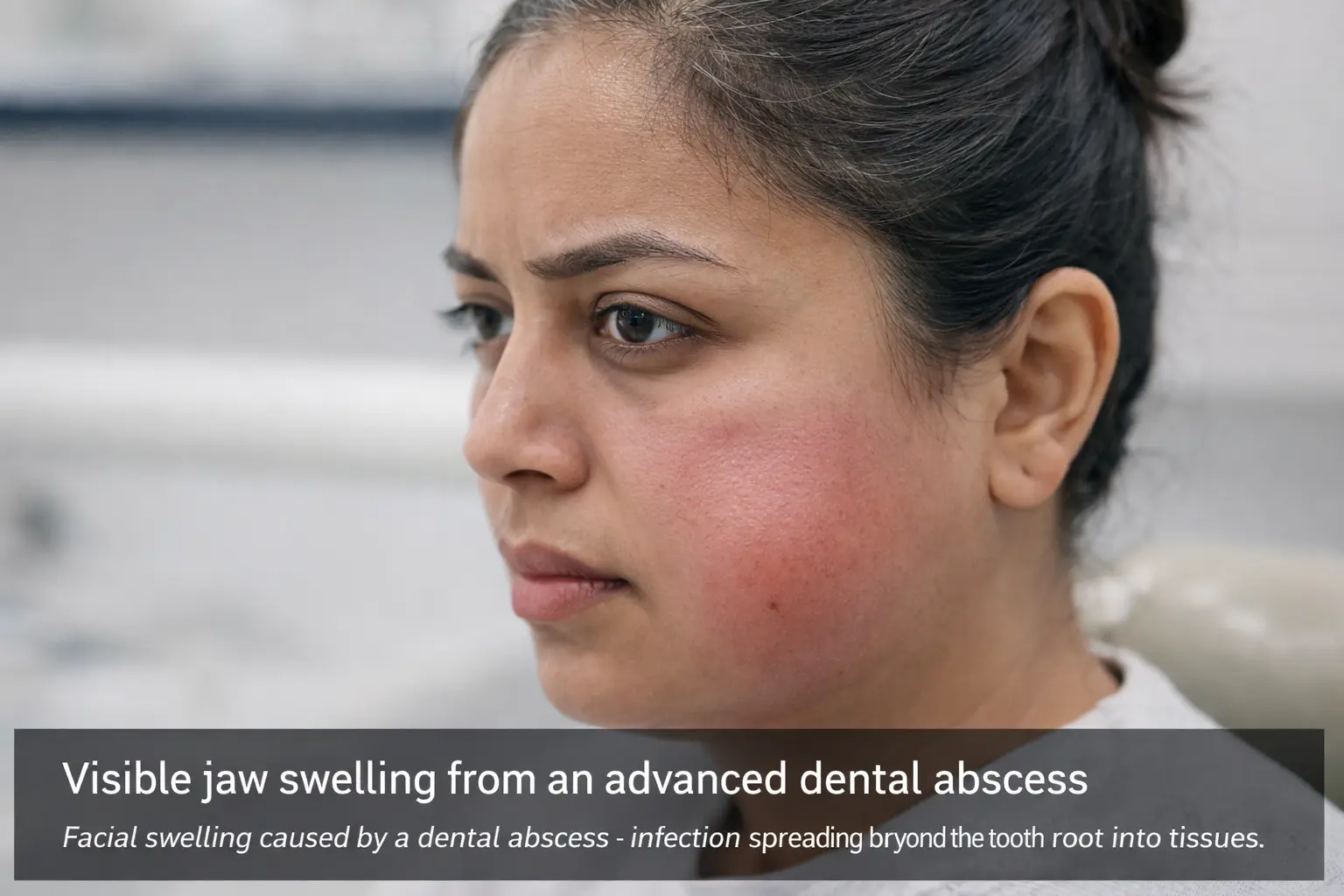
- Facial swelling — cheek, jaw, or neck looks visibly swollen. This means infection has entered the surrounding soft tissue.
- Difficulty swallowing or opening mouth — swelling pushes on muscles. If this happens, go to a hospital emergency room, not a dental clinic.
- Fever above 38.5°C — your body is fighting a systemic infection. Bacteria may now be in your bloodstream.
- Swollen lymph nodes — tender glands under the jaw or in the neck. A sign your immune system is on high alert.
- Pus draining in the mouth — a small pimple-like bump on the gum (called a fistula) that releases pus. Pain may briefly ease when it drains — but the infection is still active and spreading.
- Ear or jaw pain — infection near back teeth can radiate pain to the ear, jaw, or along the side of the face.
- Feeling generally unwell — unexplained fatigue, headache, or feverishness. These systemic signs mean the infection is no longer local to the tooth.
04. Can a Tooth Infection Spread to the Brain or Heart?
Yes. This is not alarmist — it is documented medical fact. A dental abscess is a bacterial infection. Bacteria travel through the bloodstream and lymphatic system to reach distant organs.
| Where It Can Spread | What Happens | Severity |
|---|---|---|
| Jaw and neck | Cellulitis, Ludwig’s angina | Emergency — can block airway |
| Sinus cavities | Sinusitis from upper molar roots | Moderate — antibiotics required |
| Brain | Brain abscess (rare but documented) | Life-threatening |
| Heart valves | Bacterial endocarditis | Life-threatening |
| Bloodstream | Sepsis | Medical emergency |
A 2019 study published in PLOS ONE found that dental infections account for approximately 10% of all head and neck space infections requiring hospitalisation in India. Every one of these cases was preventable with earlier dental treatment.
05. When to See a Dentist Immediately
You do not need to wait for unbearable pain. The best time to come in is the moment early signs appear.
See a dentist the same day if you have:
- Throbbing pain that has lasted more than 2 days
- Pain that wakes you up at night
- Visible swelling in your face, cheek, or gum
- Fever alongside tooth pain
- A foul taste or pus near a tooth
- Heat sensitivity that lingers more than 10 seconds
Go to a hospital emergency room if you have:
- Swelling extending to your neck or under the jaw
- Fever above 39°C
- Difficulty breathing or fully opening your mouth
At Center for Dental Implants & Esthetics, Gurgaon, we see urgent dental cases the same day. Both our Sector 51 and Sector 74 clinics are equipped for emergency assessment including CBCT imaging to map infection spread before any treatment decision is made. Many patients visiting us from DLF Phase 1, South City, and Palam Vihar have avoided hospitalisation simply by coming in early when the first symptoms appeared.
05b. Can a Tooth Infection Spread Without Pain?
Yes — and this is one of the most dangerous misunderstandings about dental infections. A tooth can be severely infected even when there is no pain at all.
Here is why. When the nerve inside a tooth dies completely — from deep decay or a previous injury — the pain signal switches off. But the bacteria do not stop. They continue spreading into the surrounding bone and tissue, quietly and without warning.
Patients from Sector 51, Golf Course Road, and Sohna Road Gurgaon often arrive at our clinic after months of no pain — only to discover on CBCT imaging that the infection has already destroyed significant bone around the root.
- A small recurring pimple on the gum that appears and disappears
- Persistent bad breath that does not improve with brushing
- A faint foul taste with no obvious cause
- The tooth feeling slightly loose over time
- A tooth that has gone from painful to completely numb
If a tooth that was once painful has suddenly stopped hurting — do not assume it healed. The nerve may have died. This needs assessment, not reassurance. See a dentist and ask for an X-ray.
06. Treatment Options for a Tooth Infection
The right treatment depends on how far the infection has spread and whether the tooth can still be saved.
| Treatment | When Used | What It Does |
|---|---|---|
| Root Canal Treatment | Infected pulp, tooth structure intact | Removes infected pulp, cleans and seals the canal. Tooth is saved. |
| Incision & Drainage | Abscess with significant swelling | Small cut releases pus and reduces pressure. Done alongside or before RCT. |
| Antibiotics | Spreading infection or fever present | Reduces bacterial load. Not a standalone cure — always combined with dental treatment. |
| Tooth Extraction | Tooth is unsalvageable | Removes the infection source. Replacement options discussed after healing. |
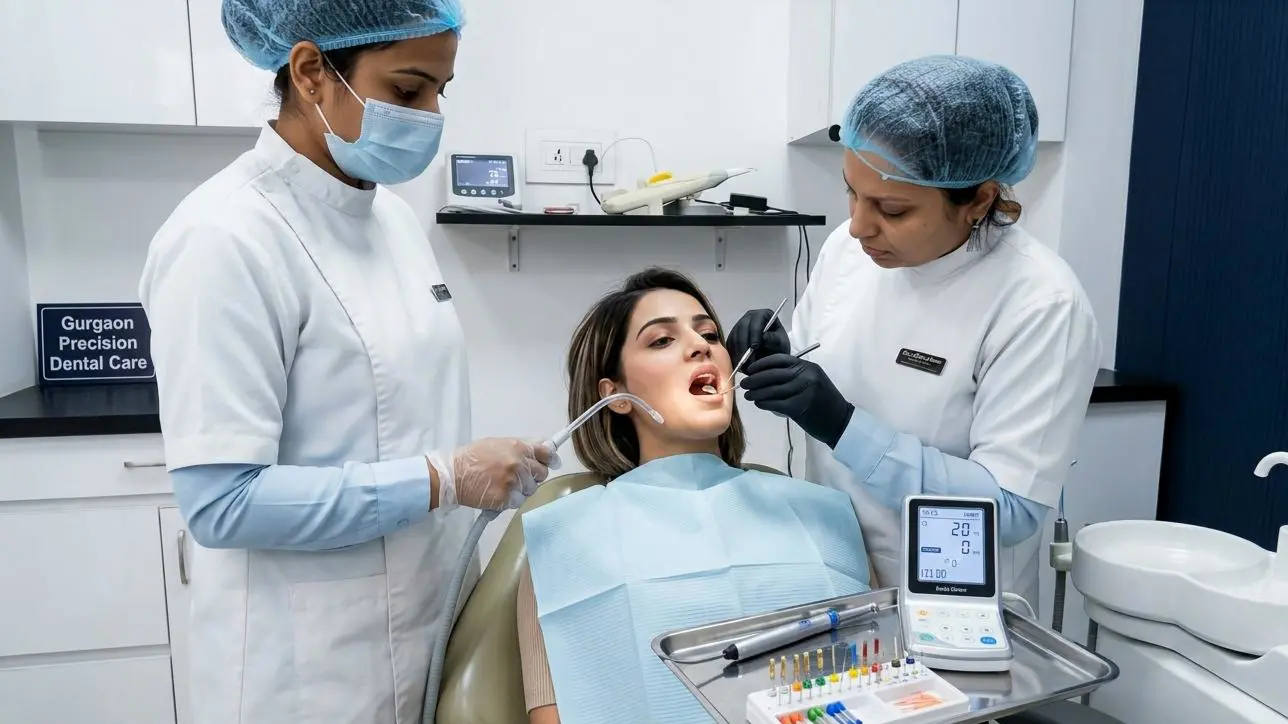
For a full walkthrough of what the procedure involves, read our page on root canal treatment in Gurgaon. If you want to understand what it typically costs before your appointment, see our detailed breakdown of root canal treatment cost in Gurgaon. We also cover what to realistically expect with pain after root canal treatment.
07. Root Canal vs Extraction — Which One?
This is the question patients ask most. Here is an honest, direct comparison.
| Root Canal Treatment | Extraction | |
|---|---|---|
| Goal | Save your natural tooth | Remove the tooth completely |
| Recovery | 2–5 days mild soreness | 3–7 days, longer for back teeth |
| Replacement needed? | No — tooth stays in place | Yes — implant, bridge, or denture |
| Long-term cost | Lower — no replacement cost | Higher if implant placed later |
| Success rate | 90–95% at 10 years (AAE, 2023) | 100% for infection removal |
| Best when | Tooth structure is intact | Tooth is cracked below gum or unsalvageable |
- Tooth already extracted? — read our guide on missing tooth replacement options in Gurgaon.
- Weighing all your options? — see our page on root canal treatment alternatives.
- Not sure if you need a root canal? — read How do I know if I need a root canal?
- Worried about early infection signs? — read Early signs of root canal infection.
Frequently Asked Questions
The most reliable signs are:
- Persistent throbbing pain — not just brief sensitivity
- Swelling in the gum, cheek, or face
- Pain when biting down
- Fever alongside tooth pain
- A foul taste or smell near the tooth
If you have two or more of these, see a dentist the same day. An X-ray or CBCT scan will confirm it within minutes.
No. A dental abscess does not resolve without treatment. Pain may reduce if the abscess drains on its own — but the bacteria remain and continue destroying bone and tissue. The infection returns, often worse. You need a dentist, not just time.
Tooth infection pain usually feels like a deep throbbing or pulsing ache — worse when lying down. Hot food intensifies it. Cold may briefly relieve it. Biting causes sharp pain. It is distinctly different from the quick, fleeting pain of sensitivity or a surface crack.
Yes. Upper molar roots sit close to the maxillary sinus — infections here cause sinus pressure and headache. Lower back tooth infections radiate to the ear, jaw, and neck. Many patients visit an ENT specialist before realising the problem is actually dental.
Yes — if you have any of these:
- Swelling extending to your neck or under the jaw
- Fever above 39°C
- Difficulty breathing or fully opening your mouth
For everything else — pain, mild swelling, pus near a tooth — visit a dentist urgently, same day if possible.
You can have a tooth infection for weeks or even months without knowing. When a nerve dies completely, pain disappears — but infection does not. This is called a chronic periapical abscess. It silently destroys bone until discovered on a routine X-ray. Painless does not mean safe. Annual dental check-ups catch these before they escalate.
No — not on their own. Antibiotics reduce swelling and bring down fever, but the infected pulp or pocket remains. Within days or weeks of stopping, the infection returns. Root canal treatment or extraction is always required. Antibiotics are a support tool, not a cure.
A cavity is damage to the tooth’s outer layers; a tooth infection is bacteria inside the pulp. A cavity is decay in the outer hard layers — enamel and dentine. A tooth infection is bacteria inside the pulp (the soft inner tissue with the nerve). An untreated deep cavity can become an infection, but they are not the same. Cavities are filled. Once the pulp is involved, you need root canal treatment.
Yes. When the nerve dies, pain disappears — but infection continues. Watch for:
- A small pimple on the gum (a fistula)
- Persistent bad breath or foul taste
- The tooth feeling slightly loose
These are signs of a chronic abscess with a dead nerve. Painless does not mean safe — it still needs treatment.
A tooth infection is diagnosed through clinical examination and imaging — usually an X-ray or CBCT scan. Diagnosis involves:
- Clinical exam — checking swelling, tenderness on biting, bite response
- Hot/cold sensitivity testing
- X-ray or CBCT scan — CBCT gives a full 3D view of infection extent, bone loss, and proximity to sinuses or nerves
At Center for Dental Implants & Esthetics, our mandatory CBCT protocol means no guesswork before any root treatment decision is made.
Do Not Wait. Tooth Infections Get Worse Fast.
Both our Gurgaon clinics offer same-day urgent dental assessment. Call or WhatsApp now.
Sector 51 Clinic
Center for Dental Implants & Esthetics
#166, Sector 51 (Ambedkar Chowk), Near Artemis Hospital, Gurgaon 122003
Sector 74 Clinic
Center for Dental Implants & Esthetics
R1-257, 2nd Floor, M3M Cornerwalk, Sector 74, Gurugram 122004
You May Also Find These Helpful
Signs You Need Root Canal Treatment
Not sure if your tooth pain needs a root canal? This guide walks through specific clinical warning signs — explained in plain language.
Read the guide →Painless Root Canal in Gurgaon
Modern root canal treatment is not what it used to be. Find out how we make it comfortable — step by step.
Learn what to expect →Root Canal Treatment Alternatives
Exploring other options? This page compares what is available when root canal is not the preferred path.
See alternatives →This page is for informational purposes only and does not replace professional dental consultation. Symptoms described may have multiple causes. Please visit a qualified dental professional for diagnosis and personalised treatment advice.

Dr. Jyoti Singh (MDS), Diplomate WCOI (Japan region) Member AAID (American Association of Implant Dentistry) stands as a beacon of excellence in implantology within Delhi NCR region. She is a BDS and MDS(Prostho) both from Maulana Azad Institute of Dental Sciences, where she secured top honors with all India rank 1 in PG entrance examination. Her extensive experience at esteemed institutions like Clove Dental and her own Center for Dental Implants & Esthetics since 2016, Dr. Singh embodies unparalleled expertise in dental implants. Boasting a wealth of 17+ years in dentistry and backed by 18 groundbreaking research papers in leading international journals (Google Scholar) and her ResearchGate profile, she epitomizes the pinnacle of proficiency and innovation in her field. She practices in Gurugram as your friendly dentist near me.