Why Dentures Become Loose Over Time
Your denture fit well when you first got it. Now it slips when you eat, clicks when you speak, and needs adhesive every single day. You are not imagining it. Something is genuinely changing inside your jaw — and this page explains exactly what, and what you can do about it.
Book a Denture Check-Up in GurgaonThe Root Cause
Why Dentures Become Loose and Start Slipping Over Time
When your natural teeth were in place, the roots were doing a very important job. Every time you bit down or chewed, the roots were sending a pressure signal deep into your jawbone. That signal told the bone: “Stay strong. You are needed here.”
The moment teeth are removed, that signal stops. Your body, being smart but not very sentimental, decides the bone is no longer needed and starts slowly dissolving it. This process is called alveolar bone resorption — in simple terms, the jawbone shrinks.
Research fact: Studies in prosthodontics show the jawbone can lose up to 25% of its width in the first year alone after tooth loss — and continues shrinking slowly over the years that follow. As the bone changes, your gums change shape with it. The denture, made to fit the original shape, no longer fits the new shape. Source
Here is the simple chain of events:
Why does my lower denture not stay in place? The lower denture almost always becomes loose sooner than the upper one. This is because the lower jawbone loses volume faster. The upper denture also has suction from the roof of the mouth helping it stay — the lower denture has no such help.
This is not a manufacturing defect. It is not your dentist’s fault. It is a normal biological change — but one that needs attention. Ignoring it makes things worse, not better.
Self Check
Signs Your Denture Has Become Loose
Many people live with a loose denture for months — even years — before visiting a dentist. They adjust their eating habits, avoid certain foods, and use more adhesive. But ignoring the problem speeds up bone loss further.
Do any of these sound familiar?
Slipping while eating
Denture shifts or lifts up when you bite into food, especially anything firm or chewy.
Clicking sounds while speaking
You hear or feel the denture tapping against your palate or jaw when you talk.
Sore spots and ulcers
A moving denture rubs the gums. Sore patches, redness, or small mouth ulcers develop.
Using adhesive every day
If you cannot function without adhesive, the underlying fit has already changed significantly.
Food getting under the denture
The seal between the denture and gums has broken. Food particles enter the gap constantly.
Avoiding social situations
You stop eating out or speaking confidently because the denture might slip and embarrass you.
Common belief
“My denture was always a bit loose. It is just how it is. I will manage.”
The reality
A loose denture is not something to manage — it is a sign the jaw has changed and the denture needs attention. Leaving it loose speeds up bone loss even more.
About Adhesives
Why Denture Adhesive Stops Working
Denture adhesive is like using tape to fix a crack in a wall. It may hold things together for a little while, but it is not actually fixing the problem underneath.
Adhesive works well when the looseness is very mild — for example, during the first few weeks of wearing a new denture while your gums are still adapting. But once the jawbone has genuinely shrunk, no amount of adhesive can give you a proper fit back.
What adhesive cannot fix:
- Bone shrinkage inside the jaw — adhesive sits on the gum surface, not the bone
- Large gaps that have developed between the denture and the gum ridge
- Worn-down denture teeth that have changed your bite
- A cracked or deformed denture base
- Infection or sores that have developed under the denture
Did you know? Some zinc-containing denture adhesives — if used in large quantities over long periods — have been associated with zinc toxicity in a small number of patients, causing nerve problems. Using adhesive as a permanent substitute for a proper-fitting denture is not safe long term. Read more
If you are already using adhesive to manage loose dentures, that is a sign it is time for a proper dental assessment — not more adhesive. Read our detailed guide on why denture adhesive stops working to understand what is really happening.
Temporary Fix
Denture Relining: What Is It and When Does It Help?
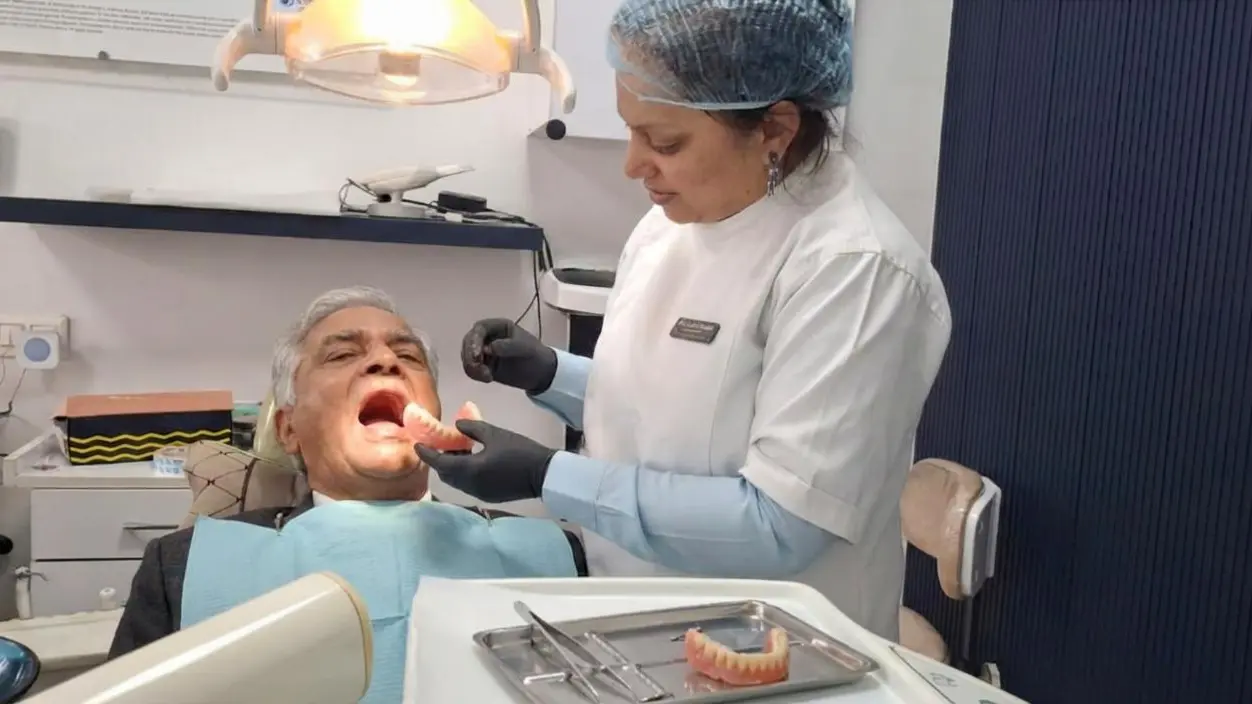
Think of relining as adding a new insole to an old shoe. The shoe itself is fine, but the shape of your foot has changed and there is now too much space inside. A new insole fills that gap and makes it fit snugly again.
In a dental reline, your dentist adds a fresh layer of material to the inner surface of your denture — the part that sits against your gums. This new layer matches the current shape of your gum ridge, giving the denture a snug fit again.
Two types of reline
| Type | Best For | How Long It Lasts |
|---|---|---|
| Soft reline | Sensitive gums, mild bone shrinkage, new denture wearers | 1–2 years |
| Hard reline | Stable gums, moderate bone change, good overall denture condition | Up to 5 years |
Relining is a good option when:
- The denture teeth are still in reasonable condition — not worn flat
- The base of the denture is not cracked or broken
- Your bite still feels comfortable overall
- Bone shrinkage is moderate, not severe
- The denture is less than 5–6 years old
Relining is a temporary solution. Because bone continues to shrink, most patients need a reline every 1 to 2 years to maintain a reasonable fit. It can delay the need for a new denture, but it cannot stop bone loss.
What does denture relining cost in Gurgaon?
A professional denture reline in Gurgaon typically costs between ₹3,000 and ₹8,000 depending on the type (soft or hard) and whether one or both arches are relined. This is significantly less than a new denture — which is why relining is worth considering when the denture itself is still in good condition. For an accurate quote for your specific denture, a brief examination is needed first.
You can read more about your options in our detailed guide on dentures in Gurgaon. If you are unsure whether relining is enough or a new denture is needed, our page on denture relining vs new dentures walks through the decision clearly.
Knowing When
When Is It Time for a New Denture?
Even the best-made denture does not last forever. Most conventional dentures need to be replaced every 5 to 8 years. Some people push them further, but that often means years of poor fit, sore gums, and faster bone loss.
A new denture is needed when:
- The denture teeth are worn flat — you can see the flat surfaces where the original tooth shape has disappeared
- The denture base is cracked or has been repaired multiple times
- Relining no longer restores a comfortable fit
- Your bite feels off — your jaw is closing in a different position than it should
- You have had the same denture for more than 7 years
- There has been significant additional bone or weight loss since the denture was made
A word of caution: People sometimes keep an old, poorly fitting denture to save money on a new one. This is actually more costly in the long run. A loose denture accelerates bone shrinkage. More bone shrinkage means a more difficult (and expensive) path to implants later, should you ever want that option.
At Center for Dental Implants & Esthetics, we do all denture teeth setting in-house. This means better control over colour, shape, and bite — and a more natural look for you. For a full breakdown of what different types of dentures cost, see our denture cost guide for Gurgaon.
The Permanent Solution
Implant Supported Dentures: Stop the Slipping for Good
If you are tired of adhesive, sore gums, and the anxiety of your denture slipping at a meal — implant supported dentures are worth understanding.
Small titanium posts (dental implants) are placed inside the jawbone. Your denture then clips or locks onto these posts. The result is a denture that does not slip, does not float, and does not embarrass you. You still remove it at night for cleaning — but during the day, it stays exactly where it should be.

Why implants work where regular dentures fail:
- Implants press into the bone when you chew — just like natural tooth roots did
- This stimulation signals the bone to stay strong, slowing down bone shrinkage significantly
- The denture is anchored — it cannot drift, click, or lift
- You can eat a wider variety of foods with more confidence
- No more daily adhesive routine
Three main implant options for denture wearers:
Implant Overdenture (Lower Jaw)
- Just 2 implants needed in lower jaw
- Denture snaps onto implants
- Most affordable implant option
- Removable for easy cleaning
- Transforms lower denture stability
All-on-4 Implants
- 4 implants support a full arch
- Fixed — cannot be removed by patient
- Closest to natural teeth in function
- Often no bone graft needed
- Long-term solution
All-on-6 Implants
- 6 implants for added stability
- Better distribution of chewing force
- Recommended for upper arch or denser bone
- Fixed full-arch restoration
- Maximum stability and confidence
Not everyone is immediately ready for implants — bone quantity, general health, and cost all play a role. But a consultation can tell you quickly where you stand. Read our full guide on dental implants vs dentures to understand the comparison in detail.
If you have already been told you have bone loss, read our page on getting implants with bone loss — options exist even then.
Know Your Risk
Why Dentures Become Loose Faster in Some People
Two people can get dentures on the same day. Five years later, one has a reasonably fitting denture and the other has a completely loose one. Why the difference? Several factors affect how quickly bone shrinks.
| Risk Factor | Why It Speeds Up Bone Loss |
|---|---|
| Severe bone loss at time of extraction | Less bone to begin with — deteriorates faster |
| Long period without teeth before getting a denture | Bone shrinkage accelerates when there is no denture applying any pressure |
| Osteoporosis | Whole-body bone loss affects jawbone too — common in older women |
| Poorly fitting denture from the start | Uneven pressure on gums leads to faster and uneven bone loss |
| Wearing dentures overnight | Gums need rest; continuous pressure can worsen the ridge |
| Diabetes | Affects healing and gum tissue health, increases infection risk |
| Smoking | Reduces blood supply to gum tissue, slows healing, worsens bone quality |
In my clinical experience, patients who already had significant bone loss before getting their denture — often because teeth were extracted due to advanced gum disease — tend to need relining or implant stabilisation much sooner than others. This is why it is so important to have a thorough bone assessment done when the denture is first made.
Experience You Can Trust
Written by a Specialist Who Has Treated Thousands of Denture Patients
Dr. Jyoti Singh
MDS Prosthodontist · 17+ Years Clinical Experience
- Trained at MAIDS, New Delhi
- 10,000+ Implants Placed
- Nobel Biocare Trained
- Diplomate WCOI (Japan Region)
- Strict CBCT Protocol
- US FDA-Approved Implant Systems
“During my training at Maulana Azad Institute of Dental Sciences, I worked with a very large number of denture patients. Many of them came to us frustrated — their dentures had become loose, their gums were sore, and they had been managing with adhesive for years. In most cases, the problem was a combination of bone shrinkage that had not been addressed early enough, and dentures that had not been reviewed regularly.
What I tell my patients today is simple: a loose denture is not the end of the road. There is almost always something we can do — relining, a new denture, or implants for those who want a permanent solution. Come and see us before things get too difficult.”
Learn more about Dr. Jyoti Singh’s background and approach →
Serving Gurgaon & Delhi NCR
Treatment for Loose Dentures in Gurgaon
Center for Dental Implants & Esthetics is one of the most established dental clinics in Gurgaon, with a dedicated focus on implants and complex dental rehabilitation — including denture patients who need relining, new dentures, or implant stabilisation.
We have two clinics across Gurugram — one near Artemis Hospital in Sector 51 and one at M3M Cornerwalk in Sector 74 — making it easy to reach us from any part of the city or surrounding NCR areas.
Sector 51 Clinic
#166, Sector 51 (Ambedkar Chowk),
Close to Artemis Hospital, Gurgaon 122003
Sector 74 Clinic
R1-257, 2nd Floor, M3M Cornerwalk,
Sector 74, Gurugram 122004
Is Your Denture Loose? Here Is What a Dental Examination Can Tell You
Not every loose denture needs the same solution. A proper examination at our clinic will assess exactly what is happening in your jaw and give you honest answers about what will actually help.
After your appointment, you will know:
- Whether a professional reline can restore a comfortable fit
- Whether your denture has passed its useful life and a new one is needed
- How much bone you still have and whether implants are possible for you
- The most cost-effective path forward for your specific situation
- What happens if you leave things as they are
There is no obligation. There is no pressure. We will simply tell you what we see and what your options are.
Talk to Us About Your Loose Denture
Same-day appointments often available. Both our Gurgaon clinics welcome walk-ins.
Center for Dental Implants & Esthetics
#166, Sector 51 (Ambedkar Chowk),Close to Artemis Hospital,
Gurgaon, Haryana 122003
Center for Dental Implants & Esthetics
R1-257, 2nd Floor, M3M Cornerwalk,Sector 74, Gurugram,
Haryana 122004
Frequently Asked Questions
Loose Denture Questions — Answered Honestly
Why do dentures become loose after years of wearing them?
Dentures become loose because the jawbone underneath slowly shrinks over time. This is called bone resorption. When natural teeth are removed, the bone that supported their roots no longer receives chewing stimulation. Without that stimulation, the bone dissolves gradually — and the gum ridge it supports changes shape. Since your denture was made to fit the original jaw shape, it no longer fits the new shape.
- Bone loss is fastest in the first year after tooth extraction
- Research shows up to 25% of jaw width can be lost in the first year alone
- The lower jaw loses bone faster than the upper jaw
- This process continues slowly for the rest of your life
Can a loose denture be tightened or adjusted?
Yes — in many cases, a dentist can improve the fit of a loose denture through a procedure called relining. This adds new material to the inner surface of the denture so it matches the current shape of your gums. However, relining is not a permanent cure. The best option depends on how much the denture has loosened:
- Mild looseness: A soft or hard reline can restore a good fit
- Moderate looseness after several years: A reline helps temporarily, but a new denture may be needed soon
- Severe looseness with major bone loss: Implant stabilisation is the most reliable long-term solution
- A dentist must examine the denture and jaw before advising which approach will work
How long do dentures last before they become loose?
Most conventional dentures last 5 to 8 years before needing replacement. However, looseness can begin earlier — sometimes within 1 to 2 years — especially if there was significant bone loss at the time of extraction. Important points to know:
- Dentures should be reviewed by a dentist every 1–2 years even if they feel comfortable
- A reline every 1–2 years can extend the useful life of a well-made denture
- Teeth worn flat, a cracked base, or a changed bite are signs replacement is overdue
- Implant-supported dentures do not become loose in the same way — implants anchor them into bone
Can denture adhesive fix a loose denture permanently?
No. Denture adhesive is a temporary comfort measure, not a treatment for loose dentures. It cannot fix bone shrinkage, change the shape of your jaw, or rebuild the gap that has formed between your denture and gums. Using adhesive daily is a sign that the fit has already changed significantly and professional attention is needed.
- Adhesive works best when looseness is very mild and temporary
- Long-term heavy use of some zinc-containing adhesives carries health risks
- Adhesive does not stop bone from continuing to shrink
- A proper reline or new denture will serve you far better than adhesive long-term
Do dental implants stop dentures from slipping?
Yes — implant-supported dentures are the most reliable solution to a loose denture. Small titanium implants placed in the jawbone give the denture a firm anchor. The denture clips or locks onto the implants and cannot slip, float, or lift during eating or speaking. Additional benefits include:
- Implants stimulate the jawbone, slowing or stopping further bone loss
- No denture adhesive needed
- You can eat a wider variety of foods with more confidence
- Just 2 implants in the lower jaw can transform a loose lower denture
- Implants can last a lifetime with proper care — they are a long-term investment
What happens if I don’t fix my loose denture?
Leaving a loose denture unaddressed causes real and progressive damage. Many patients live with it for years not realising how much is changing inside the jaw. Here is what happens over time:
- The jawbone shrinks faster — a loose denture applies uneven pressure that worsens bone loss
- Sore spots, ulcers, and gum infections develop from constant friction
- Facial appearance changes — the chin moves upward and cheeks appear sunken as bone reduces
- Chewing becomes less efficient — this can affect digestion and nutrition over time
- Future implant options become limited or more complex if bone loss becomes severe
The sooner a loose denture is assessed, the more options remain open — and the simpler and less expensive the solution is likely to be.
How do I stop my denture from moving when I eat?
The right answer depends on why the denture is moving. A dentist needs to examine the fit first. In general:
- Short-term: Denture adhesive can reduce movement temporarily while you arrange a dental appointment
- Mild looseness: A professional reline (adding new material to the inner surface) restores a snug fit
- Denture older than 5–7 years: A new denture made to the current jaw shape is usually the better investment
- Persistent movement despite relining: Implant stabilisation — even just 2 implants in the lower jaw — anchors the denture so it cannot move
- Avoid DIY reline kits — they can damage the denture surface and make professional relining harder
Is it safe to use denture adhesive every day?
Using a small amount of adhesive occasionally is generally considered safe. However, using it every day in large quantities over a long period is not recommended — and signals that the denture fit needs professional attention, not more adhesive.
- Some adhesives contain zinc — long-term excessive use has been linked to zinc toxicity in rare cases, causing nerve symptoms
- Daily adhesive use means your denture is loose — the underlying bone loss continues regardless
- Adhesive residue can harbour bacteria under the denture if not cleaned thoroughly each day
- If you cannot function without adhesive, book a dental assessment — relining or a new denture is a far better solution
Is it dangerous to wear a loose denture?
Yes, wearing a loose denture long-term causes real harm. Many people manage with a loose denture for years without realising how much damage is happening. Here is what a loose denture does over time:
- Accelerates jawbone shrinkage — the moving denture applies uneven pressure that worsens bone loss
- Creates sore spots and mouth ulcers from constant friction
- Can lead to oral infections if the gums are continuously irritated
- Changes your facial appearance over time — the chin rises and cheeks sink as bone reduces
- Reduces what treatment options are available for implants later, if bone loss becomes severe
The sooner a loose denture is addressed, the more options remain available.
How do I know if I need a reline or a completely new denture?
A dentist needs to examine both your denture and your jaw to answer this accurately. As a general guide:
- A reline is likely enough if: denture teeth are still in good shape, denture is less than 5 years old, and bone loss is moderate
- A new denture is likely needed if: teeth are worn flat, denture base is cracked or repeatedly repaired, bite has changed significantly, or denture is older than 7–8 years
- If relining no longer holds a good fit, the jaw shape has changed too much — a new denture is the better investment
Visit our dentures page in Gurgaon for full information on our denture services.
Does bone loss mean I cannot get dental implants?
Not necessarily. Bone loss reduces the bone available for implants, but options still exist in many cases. Modern techniques can work around bone loss:
- Bone grafting can rebuild lost bone so implants can be placed
- Zygomatic implants are placed in the cheekbone when the upper jaw has severe bone loss
- All-on-4 uses angled implants to make use of remaining bone — often without bone grafting
- A CBCT scan (3D X-ray) can precisely measure how much bone remains
- Early assessment is always better — the more bone you preserve now, the simpler treatment is later
Read more on our page about getting implants with bone loss.
Further Reading
Pages That May Help You Next
How to Fix Loose Dentures
A practical guide covering every option — from same-day adhesive relief to relining, new dentures, and implant stabilisation. Helps you understand what is right for your situation.
See All Fix Options →Denture Relining vs New Dentures — Which Do You Need?
Not sure whether a reline will be enough or a new denture is overdue? This page walks through the key differences, costs, and what your dentist will look for during assessment.
Read the Comparison →Why Denture Adhesive Stops Working
If your adhesive is no longer holding your denture in place, this page explains exactly why — and what it tells you about the state of your denture fit and jawbone.
Read the Guide →Denture Cost in Gurgaon
An honest overview of what different types of dentures cost in Gurgaon — conventional, BPS, and implant-supported — and what factors affect the final price at our clinics.
View Cost Overview →Disclaimer: This page is for informational purposes only and does not replace professional dental consultation. Symptoms described may have multiple causes. Please visit a qualified dental professional for diagnosis and personalised treatment advice.