What Happens If You Do Not Replace a Missing Tooth?
Many people think a missing tooth is only a cosmetic issue. In reality, it quietly triggers bone loss, teeth shifting, and bite problems — serious consequences of a missing tooth that dentists see every day.
Many people do not realise the serious consequences of a missing tooth until the damage has already started. A missing tooth looks like a small gap. But inside your jaw, things start changing from the very first week after extraction. The neighbouring teeth tilt. The jaw bone shrinks. The bite shifts. By the time most patients come to me, the problem has already grown bigger than one missing tooth.
At our dental implant clinic in Gurgaon, we commonly see patients who waited several years before replacing a missing tooth. In almost every case, treatment has become more complex and more expensive than it needed to be.
I understand why people wait. It does not hurt. They think — “it is just a back tooth, nobody can see it.” But after placing 10,000+ implants over 17 years, I have seen what that delay actually costs.
What happens if you do not replace a missing tooth?
- Neighbouring teeth start shifting into the gap
- Jaw bone begins shrinking due to lack of stimulation
- Chewing becomes inefficient and uneven
- Gum disease risk increases around tilted teeth
- The bite becomes unbalanced, straining the jaw joint
- Face shape can change as bone volume reduces over time
Over time these changes affect the health of the entire mouth — not just the area of the missing tooth.
Here are the 7 most common problems I see when a missing tooth is left untreated. These are real clinical observations backed by published dental research.
Even a single missing tooth starts affecting jaw bone density within the first few months of extraction. The longer you wait, the more bone you lose — and this directly affects what treatment options remain available to you later.
Missing tooth consequences
These are not rare worst-case scenarios. These are everyday findings in our clinic — in patients who came after waiting too long.
Your Neighbouring Teeth Start to Shift
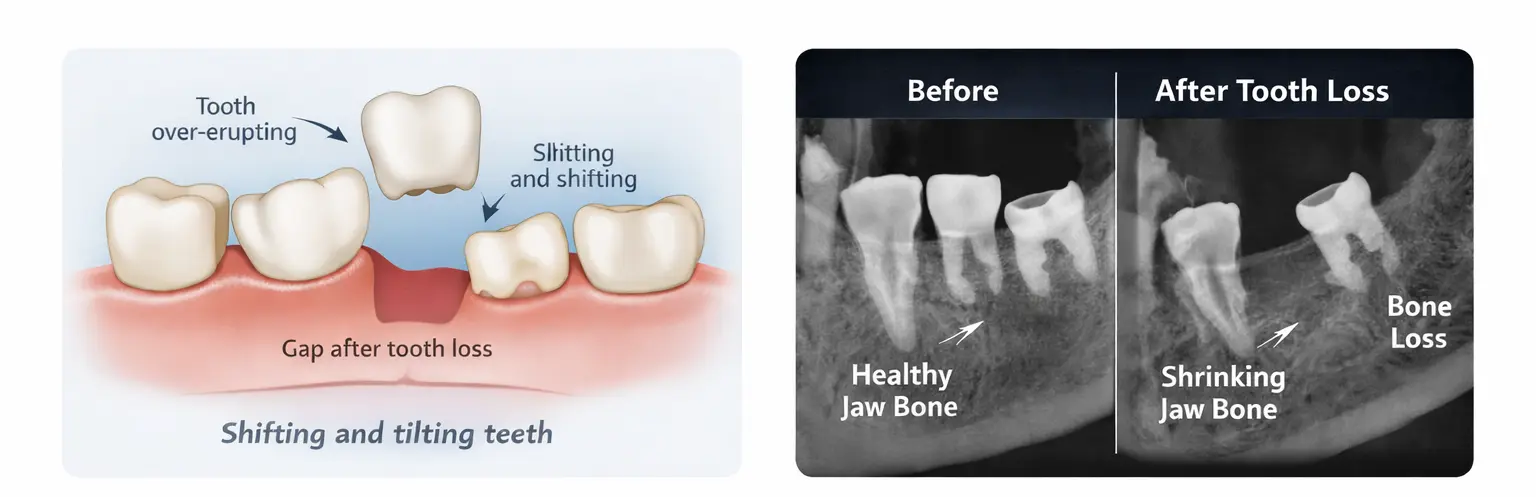
Every tooth in your mouth holds its position because of the teeth next to it. When one tooth is missing, that support is gone. The teeth on either side of the gap slowly tilt and drift inward. The tooth directly above or below the gap also moves — it over-erupts, meaning it grows out further than it should.
This movement is slow. You may not notice it for months. But once teeth shift, they create:
- Crooked gaps that are hard to clean
- Food trapping between tilted teeth
- Bite imbalance — one side takes more pressure
- A more complex and expensive treatment if you decide to get an implant later
Patients who delay a single implant by 2–3 years often need orthodontic treatment first to re-create space before the implant can be placed. What was a straightforward procedure becomes a multi-step case.
Your Jaw Bone Starts to Shrink
This is the most serious consequence — and the least visible. Your jaw bone stays healthy because of the stimulation it receives through chewing. When a tooth root is present, every time you bite, a small force travels down the root into the bone. That signal keeps the bone alive and dense.
When a tooth is removed, that signal stops. The bone in that area no longer receives stimulation. So the body begins to resorb it — break it down and withdraw it.
By the third year, bone loss can reach 40–60% in width and 30–40% in height in some patients (Atwood DA, 1971; Journal of Periodontology). This matters because:
- Less bone means implant placement becomes difficult or impossible without a bone graft
- Bone graft adds cost, time, and recovery
- Some patients lose so much bone that even grafting has limitations
Bone loss only happens if you remove many teeth.
Even a single missing tooth causes bone loss directly beneath that gap, starting within weeks of extraction.
Read more about how implants help stop jaw bone loss — one of the most important but rarely discussed benefits of implant treatment.
Your Bite Changes — and Your Jaw Starts to Strain
Your bite is a finely balanced system. Every tooth plays a role. When one is missing, the remaining teeth have to take on extra load during chewing.
Over time this uneven pressure causes:
- Excessive wear on certain teeth — they grind down faster
- Sensitivity in teeth that are overworked
- Jaw muscle fatigue and tension headaches
- In some patients, pain or clicking in the jaw joint — a condition called TMJ disorder (temporomandibular joint disorder, meaning the joint that connects your jaw to your skull becomes strained)
A study published in the Journal of Oral Rehabilitation (2014) found that patients with missing posterior teeth showed significantly higher TMJ dysfunction rates compared to those with complete dentition.
Your Risk of Gum Infection Goes Up
When neighbouring teeth tilt into the gap, they create new pockets and angles that are very difficult to clean with a normal toothbrush. Food gets trapped. Bacteria accumulate. And gum infection follows.
This matters more than most patients realise. Gum disease — called periodontitis — is the leading cause of tooth loss in adults in India. If one missing tooth causes neighbouring teeth to shift and become harder to clean, you may be setting the stage for losing more teeth.
- Deep pockets form around tilted teeth
- Persistent bad breath becomes a problem
- Gum bleeding increases
- Bone loss around neighbouring teeth accelerates
Gum disease is not just a mouth problem. Research from the Indian Journal of Dental Research has linked severe periodontitis with higher risk of diabetes complications, heart disease, and premature delivery in pregnant women.
Chewing Becomes Harder Than You Think
Your back teeth do most of the work during chewing. A single missing molar reduces your chewing efficiency significantly. Patients tell me they start naturally chewing more on the opposite side — without even realising it.
Over time this creates its own set of problems:
- The overworked side wears down faster
- You start avoiding certain foods — raw vegetables, nuts, fruits, some meats
- Nutrition quietly suffers — especially in older patients
A 2019 study published in Nutrients found that adults with tooth loss consumed significantly less fibre, vitamins, and minerals compared to those with complete dentition. This is not a small issue — it has real long-term health consequences.
Your Face Shape Can Change
The lower third of your face is supported by your teeth and the jaw bone beneath them. When bone is lost — especially after multiple missing teeth — the support for the cheeks and lips reduces.
You may start to notice:
- Sunken cheeks or a slightly collapsed lower face
- Deeper lines from the corners of the nose to the corners of the mouth
- An appearance of ageing faster than you should
This is more visible with multiple missing teeth. But even with a single missing tooth in the front or premolar region, the surrounding area can look subtly different over the years as bone shrinks.
A missing back tooth does not affect appearance — nobody can see it.
Even a missing back tooth causes bone shrinkage that can subtly affect the shape of the lower face over years.
Replacing It Later Becomes More Complex
This is what I tell every patient who says they will “come back later.” The longer you wait, the harder the treatment gets. Here is exactly what happens:
Ideal window for implant planning
Bone is intact. Neighbours have not shifted. Implant placement is straightforward. Most patients can complete treatment in 3–5 months.
Bone loss has begun
Some bone width is already reduced. Neighbouring teeth may have started tilting. A bone graft may be needed before implant placement.
Significant drift and bone loss
Space for the implant is reduced. Orthodontic treatment may be required to create space. Bone grafting is almost always needed. Treatment timeline stretches to 12–18 months.
Complex full-mouth situation
Multiple teeth may have been affected. Full-mouth rehabilitation may now be required. Full mouth dental implants may be the only lasting solution for patients who have lost several teeth over time.
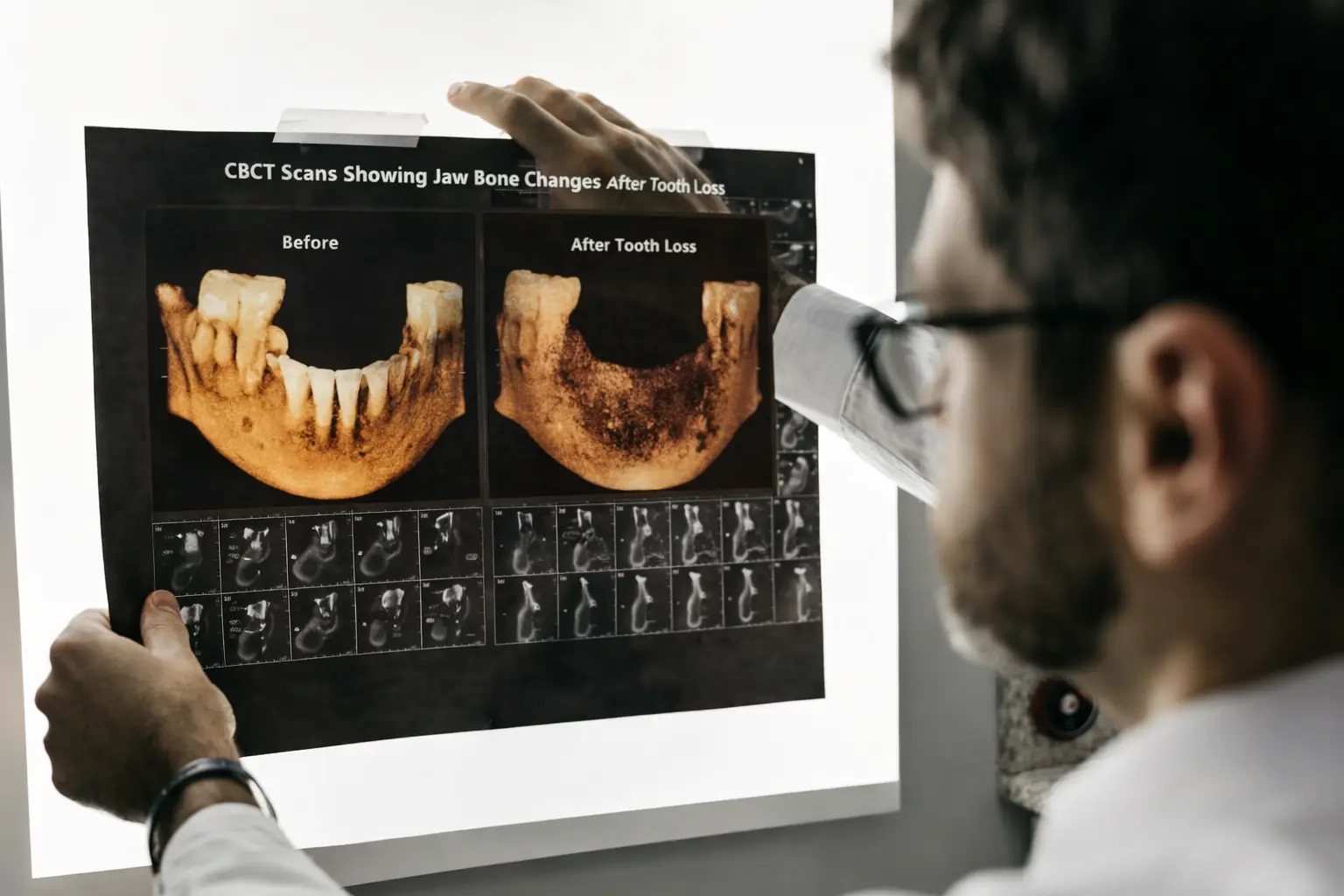
Not sure if bone loss has already started? A 3D CBCT scan shows the exact condition of your jaw bone in minutes. At Center for Dental Implants & Esthetics in Gurgaon, we use CBCT imaging for every implant case — so your treatment plan is based on facts, not guesswork.
Call to book a scan →“In my clinical experience, the patients who have the most difficult implant cases are not those with complex medical histories — they are the ones who waited 3, 4, 5 years before deciding to act. By then, what should have been a routine single implant becomes a multi-stage, multi-visit case. I am not saying this to scare anyone. I am saying it because the earlier you come, the simpler and less expensive your treatment will be.”Dr. Jyoti Singh — MDS (Prosthodontist), Diplomate WCOI (Japan Region), Nobel Biocare Trained • Center for Dental Implants & Esthetics, Gurgaon
How Can a Missing Tooth Be Replaced?
There are three main ways to replace a missing tooth. Each has its place. The right choice depends on your bone health, age, budget, and how many teeth are missing.

| Option | How It Works | Bone Preserved? | Feels Natural? | Long-Term Reliability |
|---|---|---|---|---|
| Dental Implant | A titanium screw placed in the jaw bone acts as an artificial root. A crown is placed on top. | Yes — stimulates bone | Yes — closest to natural tooth | 20–25+ years with proper care |
| Dental Bridge | Two neighbouring teeth are used as anchors. A false tooth bridges the gap between them. | No — bone still shrinks | Mostly yes | 10–15 years typically |
| Removable Denture | A removable plastic or metal frame holding artificial teeth. Worn during the day, removed at night. | No — accelerates bone loss | Less natural feel | 5–7 years, needs relining |
For most patients in good general health, dental implants in Gurgaon are the only option that addresses both the missing tooth and the underlying bone loss problem. A bridge and denture replace the crown — but nothing beneath the gum. Only an implant replaces the root.
If you have lost several teeth or are worried about the financial side, you can read about dental implant cost in Gurgaon to understand what realistic treatment actually involves in our clinic.
For patients who have lost many teeth, full mouth dental implants using systems like All-on-4 or All-on-6 can restore complete function in a single planned treatment.
For a full breakdown of your choices, read our guide on options for replacing a missing tooth in Gurgaon. And if you are wondering whether delay has already affected you, our guide on getting implants even with bone loss explains what is still possible.
Also useful: our earlier article on 10 reasons dentists recommend replacing missing teeth — a detailed look at why this decision matters beyond what this article covers.
Patient Questions Answered
Real questions I hear in my clinic every week.
If a missing tooth is never replaced, the jaw bone beneath it slowly shrinks due to lack of stimulation. Neighbouring teeth tilt and drift into the gap. The opposing tooth over-erupts. Over time, gum disease becomes more likely, chewing efficiency drops, and the facial structure above the gap can change. What starts as one missing tooth can eventually affect the health of the entire mouth.
Bone loss begins within weeks of extraction. Significant jaw bone reduction — around 20–30% of width — can occur in the first year. Teeth start shifting noticeably within 6–12 months. The longer you wait, the more complex and expensive treatment becomes. Most dentists recommend planning replacement within 3–6 months of tooth loss, once healing is complete.
Yes. Teeth rely on neighbouring and opposing teeth to maintain their position. When one tooth is removed, the teeth on either side tilt toward the gap and the tooth above or below over-erupts — meaning it moves further out of the gum. This shift is gradual but measurable and creates bite imbalance and cleaning problems.
Studies show that in the first year alone, the jaw bone at the extraction site can lose 20–30% of its width and about 4mm of height on average (Tallgren A, 1972; Atwood DA, 1971). Over three years, total bone loss can reach 40–60% in width. This is why early replacement — ideally with a dental implant, which stimulates the bone — is important. A bridge or denture does not stop this bone loss.
Yes, indirectly. When neighbouring teeth tilt into a gap, they create new angles and pockets that are difficult to clean. Bacteria accumulate in these spaces and cause gum infection — called periodontitis. If untreated, this infection can spread along the bone and cause further tooth loss. A single missing tooth can therefore trigger a chain of problems in the rest of the mouth.
For most patients, yes. A dental implant is the only replacement that addresses both the missing crown and the root beneath it. It stimulates jaw bone, which prevents bone loss. It does not require grinding down neighbouring healthy teeth (unlike a bridge). And with proper care, implants can last 20–25 years or longer. A bridge or denture replaces the visible tooth but does nothing for the bone beneath.
With a single missing tooth, facial changes are subtle but can occur over years as the jaw bone shrinks in that area. With multiple missing teeth, the lower face loses support and the cheeks can appear sunken. The nasolabial folds — lines from the nose to the corners of the mouth — deepen. Patients often say they look older. This is one of the less obvious but very real consequences of untreated tooth loss.
Often yes, but it may require additional procedures. If significant bone loss has occurred, a bone graft is usually needed before an implant can be placed. This adds 3–6 months to the treatment timeline and additional cost. In cases of extreme bone loss, special implant techniques may be required. This is why earlier treatment is almost always simpler and less expensive. Our clinic uses CBCT 3D imaging to assess your remaining bone and plan the most suitable approach for your specific situation.
Yes, it absolutely should be replaced. Back teeth — premolars and molars — do the majority of chewing work. Losing one shifts load onto other teeth, causes them to wear faster, and can strain the jaw joint. Bone loss still occurs beneath a hidden missing tooth. The fact that others cannot see it does not mean the damage is not happening. Back tooth implants are one of the most common and impactful procedures in our clinic.
The cost of a single dental implant in Gurgaon varies depending on the implant brand, the condition of your bone, and whether additional procedures like bone grafting are needed. At Center for Dental Implants & Esthetics, we use US FDA-approved implant systems including Nobel Biocare, Straumann, and Zimmer Biomet. For a complete and transparent cost breakdown, visit our page on dental implant cost in Gurgaon. We believe in honest, transparent pricing — no hidden charges.
Still Waiting? Book a Consultation Today.
The earlier you come, the simpler and more affordable your treatment will be. Our team will assess your bone, explain your options, and give you an honest plan — no pressure.
Center for Dental Implants & Esthetics
#166, Sector 51, (Ambedkar Chowk)Close to Artemis Hospital
Gurgaon, Haryana 122003
Center for Dental Implants & Esthetics
R1 – 257, 2nd Floor, M3M CornerwalkSector 74, Gurugram
Haryana 122004
Missing Tooth Replacement Options in Gurgaon
A complete guide to every option available — implants, bridges, and dentures — explained clearly so you can make an informed choice with your dentist.
Missing Tooth replacement options →Dental Implants in Gurgaon — Everything You Need to Know
How implants work, who is a good candidate, what the procedure involves, success rates, and why Center for Dental Implants & Esthetics is a trusted choice in Delhi NCR.
Dental implants in Gurugram →Dental Implant Cost in Gurgaon — Transparent Pricing
What does a dental implant actually cost in Gurgaon? A clear, honest breakdown of all factors — implant brand, bone condition, crown type — with no hidden numbers.
Dental Implants cost breakdown →This page is for informational purposes only and does not replace professional dental consultation. Symptoms described may have multiple causes. Please visit a qualified dental professional for diagnosis and personalised treatment advice.

Dr. Jyoti Singh (MDS), Diplomate WCOI (Japan region) Member AAID (American Association of Implant Dentistry) stands as a beacon of excellence in implantology within Delhi NCR region. She is a BDS and MDS(Prostho) both from Maulana Azad Institute of Dental Sciences, where she secured top honors with all India rank 1 in PG entrance examination. Her extensive experience at esteemed institutions like Clove Dental and her own Center for Dental Implants & Esthetics since 2016, Dr. Singh embodies unparalleled expertise in dental implants. Boasting a wealth of 17+ years in dentistry and backed by 18 groundbreaking research papers in leading international journals (Google Scholar) and her ResearchGate profile, she epitomizes the pinnacle of proficiency and innovation in her field. She practices in Gurugram as your friendly dentist near me.