Why You Should Avoid Basal Implants — A Dentist’s Honest Take
Basal implants are not US FDA-approved, require more invasive surgery, have far less long-term research behind them, and are very difficult to remove if something goes wrong. For most patients in Gurgaon, conventional (crestal) implants are safer, better-studied, and the right choice. Basal implants should only be considered as a last resort when no other option exists.


You may have come across clinics in Gurgaon or Delhi offering “basal implants,” “same-day teeth,” or “cortical implants” at a price that seems too good to be true. Patients often come to our clinic after reading about these and asking the same question: “Doctor, are basal implants really better?”
After 17 years of clinical practice, having placed over 10,000 implants at our centres in Sector 51 and Sector 74, Gurgaon — my honest answer is: in most cases, no. This article will help you understand why.
01. What Is a Basal Implant?
To understand this, you first need to know a little about your jawbone. Your jaw has two layers of bone:
- Alveolar bone — the softer, outer layer that holds your teeth. When a tooth is lost, this bone shrinks over time.
- Basal bone — the dense, inner layer that forms the base of your jaw. It stays intact even after tooth loss.
A basal implant (also called a discoid or cortical implant) is designed to anchor into this deeper basal bone. It is inserted sideways, parallel to the jawbone, through a surgical cut in the gum. The disc-shaped design locks it into the hard bone.
A conventional (crestal) implant, on the other hand, is inserted at 90 degrees into the jawbone — like a screw going straight into wood. The bone gradually grows around it (this is called osseointegration — bone fusing with the implant) before a crown is placed on top.
02. Basal vs Conventional Implants — Full Comparison
| Factor | Basal / Discoid Implant | Conventional / Crestal Implant |
|---|---|---|
| Insertion angle | Sideways (parallel to jaw) | Straight down (90° into bone) |
| Surgery type | Invasive — gum opened extensively | Minimally invasive, keyhole |
| Bone integration | None — lodged in, not fused | Full osseointegration with bone |
| Loading time | Immediate (same day) | 6 weeks–6 months (protocol-based) |
| Healing time | Longer — more invasive surgery | 1 week for soft tissue healing |
| US FDA approval | Not approved | Approved |
| Long-term data | Very limited — new technique | 30+ years of published evidence |
| If it fails / fractures | Very difficult removal, major bone loss | Retrievable with controlled bone loss |
| Cost | Lower | Higher — but backed by evidence |
03. Why We Say Avoid Basal Implants
At Center for Dental Implants & Esthetics in Gurgaon, we have a strict policy: we only recommend basal implants as an absolute last resort — when conventional implants and bone grafting are genuinely not possible. Here is exactly why.
The surgery is more invasive than most patients are told
To place a basal disc implant, the gum must be peeled away from the bone extensively. This is a significantly deeper surgery than the keyhole procedure used for conventional implants.
In older patients — which is a common demographic for implants — this can cause serious problems. Blood supply from beneath the gum to the bone is reduced. Delayed healing, swelling, and post-operative discomfort are far more common. We believe every patient deserves the least invasive path to a great outcome.
There is no bone fusion — and that matters
A conventional implant is held in place by your own bone growing around it. Over 2–6 months, the titanium and bone become one structure. This is why conventional implants can last 20–30 years.
Basal implants are simply mechanically locked into dense bone. They do not fuse. There is no biological bond. This means long-term stability depends entirely on the mechanical grip — which can loosen over time without the body’s support.
Conventional dental implants have a 95–98% success rate over 10 years in published clinical studies. The same level of long-term data simply does not exist for basal implants. (Source: Journal of Oral Implantology)
Retrieval after failure is a serious problem
No implant is guaranteed forever. If a conventional implant ever fails, it can typically be removed in a controlled way with minimal bone loss.
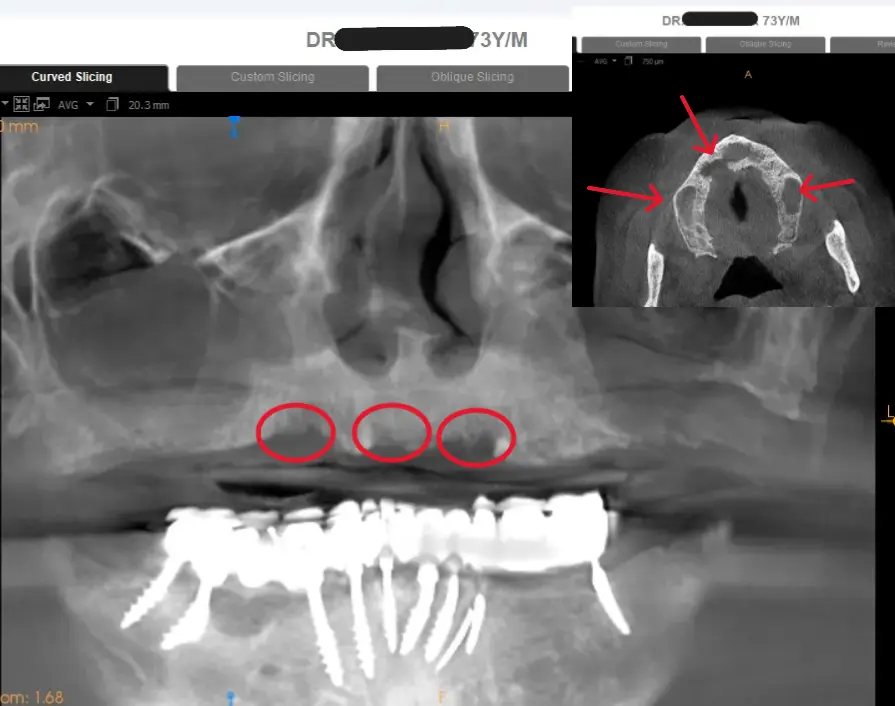
A 2015 case report published in an indexed medical journal documented a patient with a fractured basal implant. Retrieval required removing a significant amount of surrounding jawbone. The patient was left in a far worse position than if they had never received the basal implant at all.
Important: If a basal implant fails or fractures inside your jaw, removing it is not a simple procedure. It can cause extensive bone loss, making future conventional implants much harder to place. This is a risk patients are rarely warned about upfront.
04. What the Research Actually Says
One thing I always tell patients is: follow the science, not the sales pitch. Here is an honest look at the published evidence.
- Scientific literature on basal-discoid implants in PubMed — the world’s leading medical research database — is extremely limited.
- Even Carl E. Misch — considered the godfather of modern implantology — could only publish a 5-year follow-up study on 36 patients, and even that required a modification to the original technique.
- Most other published case reports involve very small patient numbers, which are not statistically significant enough to draw clinical conclusions from.
- In contrast, conventional (crestal) implants have over 30 years of peer-reviewed data, including multi-thousand patient studies with 10–20 year follow-up periods.
Science demands long follow-up periods to truly measure implant success. Basal implants simply do not have this yet. Your jaw deserves better than being a test case.
05. Myth vs Fact — Common Claims About Basal Implants
“Basal implants are better because they give you teeth the same day.”
Conventional implants can also be loaded immediately in many cases. And immediate loading does not guarantee long-term success — it just delays the process, not strengthens it.
“Basal implants work even if you have no bone — so they’re better for weak bone cases.”
Modern bone grafting techniques and zygomatic implants can solve the vast majority of bone deficiency cases — with far better long-term outcomes. See our guide on bone grafting for implants.
“Basal implants are cheaper so they must be just as good for less money.”
Lower cost reflects lower manufacturing standards and no regulatory compliance costs — not clinical superiority. Read the truth about low-cost implants in Gurgaon.
“Basal implants are approved and safe — dentists use them widely.”
Basal implants are not US FDA approved. The fact that some dentists use a technique does not make it evidence-based or safe. Conventional implants carry full US FDA approval and decades of safety data.
06. Red Flags — What Patients Should Watch Out For
If you are consulting a clinic about basal implants, be careful if you hear any of the following:
“Teeth in 24 hours — guaranteed”
This promise is used to attract patients. Immediate loading is sometimes possible with conventional implants too. But nothing in dentistry is truly guaranteed. Ask about their protocol.
“No bone graft needed — ever”
Every jaw is different. Any dentist who guarantees this without CBCT imaging first is taking a shortcut with your jaw.
“It’s the latest technique — much better than old implants”
In medicine, newer does not mean better. Conventional implants have been refined over 30+ years. Basal implants are newer — not more proven.
“The price is 50–60% cheaper than conventional implants”
Ask why. No regulatory compliance. Less research. No long-term data. The savings now may cost you significantly more later.
07. When Can Basal Implants Be Considered?
To be fair and clinically accurate: basal implants do have a small role in dentistry. They may be considered when:
- There is severely insufficient bone in the jaw and the patient cannot undergo bone grafting for medical reasons.
- All other options — conventional implants, zygomatic implants, bone augmentation — have been genuinely exhausted.
- The patient is fully informed of the risks, the lack of long-term data, and the difficulty of retrieval if the implant fails.
In my clinical experience over 17 years in Gurgaon, this scenario is rare. Most patients who are told they “cannot have conventional implants” can, after proper CBCT evaluation, bone grafting, or consideration of zygomatic implants — see our page on zygomatic implants.
Seeing the Difference in Practice — Basal vs Conventional for Full Mouth Cases
On our Full Mouth Dental Implants page, we have a detailed clinical section that shows exactly what happens when patients come to us after being offered basal implants — and why All-on-4 and All-on-6 with US FDA-approved systems is the safer, more predictable path.
It covers the “teeth in a day” claim, what happens when basal implants fail and cannot be retrieved cleanly, and why some clinics still market them despite the risks. If you are considering full mouth teeth replacement in Gurgaon, this section is worth reading before you decide.
Read the Full Clinical Comparison08. What You Should Do Instead
If you are missing teeth and looking for the best solution in Gurgaon, here is what we recommend:
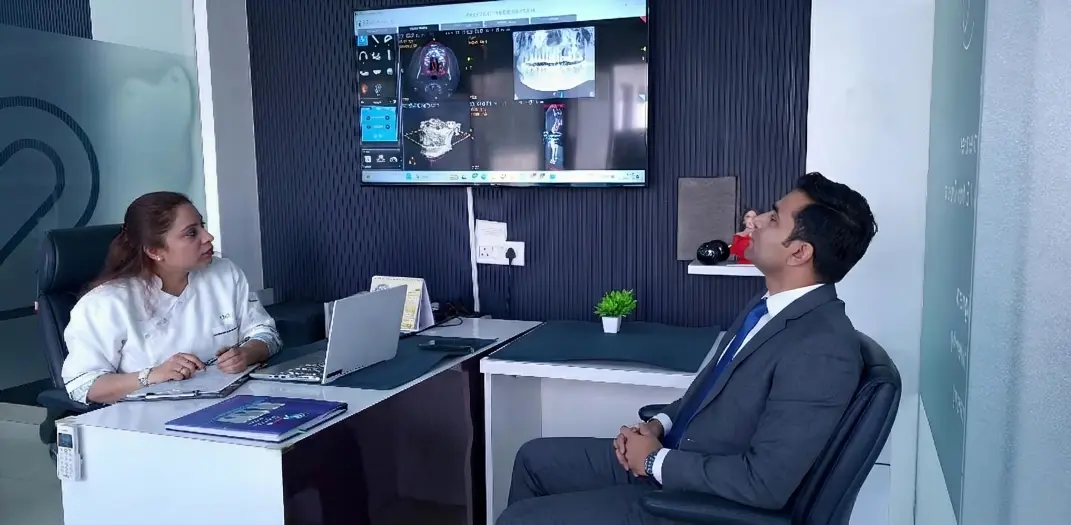
- Get a proper CBCT scan — a 3D X-ray that shows exactly how much bone you have. We use strict CBCT protocol before any implant planning. No guesswork. Learn how 3D imaging helps implant planning.
- Ask about bone grafting — if bone is low, grafting can build it back. See our bone grafting page: bone grafting for implants in Gurgaon.
- Ask about US FDA-approved implant systems — at CDIE we use Nobel Biocare, Straumann, and other globally approved systems. See our Nobel Biocare implants page.
- Ask for long-term implant data — a good implantologist should show you evidence, not just before-after photos.
- Explore All-on-4 or All-on-6 if you need full-mouth teeth — these use conventional implants with immediate loading safely. All-on-4 implants in Gurgaon or All-on-6 implants in Gurgaon.
In my clinical experience, the patients who get the best results are the ones who do not rush. They take time to understand their options, get proper imaging, and choose evidence-based treatment. That extra time is always worth it.
Frequently Asked Questions
Basal implants are not US FDA-approved, and long-term clinical data supporting their safety is very limited compared to conventional implants. They carry a higher surgical risk due to more invasive placement, and retrieval in case of failure can result in significant bone loss. For most patients, conventional implants are a far safer choice.
Conventional implants are placed vertically into the jawbone and fuse with the bone over 6–12 weeks (osseointegration). Basal implants are placed sideways into the deeper basal bone and rely on mechanical grip rather than bone fusion. Conventional implants are FDA-approved, backed by 30+ years of data, and minimally invasive. Basal implants are newer, more invasive, and have limited long-term evidence.
Yes — in most cases. Bone grafting can rebuild the bone, and zygomatic implants can be used for patients with severe upper jaw bone loss. At our centre in Gurgaon, we perform a thorough CBCT scan before concluding that conventional implants are not possible. Basal implants are rarely the only answer.
Basal implants cost less because they are not subject to the same regulatory approvals as FDA-approved implant systems. Lower manufacturing standards and no compliance costs keep prices down. However, the total cost of a failed basal implant — including retrieval surgery and bone reconstruction — can be far higher than a conventional implant placed correctly the first time.
If a basal implant fractures or fails, removing it is a complex, high-risk procedure. The disc-shaped design means the dentist must open a large area of gum and remove surrounding bone to retrieve it. Published case reports show that patients can lose significant bone during retrieval, making future implant placement very difficult.
Yes — in suitable cases. Techniques like All-on-4 and All-on-6 use conventional FDA-approved implants and can provide a fixed set of teeth on the same day as surgery. Our centre in Gurgaon offers this as a thoroughly evaluated, protocol-driven procedure. This is very different from basal implants, which use immediate loading as a marketing pitch rather than a clinical protocol.
Look for a dentist who uses US FDA-approved implant systems, performs CBCT imaging before surgery, explains all options including risks, and does not push “same-day” procedures without proper evaluation. You can also check if they are trained with major implant systems like Nobel Biocare or Straumann. Read our guide on what to check before dental implant surgery.
Yes. Basal implants are also called cortical implants or discoid implants. The terms are used interchangeably in marketing. All refer to the same design: a disc-shaped implant placed into the dense basal (cortical) bone of the jaw — as opposed to conventional implants that integrate with the alveolar bone through osseointegration.
Get an Honest Second Opinion in Gurgaon
If you have been advised basal implants, please speak to us first. We use only US FDA-approved implant systems, strict CBCT protocol, and mandatory blood test checks — because your safety is not negotiable.
Sector 51, Gurgaon
Center for Dental Implants & Esthetics
#166, Sector 51 (Ambedkar Chowk), Close to Artemis Hospital, Gurgaon, Haryana 122003
Sector 74, Gurgaon
Center for Dental Implants & Esthetics
R1-257, 2nd Floor, M3M Cornerwalk, Sector 74, Gurugram, Haryana 122004
You May Also Want to Read
Basal Implants vs Conventional Implants — Full Comparison
A deeper side-by-side clinical comparison to help you understand every difference before making a decision.
ImplantologyComplete Guide to Dental Implants in Gurgaon
Everything you need to know about conventional implants — procedure, healing, cost, and who is a good candidate.
Bone HealthCan I Get Dental Implants With Bone Loss?
Bone loss doesn’t always mean you can’t have implants. Find out what your real options are — from grafting to zygomatic implants.
This article is for informational purposes only and does not replace professional dental consultation. Please consult a qualified dental professional for personalised advice regarding your oral health and treatment options.

Dr. Jyoti Singh (MDS), Diplomate WCOI (Japan region) Member AAID (American Association of Implant Dentistry) stands as a beacon of excellence in implantology within Delhi NCR region. She is a BDS and MDS(Prostho) both from Maulana Azad Institute of Dental Sciences, where she secured top honors with all India rank 1 in PG entrance examination. Her extensive experience at esteemed institutions like Clove Dental and her own Center for Dental Implants & Esthetics since 2016, Dr. Singh embodies unparalleled expertise in dental implants. Boasting a wealth of 17+ years in dentistry and backed by 18 groundbreaking research papers in leading international journals (Google Scholar) and her ResearchGate profile, she epitomizes the pinnacle of proficiency and innovation in her field. She practices in Gurugram as your friendly dentist near me.
What’s your view about screw-based basal implants? Are they bad as well? Thank you!
Well we do not say that Basal Implants are bad. Choice of basal ideally should be based on amount of bone, if the bone is not sufficient for conventional endosseous implant, then basal can be chosen. We have seen these days that, conventional all on 4 implants are possible yet Basal are done in the name of immediate loading. Basal implants in cortical bone when fail create lot of challenges for the patient and more often than not patient is old and to retrieve a failed basal implant is surgical procedure which can be avoided if judicious choice is made.
Basal and cortico-basal implants are the devices of first choice, because they allow immediate functional loading in almost any clinical situation and they help avoiding risky bone buildup. And they do not lead to the dangerous disease named “peri-implantitis”. Patients which are treated with conventional implants see peri-implantitis in more than 50% of the cases. Every 2nd implant is prone to failure and if it happens, the patients are suffering from these implants all their life until the are finally removed.
Today there is almost no indication any more for conventional dental implants. In Germany the conventional implants are considered not to be “state of the art” any more, and this is communicated openly and discussed in the journals. The time for conventional dental implantology is over.