Thumb Sucking Treatment in Gurgaon
Stop the Habit Before It Damages Teeth
Your child’s jaw is still growing. Every night they sleep with the thumb in their mouth, the bone quietly shifts. Parents who act before age 7 often avoid braces entirely. Parents who wait usually do not.
- Normal age for thumb sucking?Under 3 is normal. After age 4, permanent teeth start forming and damage begins.
- Does it stop on its own?Usually by age 3–4. After that, it rarely stops without help.
- Is thumb sucking at night worse?Yes. 7–9 hours of uninterrupted bone pressure every night is the most damaging pattern.
- What is a habit-breaking appliance?A dental device that removes the suction sensation so thumb sucking becomes unsatisfying. No pain.
- Does thumb sucking change face shape?Yes. It narrows the upper jaw and pushes front teeth forward, changing the bite and lower face profile.
- How long does treatment take?Habit breaks in 4–8 weeks. Appliance stays in for 6–9 months to prevent relapse.
- Thumb sucking dentist near Artemis Hospital Gurgaon?Center for Dental Implants & Esthetics, Sector 51, Ambedkar Chowk — close to Artemis Hospital. Call +91 98716 31066.
Is Thumb Sucking Normal at Age 5? At Age 6? The Answer May Surprise You.
At age 2, thumb sucking is a comfort reflex. Completely normal. But the jaw bones of a 5-year-old are not the same as a 2-year-old’s — they are already being shaped.
Permanent teeth form below the gum line from age 4 onward. Sucking pressure at this stage pushes them into wrong positions before they even come in. By the time you see the crooked tooth, months of damage have already happened underground.
Completely normal. Most children stop on their own.
Reward charts and gentle reminders. See a dentist if still continuing after 2 months.
Permanent teeth forming. Dental check needed. Appliance likely required.
Permanent teeth already erupting. Open bite may have started. Delay means braces later.
Reference: American Academy of Pediatric Dentistry — Guideline on Non-Nutritive Sucking Habits
“Parents in Gurgaon often come to me when the child starts school — age 5 or 6. I can already see the beginning of an open bite by then. Had they come two years earlier, there might have been nothing to fix. The window matters more than any appliance.”
Dr. Jyoti Singh, MDS Prosthodontist — Center for Dental Implants & Esthetics, Sector 51 near Artemis Hospital, GurgaonWhat Does Thumb Sucking Do to Your Child’s Teeth and Jaw?
When a child sucks the thumb, three forces act at the same time. The thumb pushes the upper front teeth outward. The cheeks squeeze the upper jaw inward. The tongue drops low, losing the support it normally gives the palate from below.
The result is predictable and progressive. The longer it continues, the worse it gets.
The Four Changes That Happen
- Open bite — front teeth do not touch when the mouth is closed. The gap widens over time.
- Overjet — upper front teeth pushed visibly forward. Sometimes called “buck teeth.”
- Narrow upper palate — upper jaw becomes narrower than it should be. This is a bone change.
- Speech difficulties — tongue pushes through the gap to make sounds. Lisp develops. ‘s’, ‘z’, ‘th’ become unclear.
A 2016 study in the Journal of Orthodontics found children who continued digit sucking past age 4 had significantly higher rates of open bite and overjet compared to those who stopped earlier. [PubMed PMID 27411698]
“He only sucks while sleeping. That’s not much.”
7–9 hours of bone pressure every night. More damaging than any daytime habit — and far harder to break.
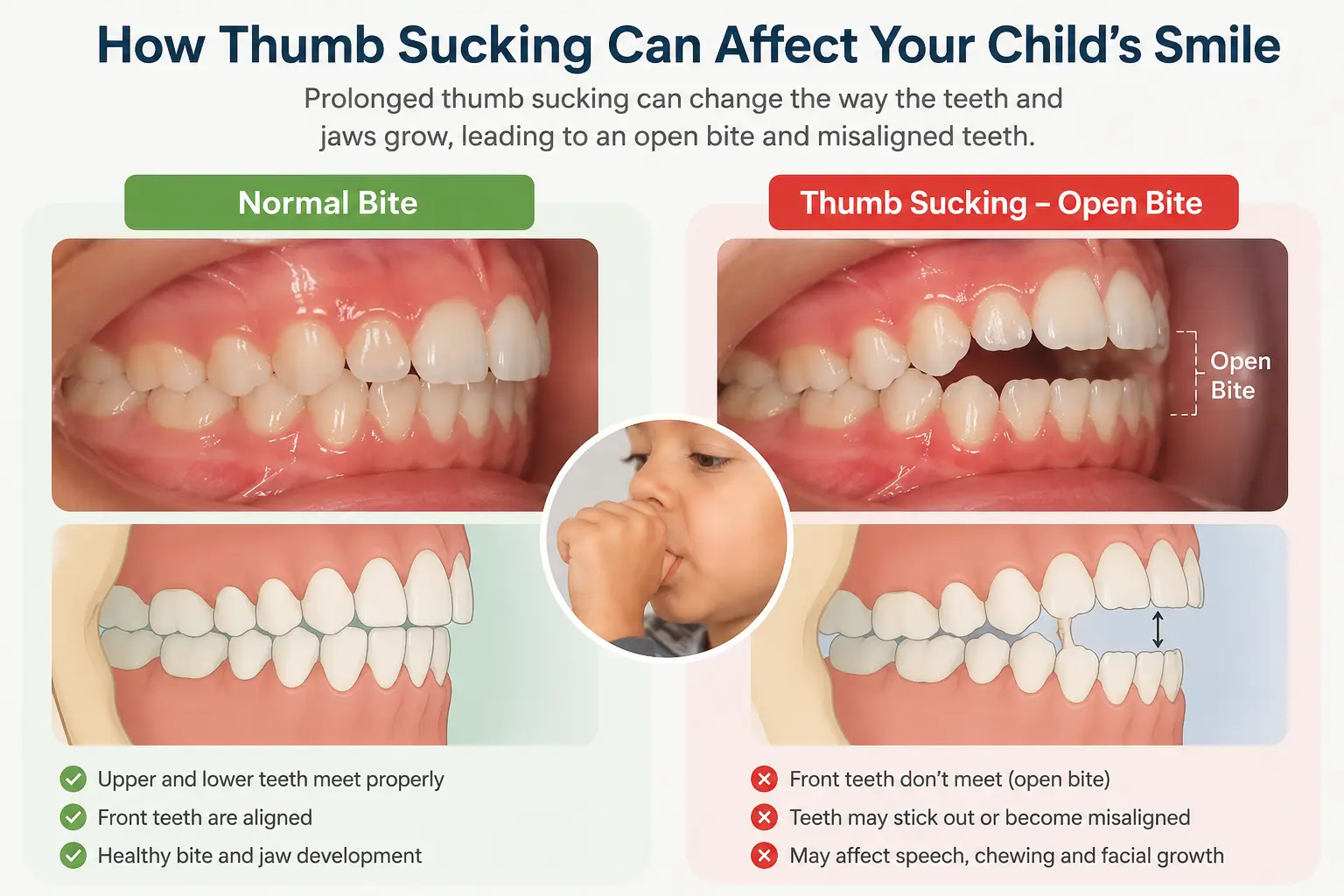
Open bite: front teeth do not meet. A direct result of prolonged thumb sucking.
Yes. Prolonged sucking narrows the upper jaw and pushes front teeth forward. In some children this creates a longer lower face and a receding chin profile. Changes before age 7 often self-correct. Changes after age 9 are more permanent.
How to Stop Thumb Sucking in a Child — What Works at Home and When to See a Dentist in Gurgaon
Start with home methods. They do work for younger children. Here is an honest account of what works and when it stops working.
Home Methods That Actually Help
Reward Charts
- Works best for children aged 2–4
- Stickers and small prizes for thumb-free days
- Loses effect if habit is deeply ingrained
- Does not address nighttime sucking
Thumb Covers / Gloves
- Physical reminder not to suck
- Works moderately for daytime habits
- Children remove them in sleep
- Not reliable for persistent or nighttime suckers
Bitter Coatings
- Dental-safe bitter nail paint on thumb
- Helpful as a deterrent for some children
- Many children habituate to taste within days
- Not reliable for children aged 5 and above
If your child is older than 4 and the habit continues after 2–3 months of consistent home effort, a dental evaluation is the next step. The habit-breaking appliance is not a punishment. It simply removes the sensation that makes sucking comforting — without any pain.
Thumb Sucking by Age — What You Should Do
| Child’s Age | Recommended Action | Why |
|---|---|---|
| Under 3 years | Watch and wait | Normal comfort behaviour. No dental risk yet. |
| 3–4 years | Reward charts, gentle reminders | Most children stop naturally with encouragement at this age. |
| 4–6 years | Dental check if home methods fail after 8 weeks | Permanent teeth forming. Small window to prevent damage. |
| 6–8 years | Dental appliance — act without delay | Permanent front teeth erupting. Open bite risk is high. |
| 8 years and above | Appliance + orthodontic assessment | Bite changes likely underway. Braces may also be needed. |
Palatal Crib and Bluegrass Appliance — Habit Breaking Treatment for Children in Gurgaon
Not every child needs the same appliance. The choice depends on age, severity of the habit, and whether sucking happens mainly during the day or at night.
Fixed Palatal Crib — Most Effective for Persistent Thumb Suckers
- Cemented to upper back teeth — child cannot remove it
- Small metal grid sits behind the upper front teeth
- Breaks suction seal — thumb no longer feels satisfying
- Best for children who suck mainly at night
- Stays in for 6–9 months, removed in one short visit
- Over 90% success rate in children aged 5–9
A 2015 study in the International Journal of Dentistry found fixed palatal cribs had over 90% success in breaking digit-sucking habits in children aged 5–9. [PMC4472878]
Bluegrass Appliance — Gentle Option for Anxious or Younger Children
- Small roller bead in the roof of the mouth
- Child plays with bead using tongue instead of sucking
- Redirects the oral habit rather than just blocking it
- Less aversive — good for children aged 4–6
- Can be fixed or removable depending on the case
- Comparable long-term success to palatal crib designs
Research in Pediatric Dentistry supports the Bluegrass appliance as an effective, less-aversive alternative to crib designs. [PMC4745967]
Fixed vs Removable — Which is Right for My Child?
| Feature | Fixed Appliance | Removable Appliance |
|---|---|---|
| Child can remove it? | No | Yes |
| Best for nighttime sucking? | Yes | Partially — child may remove during sleep |
| Eating | Avoid hard and sticky foods | Remove before eating |
| Cleaning | Brush carefully around it | Remove and clean separately |
| Success in persistent cases | Higher | Lower without full child cooperation |
| Minimum age | 5 years | 4 years |
| Typical duration | 6–9 months | 6–12 months |
“A 5-year-old who sucks only when anxious at school is a completely different case from a 7-year-old who has sucked every night for three years and already has an open bite. I choose the appliance based on the child in front of me — not what’s quickest to place.”
Dr. Jyoti Singh, MDS Prosthodontist — Center for Dental Implants & Esthetics, Gurgaon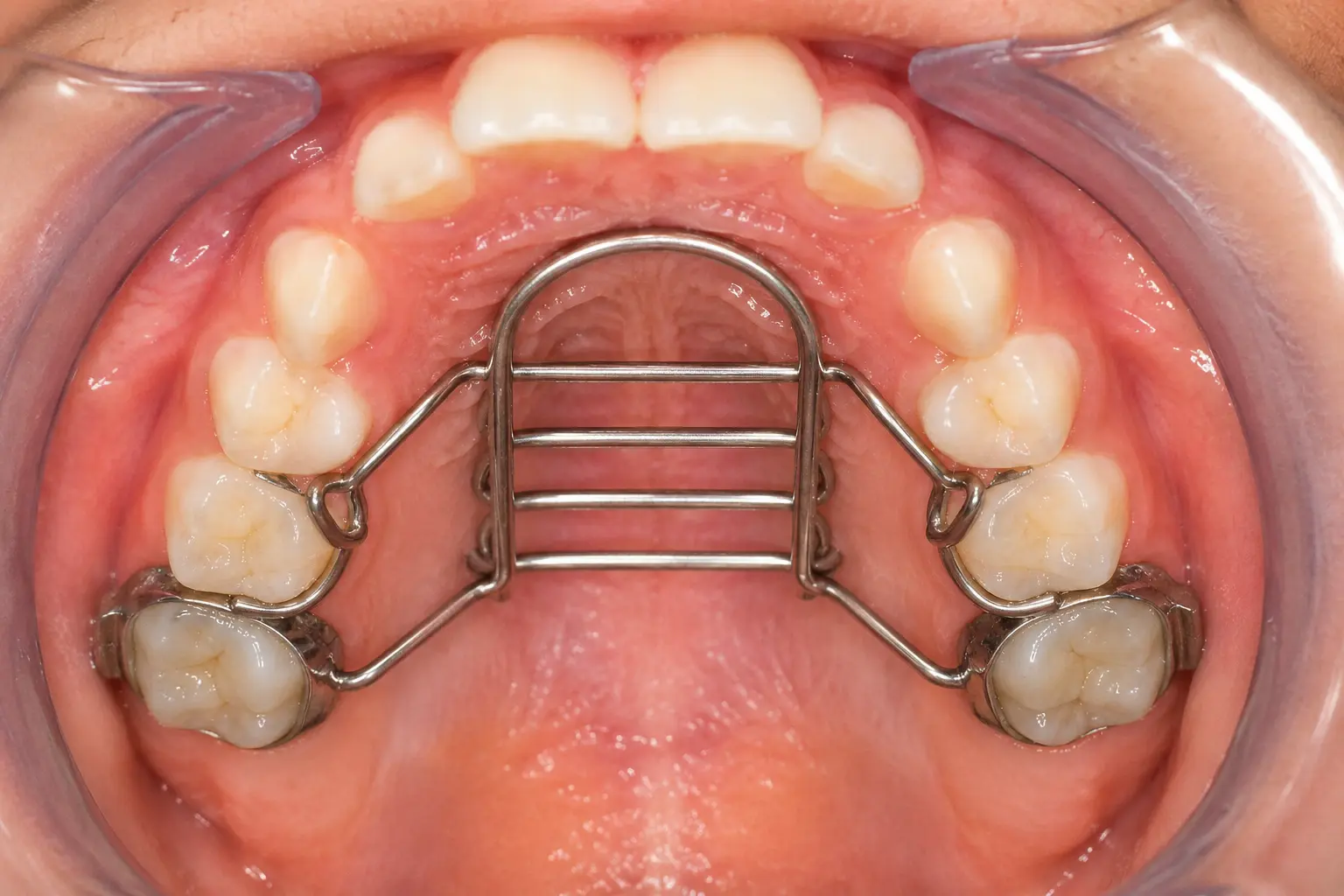
Habit-breaking appliances are custom-made. Fitting takes one short appointment. Most children adapt within a week.
Thumb Sucking Treatment Cost in Gurgaon — Honest Pricing, No Surprises
Most dental websites hide cost. We do not. Here is what you should expect to pay at Center for Dental Implants & Esthetics.
| Treatment Component | Estimated Cost | Notes |
|---|---|---|
| Initial consultation | ₹500 – ₹800 | Bite assessment, X-ray review if needed |
| Removable habit-breaking appliance | ₹5,000 – ₹7,000 | Custom-made, includes fitting appointment |
| Fixed palatal crib | ₹7,000 – ₹10,000 | Includes placement and removal appointment |
| Follow-up visits (every 4–6 weeks) | ₹300 – ₹500 per visit | Progress check, 3–4 visits typical |
Indicative ranges only. Final cost confirmed at consultation after examination.
EMI plans are available. EMI Available Ask the team when booking.
One-time. Done in 6–9 months. Damage stopped early.
18–24 months of treatment. Multiple visits. Damage already done.
Can Dental Damage from Thumb Sucking Be Reversed?
Yes, often. But the window is short and it closes fast.
A child’s jaw bones are still growing and remodelling. Remove the sucking pressure before age 7, and the bones often self-correct. The open bite closes. The palate widens. No braces needed.
After age 8–9, the bones firm up. The permanent teeth have already erupted at wrong angles. At that point, braces in Gurgaon or clear aligners become necessary. The habit appliance still comes first — starting orthodontics without stopping the habit is the most common and costly mistake. Braces will relapse if the thumb goes back in the mouth every night.
Thumb Sucking and Speech Problems
Open bite causes the tongue to push forward through the gap when making sounds — creating a lisp on ‘s’, ‘z’, ‘th’, ‘t’. Closing the open bite early often resolves the speech issue completely, without speech therapy. Late treatment may need both orthodontics and speech therapy together.
“My child will need braces no matter what. The damage is already done.”
In children under 7, stopping the habit alone often allows the open bite and palate to self-correct. The bones do the work — you just have to remove the pressure in time.
If Your Child Already Has an Open Bite
- Step 1: Stop the habit first — place the appliance
- Step 2: Wait 6–12 months to see how much the bite self-corrects
- Step 3: Reassess whether braces or other orthodontic treatment is still needed
Skipping Step 1 and jumping straight to braces is the most common and costly mistake. The braces relapse almost immediately if the sucking habit continues at night.
What Happens When You Bring Your Child to Center for Dental Implants & Esthetics, Gurgaon
The process is calm and designed around your child. Here is what happens step by step.
Consultation and Dental Assessment
We examine your child’s teeth, bite, and palate. We look for early signs of open bite or jaw narrowing and ask about the habit history — how long, how frequent, day or night. Takes 30–40 minutes.
Choosing the Right Appliance
Based on the assessment, we recommend a fixed palatal crib or a removable appliance. We explain both options to you, consider your child’s age and temperament, and decide together. We never push toward a more expensive option without clear clinical reason.
Impressions and Lab Fabrication
We take a quick dental impression of the upper teeth — painless and takes about 5 minutes. The appliance is custom-made. Ready in 7–10 days.
Fitting Appointment
For a fixed crib, fitting takes 30–40 minutes. We cement it, check the fit, and walk you through care instructions. For a removable appliance, we teach your child how to wear it. Most children are comfortable within a few days.
Follow-Up Visits Every 4–6 Weeks
We track progress and confirm whether the habit is breaking. Most parents report the thumb sucking stops within 4–8 weeks of placement. We also watch the bite for early signs of self-correction.
Appliance Removal at 6–9 Months
Once the habit is fully broken and the risk window has passed, the appliance is removed. One short appointment. We then assess the bite and decide if further care is needed — or if the bones have already self-corrected.
Two clinics in Gurgaon — Sector 51 near Artemis Hospital and Sector 74 at M3M Cornerwalk on Golf Course Extension Road. Families from DLF Phase 5, Sushant Lok, South City, Sectors 56, 57, 58, Palam Vihar, and Manesar visit us regularly. Dr. Jyoti Singh has been treating families in Gurgaon for 17 years with a simple principle: every patient gets the same honest advice she would give a family member.

Most children are relaxed by the second visit. The clinic environment is designed to keep it that way.
Frequently Asked Questions — Thumb Sucking Habit Breaking in Gurgaon
Real questions from parents. Direct answers from a specialist.
- At age 5–6, home methods alone often fail because the habit has become neurological, not just behavioural.
- A fixed palatal crib is the most reliable option — it removes the suction sensation, typically breaking the habit within 4–8 weeks.
- The appliance stays in for 6–9 months to prevent relapse.
- Reward charts and thumb covers can still be used alongside the appliance as positive reinforcement.
- A dental check to assess if bite damage has already started is important at this age.
- Age 5: Common but no longer harmless. Permanent teeth are forming below the gums. A dental check is a good idea.
- Age 6: Permanent front teeth start coming in. This is the most critical window. Action is needed now.
- Age 7: Open bite and overjet may have already started. Dental appliance and bite assessment are both necessary.
- The American Academy of Pediatric Dentistry recommends dental evaluation if the habit persists at age 4.
- Yes, in children who suck frequently past age 5–6.
- The upper jaw narrows. Front teeth push forward. The lower face can appear longer.
- In some children, the chin appears more receding as a result.
- Changes before age 7 often self-correct once the habit stops.
- Changes after age 9–10 are more permanent and may require orthodontic treatment.
- Permanent front teeth come in pushed forward (overjet) and the front bite may be open (open bite).
- Upper jaw is narrower than normal, affecting breathing and oral function.
- Speech problems — lisp, unclear ‘s’, ‘z’, ‘th’ sounds — may develop or worsen.
- After age 8–9, bone changes are harder to reverse through growth alone.
- Braces or clear aligners are usually needed — costing ₹40,000–₹1,20,000 over 18–24 months.
- Reward charts: Stickers and small prizes for thumb-free days. Effective for ages 2–4.
- Identify triggers: Anxiety, tiredness, TV time — knowing when your child sucks helps you redirect the behaviour.
- Gentle reminders: Quietly remove the thumb without scolding. Negative attention reinforces the habit.
- Thumb covers: Fabric covers or gloves at bedtime as a physical reminder.
- Bitter coatings: Dental-safe bitter nail paint. Useful for some, ineffective for others.
- If nothing works after 2–3 months of consistent effort in a child over 4 — see a dentist.
- Consultation: ₹500–₹800 (includes bite assessment)
- Removable habit appliance: ₹5,000–₹7,000
- Fixed palatal crib: ₹7,000–₹10,000
- Follow-up visits: ₹300–₹500 per visit, every 4–6 weeks
- EMI plans available at Center for Dental Implants & Esthetics.
- Comparison: braces to fix the resulting bite later typically cost ₹40,000–₹1,20,000.
- No. The appliance does not cause pain.
- It removes the suction sensation — that makes thumb sucking unsatisfying, not painful.
- There is mild tongue discomfort for the first 2–4 days while the child adjusts.
- Most children eat and speak normally within one week.
- The first few nights may be slightly restless. This is normal and passes quickly.
- Yes, absolutely. Nighttime sucking is often the most damaging pattern.
- 7–9 hours of uninterrupted bone pressure every night is far worse than occasional daytime sucking.
- The child cannot self-correct during sleep the way they might during the day.
- A fixed palatal crib is particularly effective here — the child cannot remove it during sleep.
- Nighttime-only sucking is the last habit to break and almost always needs a dental appliance.
- Sector 51 clinic: #166, Sector 51, Ambedkar Chowk — close to Artemis Hospital. Call +91 98716 31066.
- Sector 74 clinic: R1-257, 2nd Floor, M3M Cornerwalk, Golf Course Extension Road, Gurugram.
- Both clinics offer pediatric dental care including habit-breaking appliances.
- Families from DLF Phase 5, Sushant Lok, South City, Sector 56, 57, Palam Vihar visit us regularly.
- Book online or call +91 98716 31066 for an appointment.
Ready to Help Your Child Break the Habit?
Gurgaon families visit Center for Dental Implants & Esthetics for specialist pediatric care. Two convenient locations. Honest pricing. Dr. Jyoti Singh sees patients personally.
Center for Dental Implants & Esthetics
#166, Sector 51, Ambedkar Chowk
Close to Artemis Hospital, Gurgaon 122003
Center for Dental Implants & Esthetics
R1-257, 2nd Floor, M3M Cornerwalk
Golf Course Extension Rd, Gurugram 122004
Serving families from Sector 51 · Sector 74 · DLF Phase 5 · Sushant Lok · South City · Sector 56 & 57 · Palam Vihar · Golf Course Extension Road · Manesar · and all of Gurgaon / Gurugram
Also Useful for Parents
Related reading from Center for Dental Implants & Esthetics, Gurgaon
Best Age for Your Child to Get Orthodontic Braces
If thumb sucking has affected the bite, understanding braces timing helps you plan ahead. The right age varies — this guide explains it clearly for Indian parents.
Read the GuideDental Braces in Gurgaon — Types, Cost & What to Expect
If the open bite from thumb sucking needs correction, this covers all braces options available in Gurgaon — metal, ceramic, self-ligating, and clear — with honest pricing.
Explore Braces OptionsKids Dentist in Gurgaon — Everything Parents Need to Know
A complete parent’s guide to children’s dental care from first tooth to teenage years — when to start, what each age needs, and how to find the right pediatric dentist near you.
Read for Parents