Bad Breath Treatment in Gurgaon
Find the Real Cause of Halitosis
Persistent mouth odor usually comes from gum disease, tongue bacteria, cavities, or dry mouth. At Center for Dental Implants & Esthetics, our MDS specialist identifies the exact cause and treats it — not just covers it up.
Most chronic bad breath cases in Gurgaon are caused by bacteria living on the tongue, inside gum pockets, or around decayed teeth. Professional diagnosis and cleaning remove the source. Mouthwash only masks the odor temporarily.
Tick the ones that apply to you
Many patients with persistent bad breath share the same pattern. See if yours matches.
Why does your breath smell bad even after brushing?
Most patients brush twice a day and still have bad breath. That is not a hygiene failure. It is a location problem.
Bad breath comes from bacteria that produce foul-smelling gases called volatile sulphur compounds (VSCs). These bacteria live deep in gum pockets, under tongue coating, inside cavities, and around infected tooth roots. Your toothbrush simply cannot reach them.
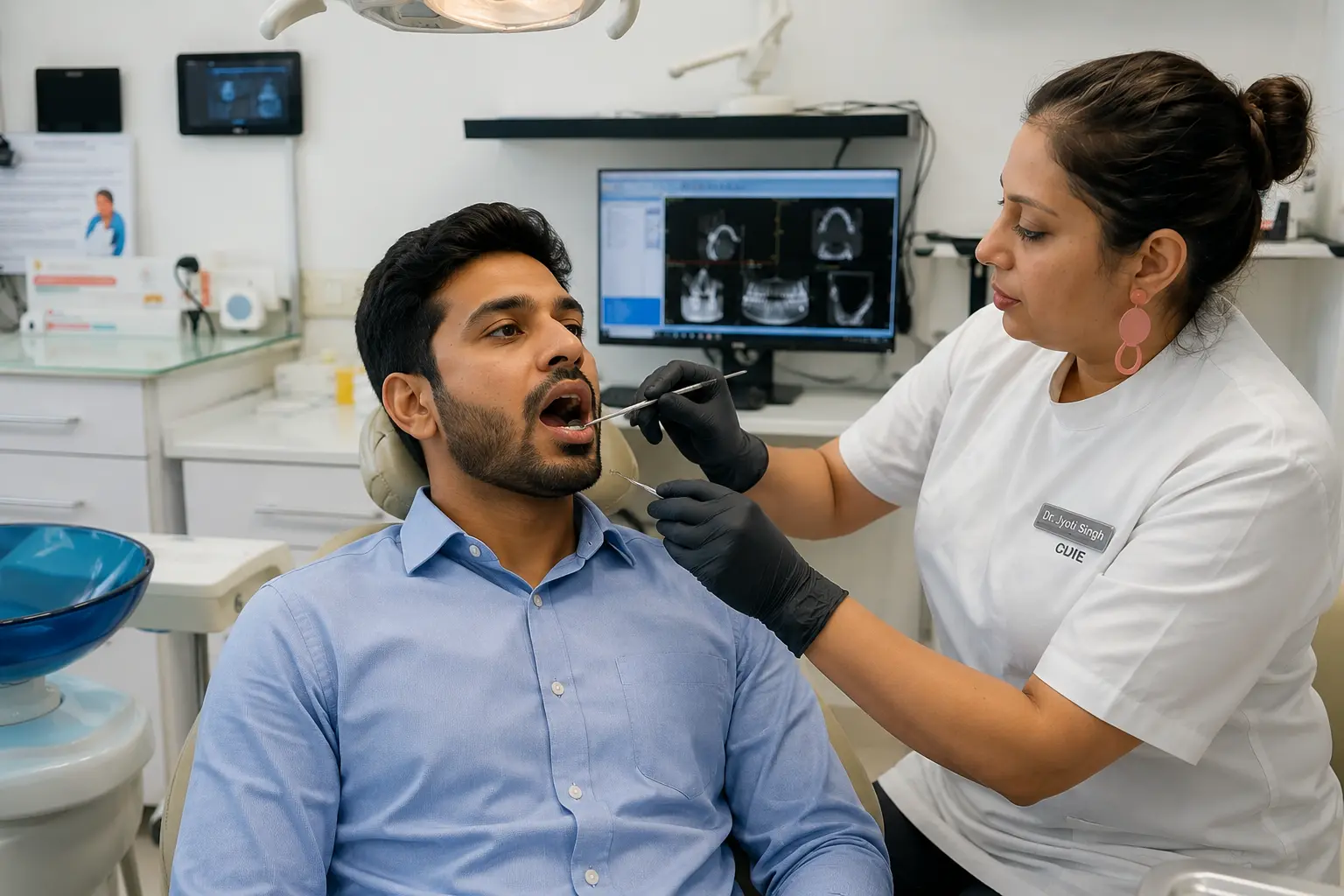
Why mouthwash makes things worse for many patients: Most mouthwashes cover the odor for 60 to 90 minutes. The alcohol in them dries out your mouth. Less saliva means bacteria multiply faster. Within two hours, the smell is back — often stronger.
The only way to fix chronic bad breath is to remove the bacteria source. Not mask it.
A review in the Journal of Clinical Periodontology (Quirynen et al., 2016) found that roughly 90% of halitosis cases originate in the mouth — primarily from tongue coating and gum pockets. Treating the mouth treats the problem. View study reference.
Where bacteria hide
- Deep gum pockets — below the visible gumline
- Under white or yellow tongue coating
- Inside untreated cavities
- Around infected tooth roots
- Beneath hardened tartar deposits
6 most common causes of bad breath
- Gum disease — bacteria in pockets below gums
- Tartar buildup — plaque hardened onto teeth
- Cavities — food trapped, bacteria multiply
- Dry mouth — less saliva to wash bacteria away
- Tobacco use — starves the mouth of oxygen
- Medical causes — GERD, diabetes, sinusitis, kidney issues
Bacteria living in gum pockets, tongue coating, or cavities that brushing cannot reach.
No. It masks odor for 1 to 2 hours. It does not remove the bacterial source.
Foul-smelling gases produced by oral bacteria — the primary cause of halitosis.
Yes. It is the single most common dental cause of chronic halitosis.
Rarely — but it can indicate uncontrolled diabetes, kidney disease, or serious gum infection.
Most patients notice fresher breath within 1 to 2 weeks of professional deep cleaning.
How we find out exactly what is causing your bad breath
This is the question most patients never get answered elsewhere. At Center for Dental Implants & Esthetics, we do a structured, step-by-step examination before any treatment begins. You leave knowing the cause, not just guessing.
01. Tongue coating examination
We look at the colour and thickness of coating on your tongue. A thick white or yellow coat is a major bacterial reservoir and one of the fastest-to-treat causes.
02. Gum pocket measurements
Using a thin probe, we measure the depth of pockets around each tooth. Pockets deeper than 4 mm usually trap bacteria that produce the strongest odors.
03. Cavity and filling check
Old or cracked fillings and untreated cavities trap food and bacteria. We check every surface of every tooth — not just the ones that feel sore.
04. Existing crowns and bridgework
Poorly fitting crowns and bridges create gaps where plaque builds up invisibly. We assess the margins of existing dental work for leakage or decay.
05. Dry mouth evaluation
Saliva is your mouth’s natural cleaner. We assess salivary flow and ask about medications, medical conditions, and lifestyle factors that reduce it.
06. Medical history review
Conditions like acid reflux, sinusitis, uncontrolled diabetes, and kidney disease can cause distinct types of halitosis. We screen for these patterns before concluding the cause is dental.
In my clinical experience at Center for Dental Implants & Esthetics in Gurgaon, a large number of patients who come in for persistent bad breath have moderate gum disease they were completely unaware of. It is painless in early stages. Most patients discover it only when someone else notices the smell.
Think gum disease may be behind your bad breath?
Gum disease is behind most cases of persistent bad breath
When plaque hardens into tartar along the gumline, bacteria irritate and inflame the gums. The gums pull away from the teeth, forming small pockets where bacteria thrive and produce the worst odors. Standard brushing cannot reach below the gumline. These pockets are only cleaned by a professional.
Warning signs your gums are involved
- Red, swollen, or tender gums
- Bleeding when you brush or floss
- Persistent bad taste in your mouth
- Gums pulling away from teeth (recession)
- Smell that mouthwash does not fix
- Loose or slightly shifting teeth
Why waiting makes it worse
Early gum disease — gingivitis — is fully reversible with professional cleaning.
Left untreated, it becomes periodontitis. This is a serious infection that destroys the bone holding your teeth in place. At that stage, treatment is longer, costlier, and results are less predictable.
The bacteria in deep periodontal pockets produce the strongest odors. Deep cleaning targets exactly this.
“A Gurgaon IT professional visited us after years of chewing mints constantly at work. He had been embarrassed in meetings and avoided close conversations. On examination, we found deep gum pockets measuring 5 to 6 mm around the upper and lower back teeth — a clear sign of moderate periodontitis. He had no pain, no bleeding he had noticed, nothing. Just the smell. After two sessions of scaling and root planing, his breath improved within ten days. He came back six weeks later for review. The pockets had reduced. He said it was the first time in four years he had felt confident in a room full of people.”
Patient identity kept confidential. Treatment: Scaling and root planing, two sessions, Center for Dental Implants & Esthetics, Sector 51 Gurgaon (near Artemis Hospital).
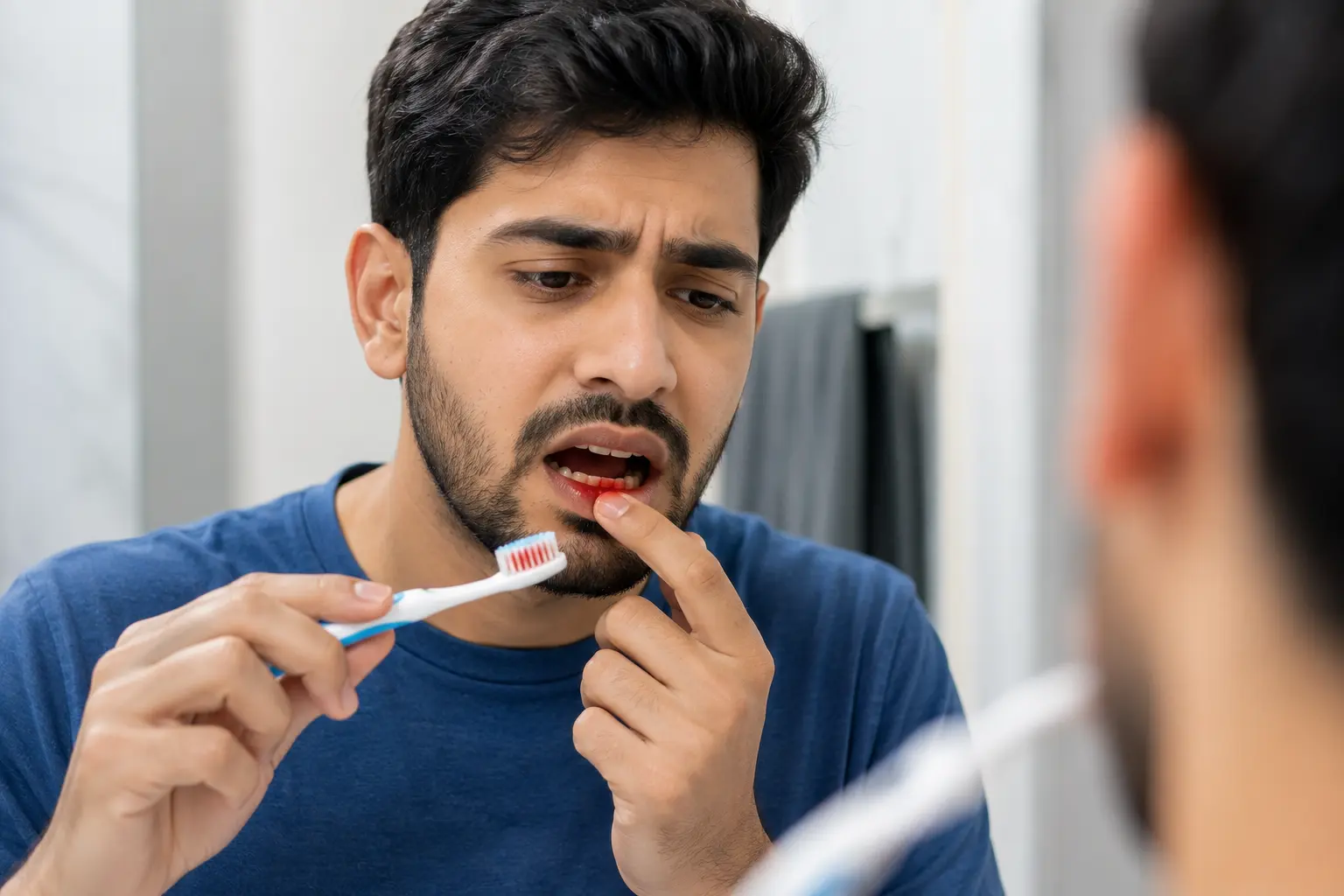
One of the earliest warning signs most patients overlook is bleeding gums while brushing. If you notice this, read: Why your gums bleed when brushing — a dentist explains.
If your gums have started pulling away from your teeth, see our guide on gum recession treatment options in Gurgaon. For a full picture of how gum disease progresses from early to advanced, read: Gingivitis vs Periodontitis — what is the difference and why it matters.
Can bad breath be cured permanently?
Yes — if the cause is dental and treated properly. Here is what that means in plain terms.
When cure is possible
- Gum disease treated — bacteria removed from pockets, pockets heal and close
- Cavities filled — food traps eliminated
- Tongue hygiene corrected — daily scraping removes coating bacteria
- Dry mouth addressed — cause identified and managed
- Regular maintenance — 3 to 6 month professional cleanings maintained
When it is managed, not cured
- Medical causes — GERD, kidney disease, diabetes require medical treatment first
- Severe periodontitis — bone loss is permanent; management keeps it stable
- Chronic dry mouth from medications — cannot be fully reversed, but managed
- Smoking — bad breath returns until smoking stops
According to a systematic review in Oral Diseases (van den Broek et al., 2008), professional scaling and root planing significantly reduces halitosis scores in patients with gum disease. View study reference. The key word is professional — home care alone cannot reach subgingival bacteria.
Patients from Sector 46, Sector 47, Nirvana Country, Mayfield Garden, Golf Course Extension Road, Sector 74, Sohna Road, and nearby Gurgaon areas visit us specifically because persistent bad breath has not responded to mouthwash, tongue cleaners, or regular dental cleaning elsewhere.
Why does my breath smell bad in the morning?
Almost everyone has morning breath. But there is a clear difference between normal morning breath and a sign of something that needs treatment.
Why morning breath happens
- Saliva drops during sleep — your mouth produces far less saliva at night. Saliva is what washes bacteria away. Less saliva means bacteria multiply rapidly through the night.
- Mouth breathing — breathing through the mouth dries it out further, worsening bacterial growth.
- Bacteria on the tongue — a large coating of bacteria on the back of the tongue produces the most sulfur gases overnight.
- Food particles — anything stuck between teeth or in cavities ferments through the night.
Normal vs concern — how to tell
- Normal: Morning breath clears within 30 minutes of brushing, eating, and drinking water
- Concerning: Smell persists even after brushing and eating breakfast
- Concerning: Others notice it mid-morning or during the day
- Concerning: There is a persistent bad taste throughout the day
- Concerning: The smell has been there for weeks or months
Three things that reduce morning breath: Use a tongue scraper before bed, not just in the morning. Drink water before sleeping. Floss at night — not in the morning. If morning breath persists despite all three, the cause is likely gum disease, cavities, or dry mouth that needs professional treatment.
The back third of the tongue is responsible for over 50% of bad breath odor in most patients. Most people brush the front of the tongue and miss the back entirely. A tongue scraper used from back to front removes the sulfur-producing coating that a toothbrush leaves behind. (Source: Quirynen et al., Journal of Clinical Periodontology, 2016.)
If your morning breath does not clear by mid-morning — or if someone at home has mentioned it — it is worth getting a proper dental examination. Professional teeth scaling in Gurgaon removes the tartar and bacteria that home care simply cannot reach.
Is your bad breath dental or medical?
The answer changes what we treat. Here is how to tell the difference.
| Dental Origin (approx. 90%) | Medical Origin (approx. 10%) | |
|---|---|---|
| When worst | Morning, after garlic or onions | Constant — does not change with meals |
| Responds to brushing | Temporarily improves | No improvement at all |
| Other signs | Bleeding gums, bad taste, cavities | Acid reflux, sinus pressure, fatigue |
| Smell type | Sulphuric, rotten egg-like | Fruity, fishy, or chemical smell |
| Treatment | Scaling, cavity filling, gum therapy | Medical treatment + supportive dental care |
At Center for Dental Implants & Esthetics, we examine your mouth thoroughly before drawing any conclusion. If we identify a dental cause, we treat it. If the pattern of your symptoms points to a medical cause — a fruity smell, no change with brushing, other systemic symptoms — we refer you to a physician while continuing supportive care on our end. We never guess.
When should you see a dentist for bad breath?
Not all bad breath needs a dentist. But these signs mean you should not wait.
See a dentist soon if
- Bad breath has lasted more than 2 to 3 weeks despite brushing
- Mouthwash gives no relief or only temporary masking
- Your gums bleed when you brush or floss
- You have a persistent bad taste in your mouth
- Someone close to you has mentioned the smell repeatedly
- You have not had a professional cleaning in more than 6 months
See a dentist urgently if
- You have a painful swelling in the gum or jaw
- A tooth is throbbing and the smell is very strong
- You have fever along with dental pain or swelling
- You had a tooth extraction recently and smell is worsening (possible dry socket)
- You have loose teeth along with bad breath
If a tooth infection is causing the smell, you may want to read about early signs of tooth infection that you should never ignore.
Bad breath lasting more than 2 weeks is not normal. Book an examination now.
How deep cleaning eliminates bad breath — step by step
If gum disease is causing your halitosis, professional scaling and root planing is the evidence-based treatment. Here is what happens.
Scaling
Ultrasonic instruments remove plaque and tartar above and below the gumline — where your brush cannot reach.
Root Planing
The tooth root surface is smoothed. This removes bacteria attached to the root and stops them re-attaching easily.
Healing
Clean gum tissue reattaches to the tooth surface. Bacteria-filled pockets shrink and close over 1 to 3 weeks.
Prevention
Home care guidance and scheduled cleanings every 3 to 6 months keep bacteria from rebuilding.
Most patients notice fresher breath within 1 to 2 weeks as gums heal. Swelling and bleeding also settle. For a full walkthrough, see our complete guide to professional teeth scaling in Gurgaon. In severe cases where pockets do not respond to cleaning alone, we discuss gum surgery options in Gurgaon.

What your appointments look like
Appointment 1 — Diagnosis
- Visual exam: gums, teeth, tongue
- Gum pocket depth measurements
- Check for cavities and old restorations
- Review of your health history
Appointment 2 — Active Treatment
- Local anesthesia — you feel no pain
- Ultrasonic scaling above and below gumline
- Root planing on affected teeth
- Antimicrobial rinse
Follow-Up Visit
- Gum health reassessment at 3 to 4 weeks
- Pocket depth re-measurement
- Home care review and corrections
- Schedule for maintenance cleanings
Long-Term Maintenance
- Professional cleaning every 3 to 6 months
- Tongue scraper technique coaching
- Flossing and water irrigation guidance
- Immediate review if smell returns
Bad breath treatment cost in Gurgaon
We believe you should know roughly what to expect before you come in. Final pricing depends on severity. You get a written estimate after examination — no surprise additions.
For a broader view of what different treatments cost, see our dental treatment cost guide for Gurgaon patients.
Over 17 years of practice at Center for Dental Implants & Esthetics in Gurgaon, Dr. Jyoti Singh has diagnosed and treated thousands of patients with gum disease, oral infections, and related conditions — including persistent bad breath that had not responded to basic cleaning elsewhere.
For halitosis, the work is not glamorous but it changes lives. When a patient tells me they can finally talk to their children or colleagues without feeling ashamed — that matters most.
Every patient receives a written diagnosis and treatment plan before any work begins. We follow a strict protocol: examine first, explain fully, then treat. No pressure. No guesswork.
Read more about Dr. Jyoti Singh’s clinical background: About Dr. Jyoti Singh — Prosthodontist, Gurgaon.
Stop covering it up. Find out what is causing it.
Book a consultation at Center for Dental Implants & Esthetics, Gurgaon. We identify the source, explain your options clearly, and start treatment the same day when possible.
Center for Dental Implants & Esthetics
#166, Sector 51, Ambedkar Chowk
Close to Artemis Hospital, Gurgaon, Haryana 122003
Center for Dental Implants & Esthetics
R1-257, 2nd Floor, M3M Cornerwalk
Sector 74, Gurugram, Haryana 122004
Common questions about bad breath treatment in Gurgaon
Direct answers to what patients most often ask — before and after their visit.
Because brushing only cleans the tooth surface. The bacteria causing bad breath are usually living in gum pockets, on the tongue coating, inside cavities, or around old fillings — all places your toothbrush cannot reach. You need professional cleaning to remove them.
Yes — if the cause is dental and treated properly. Once gum disease is treated and cavities are filled, bad breath resolves. Long-term results require:
- Daily brushing, tongue cleaning, and flossing
- Professional cleaning every 3 to 6 months
- Immediate treatment of new cavities
Medical causes like GERD or kidney disease require medical management first, then dental support.
No — but gum disease is the most common dental cause. Other dental causes include cavities, tongue coating, and dry mouth. Medical causes include acid reflux, sinusitis, uncontrolled diabetes, and kidney disease. A dental exam rules out or confirms the dental side first. If we suspect something systemic, we refer you to the right physician.
Mouthwash only masks odor for 60 to 90 minutes. It cannot reach bacteria living in gum pockets or inside cavities. Alcohol-based mouthwashes also dry your mouth, which reduces saliva — and saliva is your mouth’s natural bacteria defense. Only professional treatment removes the source.
See a dentist if:
- Bad breath has lasted more than 2 to 3 weeks despite regular brushing
- Mouthwash gives no real relief
- Your gums bleed when you brush or floss
- You have a persistent bad taste in your mouth
- Someone close to you has mentioned it repeatedly
- You have not had a professional cleaning in more than 6 months
No. We use local anesthesia to numb your gums before scaling begins. You feel pressure and vibration — not pain. Some patients notice mild sensitivity to cold water for 2 to 4 days after treatment. This settles on its own.
It depends on severity:
- Mild tartar buildup — single scaling session, 45 to 60 minutes
- Moderate gum disease — 2 visits, one week apart
- Advanced periodontitis — 3 to 4 visits, with possible surgery follow-up
Most patients notice improvement within 1 to 2 weeks of the first deep cleaning.
In roughly 90% of cases, the source is the mouth — gum disease, cavities, tongue coating, or poor hygiene. Medical causes (GERD, sinusitis, kidney disease, diabetes) account for about 10%. A strong signal for medical origin is when the smell is constant and does not change with brushing or after meals. We help identify which category you fall into. (Source: Quirynen et al., Journal of Clinical Periodontology, 2016.)
- Basic professional scaling — from ₹1,800
- Deep cleaning (scaling + root planing) — ₹3,000 to ₹6,000 depending on severity
You receive a written cost estimate after examination. No surprise charges. Payment plans available.
Not here. Halitosis is a medical condition. It affects roughly 1 in 4 adults. We treat it the same way we treat any other oral disease — clinically, with respect, and without judgment. Asking for help is the right thing to do.
This is normal if the smell clears within 30 minutes of brushing and eating. Saliva flow drops significantly during sleep, so bacteria multiply overnight. This causes temporary morning breath in most adults. However, if the smell persists past mid-morning or throughout the day, it points to an underlying cause:
- Tongue coating — the back of the tongue holds the most odor-producing bacteria
- Gum disease — bacteria in pockets continue producing sulfur gases even after brushing
- Untreated cavities — fermentation continues overnight
- Dry mouth — chronic mouth breathing or medication side effects
Use a tongue scraper from back to front before bed, floss at night, and drink water before sleeping. If morning breath still persists after these steps, book a professional dental examination.
Related guides you may find helpful
Gingivitis vs Periodontitis — What Is the Difference?
Understand how early gum disease becomes serious bone loss — and exactly when treatment changes from simple to complex.
Gingivitis vs Periodontitis explained →Early Signs of Gum Disease You Should Not Ignore
Painless in the beginning. Expensive and irreversible later. This guide helps you catch it before serious damage is done.
Early signs of gum disease →Professional Teeth Scaling in Gurgaon — A Complete Patient Guide
What scaling involves, what to expect during the procedure, recovery, and how often you actually need it done.
Professional teeth scaling in Gurgaon →This page is for informational purposes only and does not replace professional dental consultation. Symptoms described may have multiple causes. Please visit a qualified dental professional for diagnosis and personalised treatment advice.