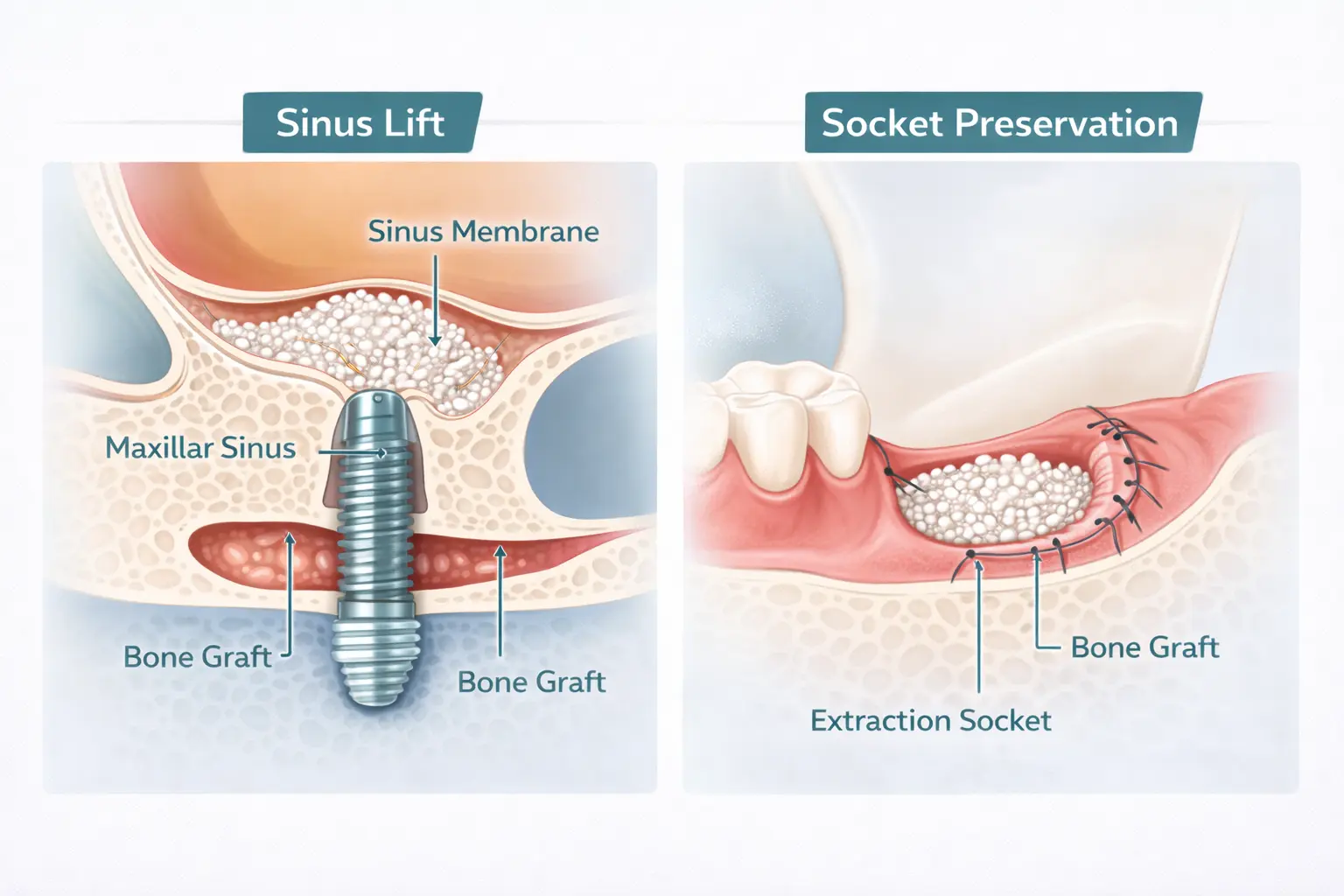
Were You Told You Don’t Have Enough Bone for Implants?
Sinus lift surgery creates the bone you need. Many patients who were rejected elsewhere have gone on to get successful implants at Center for Dental Implants & Esthetics, Gurgaon.
Most Patients Who Were Rejected for Implants
Had Only One Real Problem: Not Enough Bone
A bone shortage in the upper jaw is not a dead end. It is a solvable problem. Sinus lift surgery has been the standard answer for this since the 1970s, and today it is one of the most predictable procedures in implant dentistry when done correctly. The word “sinus” worries patients. The reality is far simpler.
You heard this at another clinic. It may simply mean that clinic does not offer sinus lift. At Center for Dental Implants & Esthetics, this is a routine part of implant planning.
When upper back teeth are missing for years, the sinus cavity drops down and the bone thins. Sinus lift lifts the sinus floor back up and fills the space with bone graft material.
If an implant was placed without enough bone support, it fails. The solution is first building the bone, then placing the implant. Sinus lift does exactly this, in the right sequence.
What Is Sinus Lift Surgery?
Think of your upper jaw as a house. The sinus is the floor of the room above it. When bone is lost, the sinus drops down. Sinus lift surgery gently raises that floor and packs bone material underneath, so there is room to place an implant.
The medical term is maxillary sinus augmentation. “Augmentation” simply means adding to something. We are adding bone volume to your upper jaw, in the area below your maxillary sinuses (the air-filled spaces in your cheekbones).
Your sinuses are completely safe during this process. We never work inside the sinus cavity itself. We work in the bone below it, lifting the membrane gently to create a small space, then filling that space with bone graft material. That material, over 3 to 6 months, fuses with your own bone. Once it matures, a dental implant can be placed with full stability.
Sinus lift is not optional when you have severe upper jaw bone loss. You cannot place an implant in bone that is too thin. The implant will not hold, or it will fail within months. Sinus lift is the foundation step that makes everything else possible.
- Lifts the sinus membrane gently upward
- Creates a small space between the membrane and the jaw bone
- Fills that space with bone graft material (natural or synthetic)
- Lets the new bone mature and integrate over 3 to 6 months
- Then places a dental implant into the now-stable bone
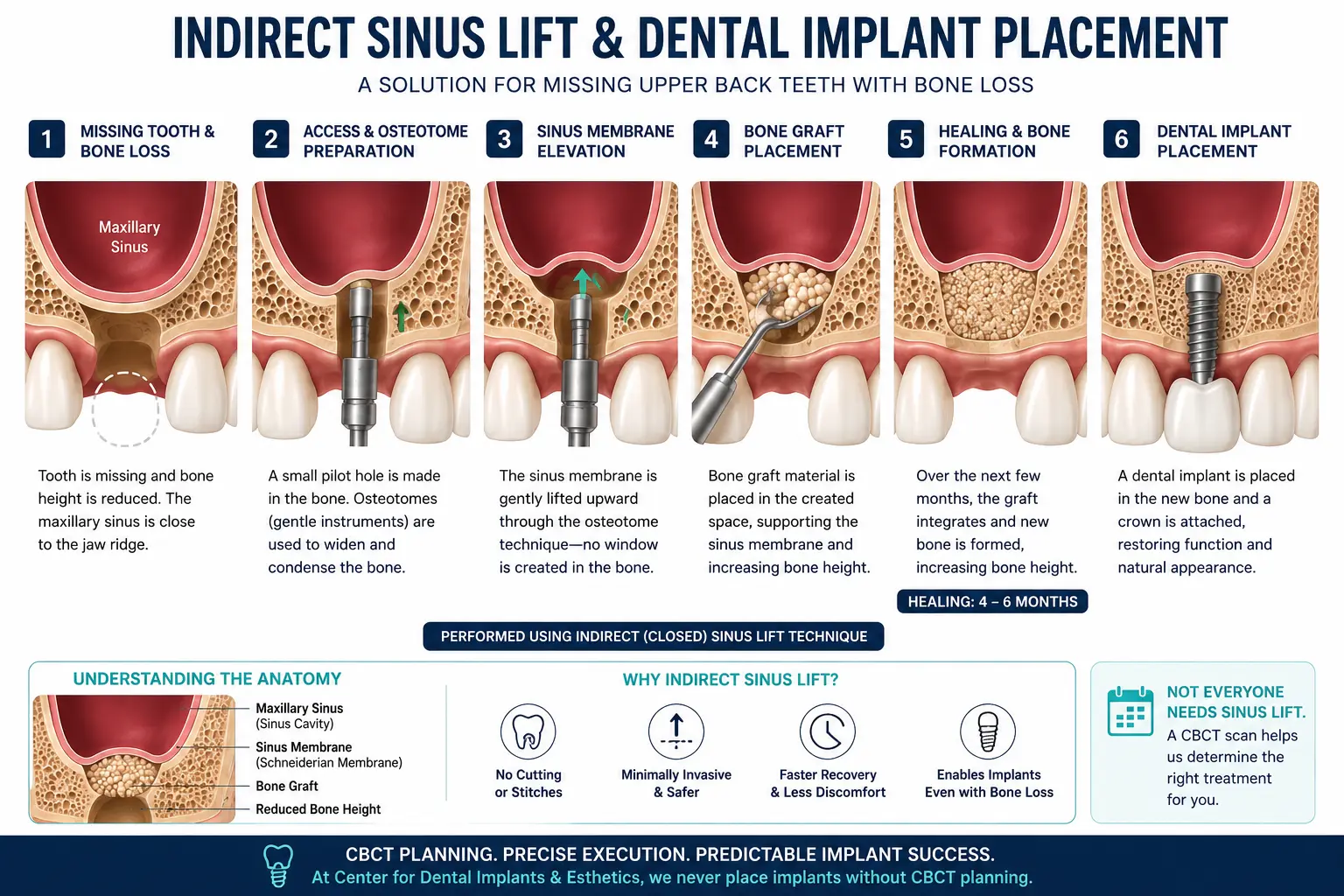
Can You Still Get Implants If Your Bone Is Too Thin?
Most of the time, yes. Here is what causes bone loss in the upper jaw, and why sinus lift is the answer.
When teeth are absent, the jaw bone that used to support those roots starts to shrink. The longer the gap, the more bone is lost. Simultaneously, the sinus cavity drifts downward. This is the most common reason patients need sinus lift.
Dentures sit on the gums, not the bone. They do not stimulate bone, so the jaw continues to shrink under them. Patients who have worn dentures in gurgaon for 5+ years often find the bone has thinned significantly by the time they consider implants.
Some people are born with a larger-than-normal sinus cavity. Even without tooth loss, this can leave inadequate bone depth for a standard implant. CBCT 3D scan confirms this quickly in a single visit.
If an implant was placed without adequate bone assessment and failed, the right approach is sinus lift first, then re-implantation. Skipping this step leads to repeated failures. See our page on dental implant failure causes.
Advanced periodontitis attacks the bone that supports teeth. Once teeth are extracted after gum disease, the bone loss is often significant enough that sinus lift is needed before any upper implant can be considered.
This is the most common story we hear. Many clinics do not offer bone grafting procedures. A “no” from such a clinic does not mean implants are impossible. It may simply mean you need a specialist with the right skills and technology.
Open Sinus Lift vs Closed Sinus Lift — Which One Is for You?
There are two main techniques. The right one depends on how much bone you have now. We decide this based on your CBCT 3D scan, not guesswork.
Lateral (Open) Sinus Lift
- Used when bone height is less than 4 to 5 mm
- A small window is opened in the side of the jaw bone
- The sinus membrane is gently lifted through this opening
- Bone graft is packed into the created space
- Implant placed after 4 to 6 months of healing
- More predictable for large bone augmentations
- This is the gold standard technique for severe bone loss
Crestal (Closed / Indirect) Sinus Lift
- Used when bone height is already 5 to 8 mm
- Approach is made from the implant site itself — no side opening
- Sinus membrane is elevated using special osteotomes (instruments)/Crestal Sinus Kit/Hydraulic/ Balloon lifter
- Smaller, less invasive — less swelling and faster recovery
- Implant can sometimes be placed at the same time
- Suitable for moderate bone deficiency cases
- Not appropriate for severe bone loss — your CBCT will tell us which applies
The technique is not a patient’s choice — it is determined by your anatomy. Choosing the wrong one leads to poor outcomes. This is exactly why we insist on CBCT planning for every sinus lift case at Center for Dental Implants & Esthetics.
Sinus Lift Procedure at Center for Dental Implants & Esthetics — What Actually Happens
You do not need to understand every medical detail. But you deserve to know what happens at each stage, so you are not anxious on the day.
CBCT 3D Scan — Before Anything Else
We take a full CBCT scan of your upper jaw and sinuses. This shows us the exact bone height, bone width, sinus anatomy, and membrane thickness. This scan takes under 3 minutes and gives us a complete 3D view that no 2D X-ray can provide. We plan your entire surgery virtually before touching a single instrument. This step prevents 90% of all complications. At Center for Dental Implants & Esthetics, CBCT is non-negotiable for all sinus lift cases.
Blood Tests and Medical Clearance
We run a mandatory pre-surgical blood panel. This checks your sugar levels, haemoglobin, clotting function, and any markers that could affect healing. Diabetic patients get an HbA1c test. Surgery is scheduled only after clearance. This is standard protocol at our clinic and is not optional.
Local Anaesthesia — You Will Not Feel Pain
The area is numbed completely with local anaesthesia. Most patients are surprised by how little they feel during the procedure. You will feel some pressure, but not pain. For anxious patients, we discuss additional sedation options at the consultation.
Graft Placement and Sinus Membrane Elevation
The surgeon works precisely in the planned area. The sinus membrane is elevated gently with specialised instruments. Bone graft material is then placed in the space created. At Center for Dental Implants & Esthetics, we use bone graft materials that have been clinically validated for sinus augmentation, sourced from US FDA-approved suppliers.
Closure and Healing Period Begins
The surgical site is closed with sutures. You go home the same day. The new bone begins integrating with your jaw over the next 4 to 6 months. This waiting period is not wasted time. It is when the foundation is being built.
Implant Placement — The Goal All Along
Once the grafted bone is confirmed to have matured (we use a follow-up CBCT to confirm this), we place your dental implant. From this point, the implant integrates with bone over another 2 to 4 months. Then your crown is placed. You now have a tooth again, built on a solid foundation that was created specifically for you.
Sinus Lift Complications — Why We Prevent Them With CBCT
Complications in sinus lift surgery are not random. They happen when surgeons operate without seeing the full picture. Here is what risks exist, and how we eliminate them before they arise.
What Are the Real Risks of Sinus Lift, and How Are They Controlled?
| Risk | How Common | How We Prevent It |
|---|---|---|
| Sinus membrane perforation (small tear) | Occurs in 10–20% of cases globally [Source] | CBCT shows membrane thickness and anatomy beforehand. Small perforations are repaired during surgery — the procedure usually still proceeds successfully. |
| Post-operative infection | Uncommon, less than 3% with antibiotic protocol | Pre-surgical antibiotics, post-operative medications, and follow-up review at our clinic within 7 days. |
| Graft failure / poor bone formation | Low when correct material used and healing is undisturbed | Validated graft material selection, mandatory blood work pre-surgery, no smoking counselling, and controlled loading. |
| Swelling and discomfort post-surgery | Expected in all patients to some degree | Cold compress protocol, prescribed pain management, and 5–7 day post-op review. Most patients manage with standard prescribed medication. |
| Benign positional vertigo (rare) | Very rare | Proper patient positioning during surgery and post-operative instructions about head position. |
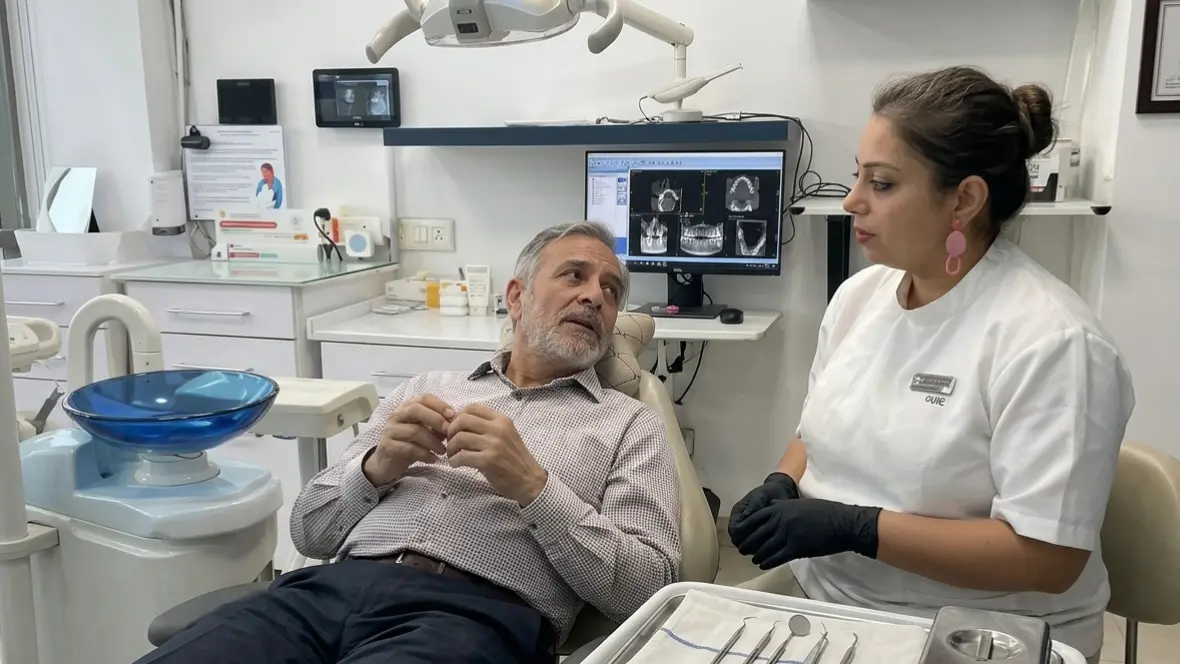
CBCT 3D imaging used for sinus anatomy analysis before surgery at Center for Dental Implants & Esthetics, Sector 51, Gurgaon
Is Sinus Lift Surgery Painful? What to Expect After Surgery
Most patients feel discomfort for 3 to 5 days, not weeks. The fear is almost always bigger than the actual experience. Here is what you will go through, day by day.
| Timeline | What You Will Experience | What You Should Do |
|---|---|---|
| Day 1 to 3 | Swelling on the cheek, mild to moderate pain, some minor bleeding. This is expected. | Cold compress every 20 minutes for the first 24 hours. Take prescribed medications. Rest. Do not blow your nose. |
| Days 4 to 7 | Swelling begins to reduce. Discomfort significantly less. Sutures still in place. | Soft food only. No straws, no smoking, no spitting. Return to clinic for 7-day review. |
| Week 2 to 4 | Most patients feel near-normal. External swelling almost gone. Some awareness of the operated site. | Avoid hard, crunchy foods. Continue normal oral hygiene around the site gently. |
| Month 2 to 3 | No visible signs of surgery externally. Bone is actively forming inside. X-ray may show early integration. | Follow-up imaging as scheduled. No pressure or trauma to the area. |
| Month 4 to 6 | Bone maturation complete in most cases. CBCT confirms readiness for implant placement. | Return for CBCT review. If bone is confirmed, implant surgery is scheduled. |
Foods to Eat and Avoid After Sinus Lift
- Soft cooked rice, dal, khichdi, upma
- Yoghurt, smoothies, bananas, soft fruits
- Soups, broths (not too hot)
- Eggs, soft paneer, soft fish
- Normal temperature or cool foods — no very hot liquids
- Blowing your nose forcefully — this is the most important restriction
- Drinking through straws — suction pressure can disturb the graft
- Smoking — dramatically reduces healing and bone formation
- Hard, crunchy, or chewy foods
- Sneezing with your mouth closed — if you need to sneeze, open your mouth
How Much Does Sinus Lift Surgery Cost in Gurgaon?
No clinic in Gurgaon shows you this number clearly. We believe in price transparency. Below is a realistic range. Your exact cost depends on which technique is needed, whether one or both sides require treatment, and the graft material used.
- Bone height 5 to 8 mm
- Less invasive approach
- Faster recovery
- Implant sometimes same day
- Per side (single sinus)
- Bone height below 5 mm
- Larger bone augmentation
- 4 to 6 months healing before implant
- Per side (single sinus)
- Most commonly needed type
- Both sinuses treated
- Multiple implants planned
- Combined with bone grafting
- Full-mouth cases like All-on-4
- Cost of implants separate
What Affects the Final Cost of Sinus Lift in Gurgaon?
- How much bone needs to be built (measured precisely on CBCT)
- One side (unilateral) vs both sides (bilateral) treatment
- Graft material type — synthetic, bovine-derived, or human cadaver bone
- Whether implant is placed simultaneously or in a second stage
- Number of implants being placed after sinus lift
Sinus Lift vs Zygomatic Implants — Which One Do You Actually Need?
Patients sometimes ask about zygomatic implants as an alternative to sinus lift. Both are valid options. The right choice depends on how severe your bone loss is and how urgently you need teeth. We help you understand this clearly at consultation.
| Factor | Sinus Lift + Implant | Zygomatic Implants |
|---|---|---|
| Bone requirement | Works when bone loss is moderate to severe | For extreme bone loss when sinus lift is not enough |
| Healing time | 4 to 6 months for graft, then implant | Can often load sooner, as cheekbone is used |
| Complexity | Standard implant specialty procedure | Highly specialised — fewer surgeons are trained |
| Cost | More affordable for single implant cases | Significantly higher total cost |
| Suitable for | Most upper jaw bone loss cases | Severe atrophy, failed multiple sinus lifts, or full-arch cases where other options fail |
| Long-term outcome | Excellent when performed correctly with CBCT | Good, but more complex management |
For more on zygomatic implants in Gurgaon and when they are indicated, read our dedicated page. For most patients who come to us after being told “implant not possible,” sinus lift is the right and sufficient solution.
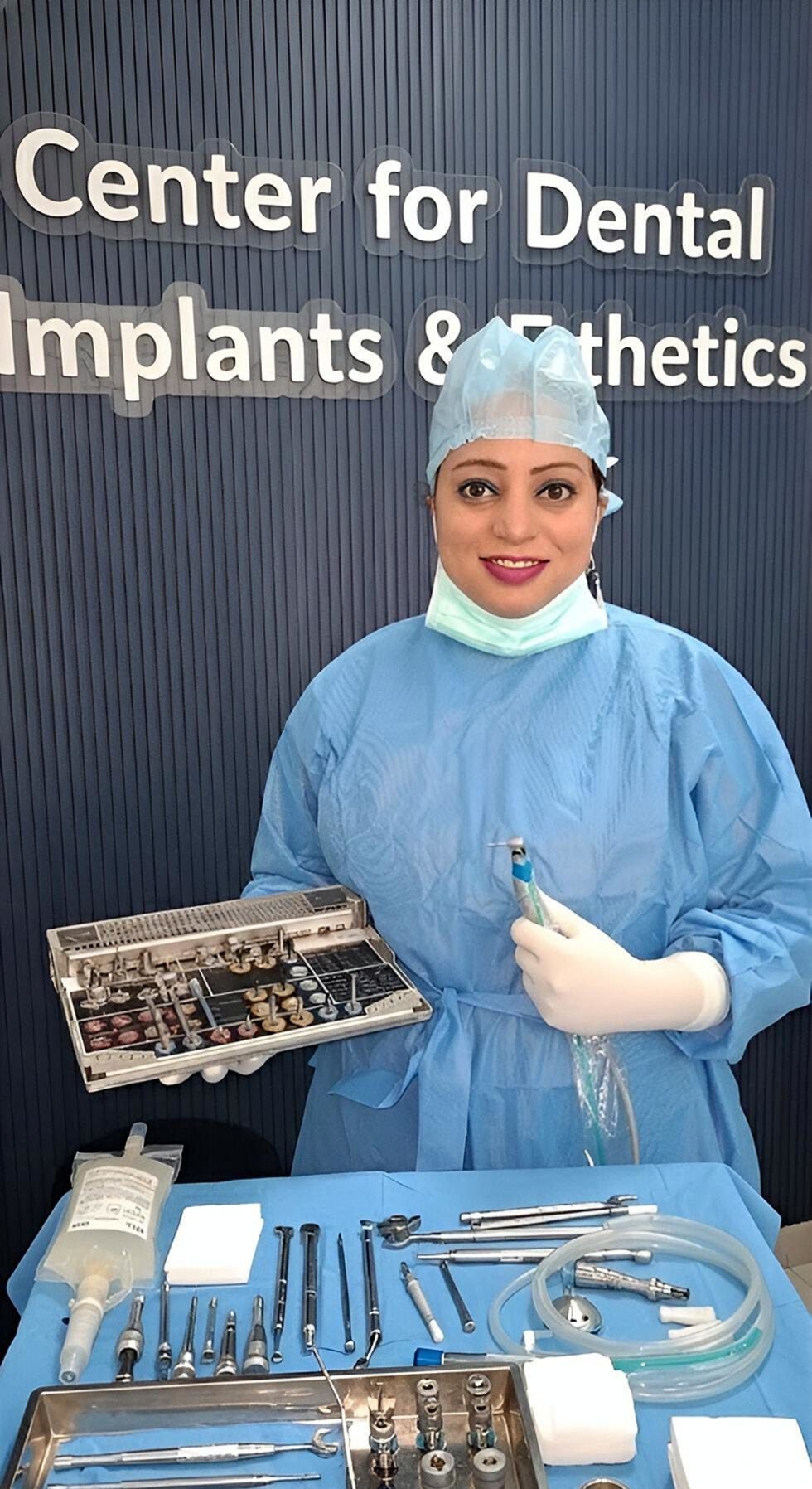
About Dr Jyoti Singh — Sinus Lift Specialist, Gurgaon
— Dr Jyoti Singh, MDS (Prosthodontics & Implantology), Center for Dental Implants & Esthetics, Gurgaon
Dr Jyoti Singh completed her MDS from Maulana Azad Institute of Dental Sciences (MAIDS), Delhi — one of India’s premier dental institutions. She is among the very few implantologists in Delhi NCR with both surgical training and prosthetic expertise. This dual training matters for sinus lift patients: the same doctor who builds your bone foundation also plans your final crown. Nothing is passed off to a junior.
As a Diplomate of the World Congress of Oral Implantology (Japan Region) and Nobel Biocare-trained implantologist, she regularly handles complex cases including multiple sinus lifts, guided implant surgery, and full mouth dental implants in Gurgaon that involve bone augmentation as part of the treatment plan.
- CBCT 3D scan for every sinus lift case — never 2D OPG
- Mandatory blood tests before every surgical case
- US FDA-approved implant systems and graft materials
- 7-day post-operative review included as standard
- Honest, ethical practice — we do not recommend surgery unless it is genuinely needed
- Both Gurgaon branches fully equipped for this procedure
Frequently Asked Questions About Sinus Lift Surgery in Gurgaon
Direct, clear answers to the questions patients ask most. No guesswork, no vague responses.
- Sinus lift is a standard, well-documented procedure used since the 1970s
- CBCT scan will confirm whether you are a candidate — this takes one visit
- Even with very thin bone (less than 4 mm), lateral sinus lift can build sufficient bone for implants
- Many patients at Center for Dental Implants & Esthetics have gone on to get successful implants after being told “not possible” elsewhere
- A CBCT-based evaluation is the only way to know for certain — not a 2D X-ray
- Day 1 to 3: Moderate discomfort and swelling, managed with prescribed pain medication
- Days 4 to 7: Swelling reduces, pain significantly less — most patients manage without strong medication from day 5
- Week 2: Most patients feel near-normal, with only mild awareness of the site
- Pain is almost always less than patients expect, especially with proper post-operative care
- Do not compare to stories you read online — individual experience varies based on case complexity
- Indirect (closed) sinus lift: Implant can sometimes be placed same day. Crown in 3 to 5 months. Total: 4 to 6 months
- Lateral (open) sinus lift: 4 to 6 months for graft to mature, then implant surgery, then 3 to 4 months for implant integration, then crown. Total: 9 to 14 months
- This timeline is not wasted time — the bone is being built correctly
- Rushing this timeline leads to implant failure, which wastes much more time and money
- We review your progress with CBCT at each stage to confirm readiness before proceeding
- Sinus membrane perforation is the most common complication, occurring in 10 to 20% of cases globally
- Small perforations are repaired during surgery — in most cases the procedure continues successfully
- CBCT 3D scanning dramatically reduces this risk by showing the membrane anatomy before we begin
- Post-operative sinus infection is uncommon — less than 3% with proper antibiotic protocol
- We give detailed post-op instructions: no nose blowing, open-mouth sneezing, no straws — all of which protect the sinus
- Your sinus function is not affected by sinus lift surgery performed correctly
- We require an HbA1c test — ideally below 7.5 before surgery is scheduled
- Patients with well-controlled diabetes have excellent sinus lift outcomes
- Healing may take slightly longer — we account for this in the treatment plan
- We work with your physician if medication adjustment is needed pre-surgically
- Poorly controlled diabetes does delay surgery — not cancels it. We help you get cleared first
- Read our guide on diabetes and dental health for a full explanation
- Indirect sinus lift: ₹30,000 to ₹50,000 per side
- Lateral sinus lift: ₹45,000 to ₹75,000 per side
- Bilateral (both sides): ₹90,000 to ₹1,50,000+
- Implant cost is additional — see our dental implant cost Gurgaon page
- CBCT scan and blood tests are quoted separately and transparently
- We never surprise patients with hidden charges — full cost is disclosed before treatment begins
- Simultaneous placement is possible when residual bone height is 5 mm or more
- The implant must achieve a minimum insertion torque value to be stable enough for simultaneous placement
- For lateral sinus lift with very thin bone, we separate the procedures by 4 to 6 months
- Rushing simultaneous placement in insufficient bone leads to implant failure
- If simultaneous placement is possible, it does reduce overall treatment time significantly
- We assess this individually for each patient — there is no universal rule
- The upper jaw has thinner cortical bone (the hard outer shell) compared to the lower jaw
- The maxillary sinuses sit just above the upper back teeth roots — when teeth are lost, the sinus cavity expands downward into the now-empty space, further reducing bone height
- The bone resorption rate in the upper jaw after tooth loss is approximately 0.5 to 1 mm per year — faster than the lower jaw
- This is why acting early matters — the longer you wait, the more bone is lost and the more complex the sinus lift becomes
- A simple CBCT taken now will show exactly how much bone you have remaining
- Sector 51 branch: #166, Ambedkar Chowk, near Artemis Hospital, Gurgaon 122003
- Sector 74 branch: R1-257, 2nd Floor, M3M Cornerwalk, Sector 74, Gurugram 122004
- All complex implant cases including sinus lift are personally performed by Dr Jyoti Singh
- Both branches have full surgical facilities and CBCT equipment
- Book your evaluation at whichever location is convenient for you — Sector 51 is close to Artemis Hospital and convenient for residents of Sectors 46 to 57, DLF, Sushant Lok. Sector 74 serves sectors 70 to 82, Vatika, South Gurgaon.
- Synthetic bone substitutes (alloplastic): Most commonly used — safe, no donor site needed, predictable results
- Bovine-derived bone (xenograft): Well-researched, excellent long-term integration, commonly used in sinus cases
- Human cadaveric bone (allograft): Pre-processed and sterilised, natural integration, available on request
- Autogenous bone (from your own body): Gold standard, but requires a second surgical site — used in specific complex cases only
- All materials used at our clinic are from US FDA-approved suppliers
- The type of material does not change the pain level or recovery significantly
Ready to Find Out If Sinus Lift Is Right for You?
One CBCT scan. One consultation. You will know exactly what is possible, what it costs, and how long it takes. No vague answers. No pressure.
Sector 51 Branch
Center for Dental Implants & Esthetics#166, Sector 51 (Ambedkar Chowk), Close to Artemis Hospital, Gurgaon, Haryana 122003
Convenient for Sectors 46–57, DLF Phase, Sushant Lok
Sector 74 Branch
Center for Dental Implants & EstheticsR1-257, 2nd Floor, M3M Cornerwalk, Sector 74, Gurugram, Haryana 122004
Convenient for Sectors 70–82, Vatika, South Gurgaon
Bone Grafting for Dental Implants in Gurgaon
Sinus lift is one type of bone graft. Understand all bone augmentation options available for implant patients, including ridge grafting and socket preservation, and when each is needed.
Read about bone grafting for implants →Dental Implant Cost in Gurgaon — Complete Breakdown
Once your sinus lift is planned, the next step is understanding implant costs. This page covers single tooth implant prices, full-mouth implant costs, and what affects the total investment.
See dental implant cost in Gurgaon →Can I Get Dental Implants with Bone Loss?
If you have been told your bone is insufficient, read this page before accepting that answer. It covers all options including sinus lift, bone graft, zygomatic implants, and which patients qualify for each.
Implants with bone loss — find out your options →This page is for informational purposes only and does not replace professional dental consultation. Symptoms described may have multiple causes. Please visit a qualified dental professional for diagnosis and personalised treatment advice.