Teeth Grinding Treatment
in Gurgaon
Your Teeth Are Shrinking.
Most People Find Out Too Late.
You may not feel it happening. But every night, grinding forces up to 250% of normal chewing force are silently flattening your enamel, stressing your jaw joint, and destroying years of dental work. The damage is permanent. It starts now.
What You Came Here to Know
Symptoms of Teeth Grinding — How Many Do You Have?
Many patients in DLF, Nirvana Country, and Golf Course Extension come with headaches or jaw pain. Grinding is often the hidden reason.
Morning Jaw Pain
- Jaw sore right when you wake up
- Tightness eases as the day goes on
- Worse on weekday mornings (stress pattern)
Morning Headaches
- Tension headache at the temples on waking
- Often mistaken for sleep headaches or dehydration
- Temporalis muscle activated overnight is the cause
Teeth Looking Shorter
- Biting edges are flat, not sharp
- Teeth look shorter compared to old photos
- Yellow dentine visible at the biting edge
Jaw Clicking or Locking
- Click sound when opening wide
- Jaw locks briefly in the morning
- Early sign of TMJ disorder
Tooth Sensitivity
- Sharp pain on cold, sweet, or biting
- Enamel thinning exposes the sensitive dentine layer
- Worsens progressively over months
Fillings and Crowns Breaking
- Fillings chip with no clear cause
- Crowns crack within a few years of placement
- Dental work fails earlier than it should
According to the Sleep Foundation, sleep bruxism affects 8–31% of the general population. Among high-stress Cyber City and Golf Course Road professionals in Gurgaon, clinical prevalence is likely much higher.
By the Time the Damage Is Visible, It Has Been Happening for Years
This is the hardest conversation to have. Enamel does not grow back. The damage is silent and slow. But the consequences stack up.
The IT Professional Who Lost Four Crowns in Three Years
A 38-year-old software architect from Cyber City came to our Sector 74 clinic in 2024 frustrated and confused. He had spent over ₹1.2 lakh on dental crowns in three years at two different clinics. Every crown eventually fractured. The previous dentists kept replacing the crown and never asked why it was breaking.
When we did a CBCT scan and bite analysis, the picture became clear. He had a deep bite causing his lower front teeth to slam repeatedly into the upper front crowns with every nighttime grind cycle. The vertical bite height had collapsed by nearly 3mm over years. He was waking with headaches three mornings a week and thought it was work stress.
The solution was not another crown. It was full occlusal rehabilitation to restore the lost bite height, combined with Invisalign to correct the deep bite. He now wears a precision night guard. No crown has broken since.
Lesson: The crown was never the problem. The bite was. Every dentist who replaced the crown without diagnosing the cause was expensive and useless.
Teeth Become Shorter
- Chronic grinders lose 2–4mm of tooth height over years
- Biting edges go from sharp to completely flat
- Front teeth look stumpy and aged
- Enamel that is ground away does not regenerate
The Face Looks Older, Faster
- Tooth height supports lower face height
- As teeth shrink, the chin moves upward
- Deep lines form around the mouth
- The face gets a collapsed, sunken look
Repeated Crown Failures
- Crowns are designed for chewing — not 90 kg grinding
- PFM crowns chip. Zirconia cracks under severe force
- Replacing crowns without managing bruxism wastes money
- Each failed crown removes more natural tooth structure
TMJ Joint Breakdown
- Years of overload damage the cartilage disc in the jaw joint
- Clicking becomes locking, then pain
- TMJ disorder caused by grinding is far harder to treat at the advanced stage
- Surgery is occasionally needed when left too long
Implants Put at Risk
- Implants placed in active grinders without management fail at higher rates
- Bone around the implant absorbs all the grinding force
- Peri-implant bone loss and implant loosening can follow
- A failed implant costs ₹40,000–80,000 to redo
Nerve Damage from Cracked Teeth
- Grinding cracks teeth in ways fillings cannot fix
- Cracks extend to the nerve over time
- This leads to root canal treatment or tooth loss
- Cracked tooth syndrome is almost always grinding-related
Key fact: Most patients who end up needing full mouth reconstruction had grinding as the starting point. The destruction did not start with one bad tooth. It started with one undiagnosed bite problem.
How Untreated Grinding Leads to Full Mouth Rehabilitation
This is the single most important thing to understand about bruxism. Each stage locks in more damage. Each stage also has a clear treatment — but only if you act.
Stage 01 and 02 cost ₹8,000–15,000 to manage. Stage 06 costs ₹1.5L–6L. Catching grinding early is not just better dentistry. It is better economics. Book an evaluation now before you move further along this path.
Why Does Teeth Grinding Happen?
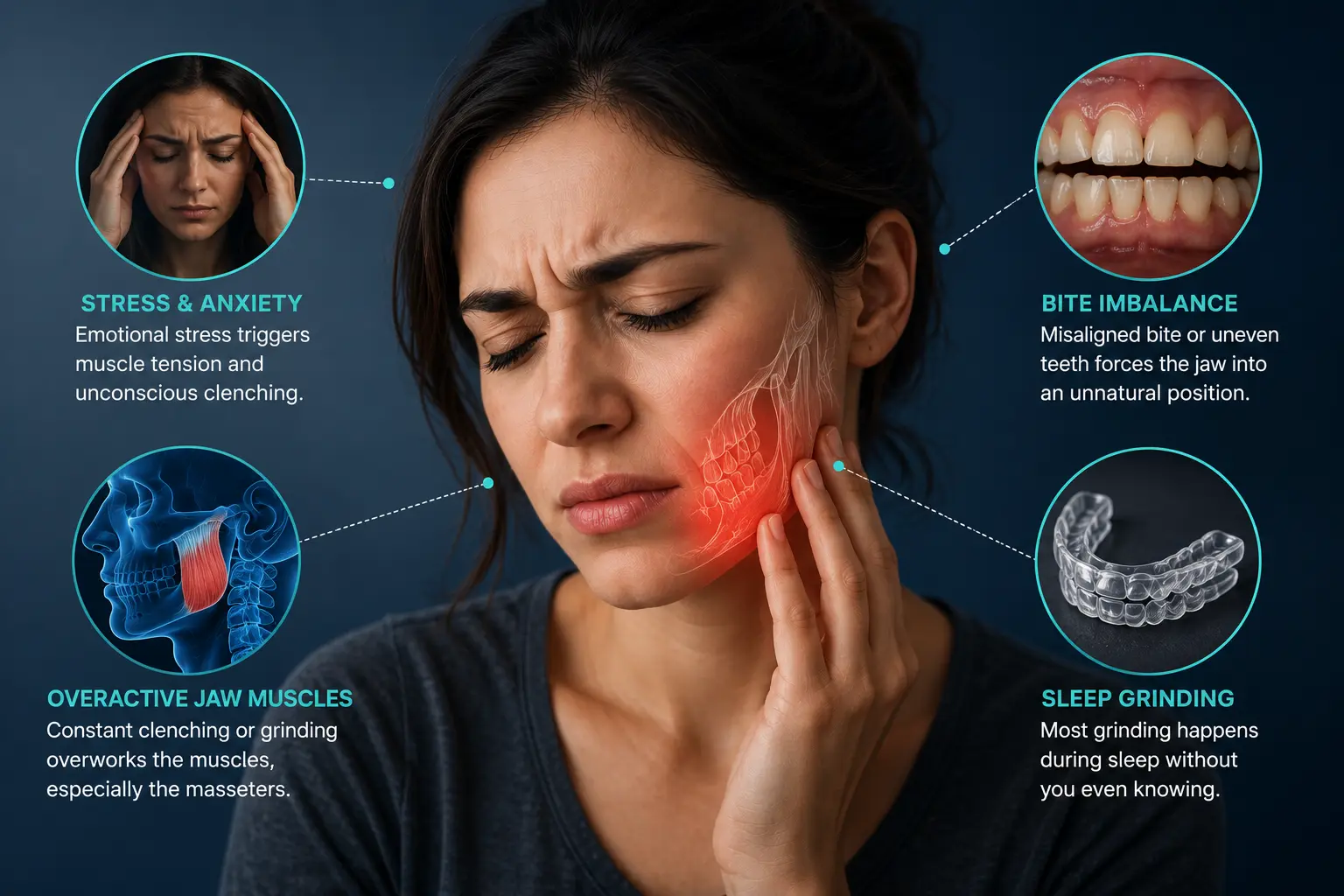
The short answer: stress, bite problems, or both. At Center for Dental Implants & Esthetics, we find that most patients from Cyber City, DLF, and South City Gurgaon come with stress as the obvious trigger. But stress alone rarely explains why one person grinds and another does not. The underlying bite condition is usually the structural reason.
-
Work Stress and Cortisol
Corporate deadline pressure, long commutes on NH-48, and late nights at Cyberhub — all raise cortisol levels. Elevated cortisol disrupts deep sleep and activates jaw muscles involuntarily at night.
-
Bite Misalignment (Malocclusion)
When upper and lower teeth do not fit together evenly, the jaw searches for a comfortable resting position throughout the night. This constant searching becomes grinding. A jaw alignment problem is the trigger nobody diagnoses.
-
Deep Bite
A deep bite means upper front teeth sit excessively over the lower ones. This blocks normal jaw movement. The jaw is forced to grind sideways to move at all. This is an extremely common pattern in Gurgaon patients we see.
-
Sleep-Disordered Breathing
Sleep apnea and bruxism often coexist. Micro-arousals during breathing pauses trigger the jaw-clenching reflex. Many patients manage one condition and wonder why symptoms persist.
-
Caffeine and Alcohol
Both reduce sleep quality. Bruxism is significantly worse during light sleep stages (N1, N2). Multiple coffees from Starbucks Ambience Mall or a nightcap at DLF Cyber Hub keeps the sleep shallow and the grinding going.

“In my clinical experience, 4 out of 10 patients who come to me with worn teeth or repeatedly broken crowns have an undiagnosed bite problem underneath. The grinding is the symptom. The bite is the cause. I trained specifically in occlusion at Maulana Azad Institute of Dental Sciences for this reason — because diagnosing the bite is what changes the treatment outcome.”
What Teeth Grinding Does to Your Mouth Over Time
Each stage is more expensive and more complex to treat than the one before.
| Stage | What Is Happening Inside | What You Notice | What Is Needed |
|---|---|---|---|
| Early (0–2 yrs) | Surface enamel wearing. Jaw muscles enlarging. | Occasional jaw soreness. Morning headaches. | Occlusal evaluation + custom splint |
| Moderate (2–5 yrs) | Significant enamel loss. Dentine exposed. Fillings crack. | Sensitivity. Teeth look flatter. Broken fillings. | Splint + bite correction |
| Advanced (5+ yrs) | Deep tooth wear. TMJ joint affected. Vertical face height reducing. | Crowns fracture repeatedly. Daily jaw pain. Face looks shorter. | Full mouth rehabilitation |
| Severe | Multiple teeth non-restorable. Bone loss. Joint degeneration. | Teeth breaking off. Severe jaw pain. Eating difficulties. | Reconstruction + implants |
Fact: Enamel is the hardest tissue in the human body. Once lost to grinding, it cannot regenerate. Chronically grinding patients lose between 2 and 4mm of tooth height over years — a change that alters both function and facial appearance permanently. Reference: NIH / J Oral Rehabil 2020.
Why Your Jaw Looks Wider or Squarer Than It Used To
This is one of the most searched but least discussed effects of chronic teeth clenching.
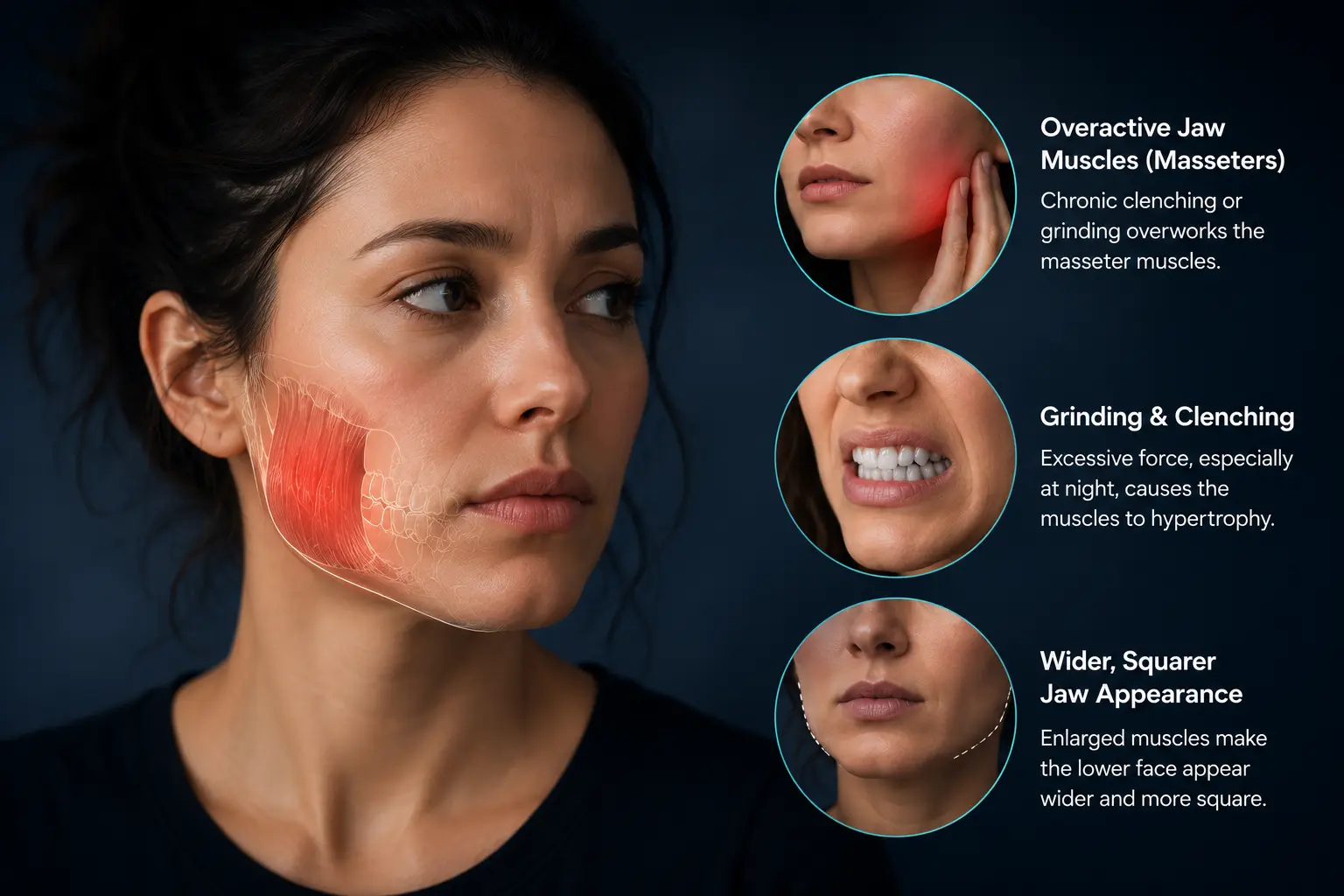
The masseter is the muscle that closes your jaw. It is the strongest muscle in the body relative to its size. When you clench and grind continuously — especially at night — the masseter works like someone doing heavy gym reps for 6–8 hours. It gets bigger.
This condition is called masseter hypertrophy. The result is a wider, squarer jawline that does not match the rest of the face. It is common in corporate professionals in their 30s and 40s in Gurgaon who do not realise it is related to grinding.
Self-Test: Check Your Masseter Right Now
Press your index finger firmly just in front of both ears. Now clench your teeth. Do you feel a hard, prominent bulge on one or both sides? If yes, your masseter is enlarged. This is a clinical sign of chronic clenching.
Signs of Masseter Hypertrophy
- Jawline has become visibly wider or more square over years
- Hard, prominent muscle felt just in front of the ear when biting
- Face looks asymmetric — one side more prominent
- Cheek soreness or tenderness when pressing the masseter
- Jaw fatigue when chewing hard foods
Treatment: Botox for Masseter Reduction
- Small Botox dose injected into the masseter reduces its bulk over 4–6 weeks
- Bite force reduces by 30–40% without affecting normal chewing
- Reduces grinding damage on teeth, crowns, and implants
- Slims the jawline in cases of cosmetic concern
- Results last 4–6 months initially. Duration increases with repeat treatment
- A 2020 systematic review in the Journal of Oral Rehabilitation confirmed Botox significantly reduces bruxism-related masseter activity and pain
Bruxism Often Exists Alongside These Conditions
Grinding rarely exists in isolation. It is usually one part of a larger picture that needs to be evaluated together.
Bruxism Diagnosis at Center for Dental Implants & Esthetics, Gurgaon
Most Gurgaon clinics look at the teeth and hand you a generic mouth guard. What you get here is a specialist occlusal evaluation backed by 3D imaging.
Full Clinical Examination
We check wear patterns on every tooth surface, muscle bulk comparison on both sides, and joint tenderness at multiple points. Each finding is recorded.
CBCT Scan (3D Jaw Analysis)
We use CBCT 3D imaging to evaluate the temporomandibular joint in detail. This reveals early joint disc changes, bone remodeling, and bite asymmetry that a flat X-ray completely misses. This is our standard protocol — not an optional extra.
Occlusal (Bite) Analysis
We map exactly which teeth are taking excessive force during biting, chewing, and lateral movement. An uneven bite causes specific muscle groups to overwork. Finding this is the foundation of actual treatment.
Sleep and Lifestyle History
We ask directly about your sleep quality, work stress, commute patterns, caffeine, and alcohol use. For patients from Cyber City, Unitech Cyber Park, or startup hubs in Sohna Road — the lifestyle picture often completes the diagnosis.
Center for Dental Implants & Esthetics — Occlusion Is Our Core Specialty
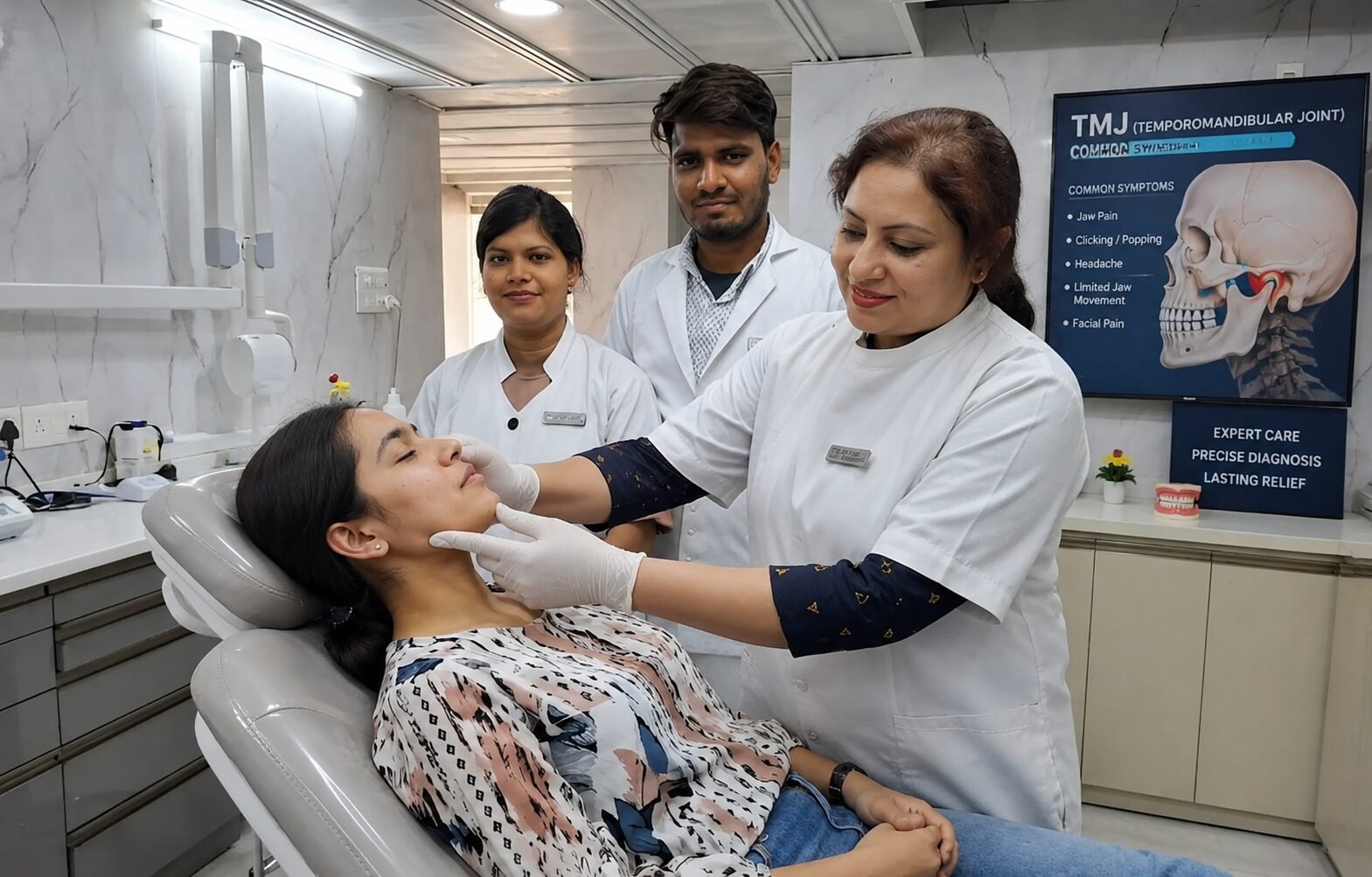
Dr. Jyoti Singh’s MDS from Maulana Azad Institute of Dental Sciences (MAIDS) specialises in prosthodontics — the dental discipline that deals entirely with restoring bite, replacing missing teeth, and managing occlusal (bite) force disorders. Bruxism and its downstream consequences sit at the center of this specialty. This is not a general dentistry add-on for us. It is what we were trained for.
With Diplomate status from WCOI (Japan Region), Nobel Biocare implant training, Invisalign certification, and over 10,000 implants placed across both our Gurgaon clinics, the experience base here goes beyond what most specialist clinics in Delhi NCR offer for this specific condition.
Bruxism Treatment in Gurgaon — Matched to Your Case
There is no single treatment for every patient. The right plan depends on severity, bite condition, and how much damage has already happened.
Precision Occlusal Splint
- Hard acrylic device made from your exact bite impression
- Worn while sleeping to reduce impact on teeth and jaw joints
- Distinct from chemist-bought trays — those are made to average dimensions and can make bite problems worse
- A splint manages the problem. It does not fix the cause
Bite Correction
- Reshapes specific teeth so all teeth meet evenly
- Removes the premature contact that forces the jaw into grinding position
- Can include Invisalign, braces, or selective crown work
- Recommended in moderate to severe cases with a diagnosed bite problem
Botox for Masseter
- Reduces clenching force by 30–40% without affecting chewing
- Effective when stress-driven clenching does not respond to splint alone
- Results at 4–6 weeks. Duration extends with repeat treatment
- Also addresses the square jaw from masseter hypertrophy
Full Mouth Rehabilitation
- For patients with extensive wear, multiple cracked teeth, or reduced bite height
- Rebuilds entire bite using crowns, veneers, or implants as required
- Restores the lost vertical dimension — the face height that grinding collapsed
- Details: Full Mouth Reconstruction Gurgaon
TMJ Treatment
- For patients with jaw clicking, locking, or chronic joint pain
- Includes splint therapy, joint physiotherapy, and CBCT monitoring
- May incorporate neuromuscular dentistry principles
- Surgery is rarely required when caught before joint disc perforation
Worn Teeth Restoration
- Composite bonding for early wear stages
- Zirconia crowns for moderate to severe damage
- Veneers for front teeth where appearance is priority
- Done only after the grinding cause is controlled — never before
Restoring worn teeth before managing the grinding cause is the single most common mistake in bruxism treatment. We rebuild teeth only after the bite has been stabilised and the clenching force is under control. The sequence matters enormously.
Can Teeth Grinding Destroy Dental Implants?
This is the question every implant patient with grinding needs answered before any implant is placed.
No Shock Absorber. The Bone Takes Everything.
A natural tooth has a periodontal ligament — a thin, shock-absorbing layer between the tooth and bone. An implant fuses directly to bone with no such cushion. Every gram of grinding force goes straight into the surrounding bone. In a moderate grinder, this can trigger peri-implant bone loss, implant loosening, and crown fracture within 2–3 years of placement.
What We Do Before Placing Implants in Grinders
- Mandatory bite force assessment before any implant planning
- Implant number and position designed around your grinding pattern, not a standard template
- Often more implants are placed to distribute the force load
- Occlusal splint fabricated before final crown placement
- No final crown placed until grinding is managed and controlled
What We Do After Implant Treatment in Grinders
- Zirconia crowns over PFM — higher fracture resistance under repeated force
- Implant screw torque checked at every recall visit
- Night guard compliance discussed and monitored at every appointment
- CBCT follow-up to track bone levels around implants at 6 and 12 months
Related: What Causes Dental Implant Failure | Risks of Implant Surgery | Peri-Implantitis Treatment
Bruxism Treatment Cost in Gurgaon — 2026 Overview
Your exact cost depends on diagnosis findings. We discuss the full plan before you commit to anything.
Prices are indicative for 2026. Your treatment plan is discussed in full detail before any work begins. EMI options available at both clinics.
A custom splint costs ₹8,000–12,000. A single failed crown replacement costs ₹12,000–25,000. A failed implant costs ₹40,000–80,000 to redo. The splint is the most cost-effective dental decision you can make today.
Frequently Asked Questions — Teeth Grinding & Bruxism
Daytime clenching is called awake bruxism and it is extremely common in high-stress work environments like corporate Gurgaon. Unlike sleep grinding, you have the ability to become aware of it and stop consciously.
- Common triggers: concentration, anxiety, multitasking, driving in traffic on NH-48
- Many people clench during long video calls without realising
- The brain uses jaw clenching as a physical outlet for mental tension
- A cognitive habit-reversal technique alongside an occlusal splint can help
- If daytime and nighttime clenching both exist, treatment needs to address both
- Yes. Psychological stress is the most widely documented trigger for sleep bruxism
- Elevated cortisol disrupts deep sleep stages where the jaw-clenching reflex is suppressed
- A 2016 review in the Journal of Dentistry found patients with anxiety disorders had significantly higher bruxism prevalence
- Managing anxiety (therapy, exercise, sleep hygiene) reduces grinding frequency
- However, stress rarely explains why teeth are being damaged specifically — that is where the bite condition plays its role
Yes, in specific cases. When bruxism is driven by a deep bite or misaligned bite, correcting the bite with Invisalign can significantly reduce the grinding trigger.
- Invisalign aligners also act as a partial splint during treatment itself
- After treatment, a retainer or night guard maintains the correction
- Invisalign is not a treatment for stress-driven grinding where the bite is already normal
- Your bite needs to be properly evaluated before deciding if Invisalign is appropriate
- Research suggests a genetic component exists. If a parent grinds, children are at higher risk
- A 2012 twin study published in the Archives of Oral Biology found approximately 52% heritability for sleep bruxism
- However, genetics set a tendency. Environmental factors like stress and bite misalignment determine whether grinding actually occurs and how severely
- If grinding runs in your family, earlier evaluation and monitoring is recommended
Fillings breaking without trauma or decay is almost always a bruxism red flag. This is one of the most common presentations we see at our Sector 51 clinic from patients in Sushant Lok and DLF Phase 3.
- Normal chewing forces are 20–40 kg. Grinding forces can reach 80–100 kg
- Composite and amalgam fillings are not designed for this kind of repeated lateral force
- The filling breaks first. The underlying tooth is next
- If your fillings have broken more than once on the same tooth, a bruxism evaluation is needed before the next filling is placed
- Yes, in two ways
- Wider jaw: Masseter hypertrophy (enlarged jaw muscle from chronic clenching) makes the lower face look wider and more square
- Shorter lower face: As teeth grind down, the vertical bite height collapses. The chin moves upward. Deep lines form around the mouth. The face looks 5–10 years older
- Full mouth rehabilitation restores the bite height and reverses this collapsed appearance
- Botox to the masseter reduces the muscle bulk and restores a more oval jawline
Related, but not the same condition.
- Bruxism = the habit of clenching or grinding teeth
- TMJ disorder = damage or dysfunction of the jaw joint itself
- Bruxism is a major cause of TMJ disorder
- TMJ disorder can also exist independently from bite problems, jaw injury, or arthritis
- Both require proper diagnosis — treating one without evaluating the other leads to incomplete outcomes
- Evaluation and splint: 1–2 visits over 1 week
- Bite adjustment: 1–3 visits
- Botox: single session, effect visible in 1–2 weeks
- Bite correction with Invisalign: 6–18 months
- Full mouth rehabilitation: 3–9 months depending on complexity
- Long-term: many patients continue wearing a splint indefinitely as a maintenance device
Clinically, yes. At both our clinics — Sector 51 near Artemis Hospital and Sector 74 at M3M Cornerwalk — we see a disproportionately high number of working professionals in their 30s and 40s presenting with bruxism-related damage.
- Cyber City, Unitech Cyber Park, and startup offices on Golf Course Extension Road feed a culture of late nights, high caffeine, and elevated cortisol
- Most of these patients have visited neurologists first for their headaches
- Bruxism was not on anyone’s radar until the dental exam revealed the wear
- If you commute, work long hours, or sleep poorly in Gurgaon and have jaw issues — get evaluated
Yes. The temporomandibular joint sits directly in front of the ear canal. When this joint is stressed, pain radiates inward and feels like it is coming from the ear.
- Ear fullness, muffled hearing, or tinnitus (ringing) can all be TMJ-related
- Many patients see multiple ENT doctors for years without resolution
- If your ENT finds normal ears but the symptoms persist, a dental TMJ evaluation should follow
Book a Bruxism Evaluation in Gurgaon
Sector 51 (Near Artemis Hospital) | Sector 74 (M3M Cornerwalk) | Delhi NCR Patients Welcome
Center for Dental Implants & Esthetics
#166, Sector 51 (Ambedkar Chowk)
Close to Artemis Hospital
Gurgaon, Haryana 122003
Center for Dental Implants & Esthetics
R1-257, 2nd Floor, M3M Cornerwalk
Sector 74, Gurugram
Haryana 122004
You May Also Want to Read
TMJ Disorder — Diagnosis & Treatment Gurgaon
Jaw clicking, locking, or daily jaw pain often starts with bruxism. This guide explains what is happening inside the jaw joint and what the treatment pathway looks like.
TMJ Treatment Gurgaon →Worn Teeth Treatment in Gurgaon
If your teeth look flatter, shorter, or more yellow at the biting edges, this is the dedicated guide on restoring tooth wear — options, process, and realistic expectations.
Worn Teeth Treatment →Long-Term Consequences of an Incorrect Bite
An uneven bite is the most under-diagnosed cause of grinding. This article connects bite problems to jaw pain, headaches, tooth wear, and what can still be done.
Bite Problems & Consequences →This page is for informational purposes only and does not replace professional dental consultation. Symptoms described may have multiple causes. Please visit a qualified dental professional for diagnosis and personalised treatment advice.