Your Jaw Clicks, Aches, or Locks.
There Is a Reason for That.
Dr. Jyoti Singh — MDS Prosthodontist & the only prosthodontist-led TMJ specialist in Gurgaon — treats jaw pain, teeth grinding, and clicking without surgery in most cases.
What Is TMJ Disorder?
TMJ stands for Temporomandibular Joint — the two joints that connect your lower jaw to your skull, one on each side just in front of your ears. When these joints or the surrounding muscles stop working properly, you get TMJ disorder (also called TMD).
- TMJ disorder causes jaw pain, clicking sounds, headaches, and trouble chewing
- It is not just a dental problem — it involves jaw joints, muscles, and sometimes your bite alignment
- Most people with TMJ disorder do NOT need surgery
- A prosthodontist is the best-trained dental specialist to manage TMJ — because the disorder often relates to how your teeth meet (your bite)
Think of your jaw joint like a door hinge. When the hinge is worn or misaligned, the door sticks, creaks, or jams. Your jaw does the same thing — and every time you eat, talk, or yawn, that hinge is working. When something goes wrong, you feel it every single day.
In my 17 years of practice at Center for Dental Implants & Esthetics, I see TMJ problems in all kinds of patients — stressed professionals, people with missing back teeth, and those who clench at night without even knowing it. It is more common in Gurgaon than most people realise, especially with the long working hours and WFH culture.
Quick Answers
The joint connecting your lower jaw to your skull. When it misfunctions, you get pain, clicking, or locking.
Yes. In over 90% of cases, splints, bite correction, and physiotherapy are enough. Surgery is a last resort.
A custom-made hard resin guard worn at night that repositions your jaw to reduce muscle strain and protect teeth.
Nighttime teeth grinding (bruxism) — you clench without knowing. A night guard stops this.
Yes. Missing back teeth shift your bite, overloading the jaw joint. This is a major and overlooked cause of TMJ.
Mild cases improve in 4 to 8 weeks. More complex bite issues take 3 to 6 months depending on the treatment plan.
Involuntary grinding or clenching of teeth, usually at night, often triggered by stress. It damages teeth and overworks the jaw muscles.
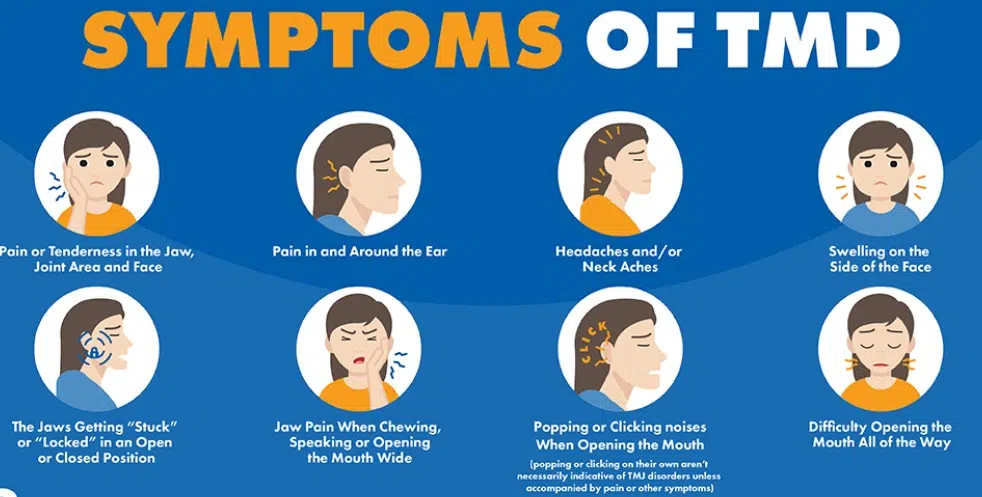
TMJ Symptoms — Are You Experiencing Any of These?
Many people live with TMJ pain for months, assuming it will go away. It usually does not. Here is what to look for:
Clicking or Popping Jaw
A sound every time you open or close your mouth. Often painless at first, but it signals the disc inside the joint is shifting.
Jaw Pain While Chewing
Pain that comes when you eat hard or chewy food. Can radiate to the ear, temple, or neck.
Morning Jaw or Headache
If your jaw hurts when you wake up, you are almost certainly grinding or clenching in your sleep.
Ear Pain Without Infection
TMJ joint sits right next to the ear canal. Jaw joint problems can feel exactly like an ear infection — but antibiotics will not help.
Jaw Locking
Your mouth gets stuck open or closed. This means the disc has slipped significantly and needs prompt attention.
Worn or Cracked Teeth
Flat teeth, chipped edges, or sensitivity to cold — all signs of grinding. Once enamel is gone, it does not grow back.
When Two Symptoms Come Together
Jaw pain plus headache, or jaw clicking plus ear pain — that combination is almost always TMJ. Many patients go to a general physician, get tested for ear infection or migraine, and find nothing. Then they come here.
The jaw joint is one of the most overworked joints in your body. You use it every few minutes, all day long. When it is inflamed or misaligned, the pain spreads in ways that confuse everyone — including some doctors.
If you have had unexplained headaches, ear pain, or facial pain for more than 3 weeks, get a proper jaw evaluation before spending more time and money chasing the wrong cause.
What Causes TMJ Disorder?
There is rarely one single cause. It is usually a combination of factors — and the Gurgaon lifestyle makes some of them worse.
Bruxism (Teeth Grinding)
The most common cause. Stress, anxiety, and poor sleep drive unconscious grinding — especially in corporate and IT professionals.
Missing Back Teeth
When back molars are missing, your bite collapses. The jaw joint absorbs the extra load. This is why TMJ and missing tooth consequences are deeply connected.
Misaligned Bite (Malocclusion)
When teeth do not meet evenly, the jaw muscles work harder to compensate. Over time, the joint wears down. A misaligned bite causing jaw pain is correctable.
Stress and Jaw Clenching
WFH, long hours, deadlines — jaw muscle pain due to stress is very real. Many patients clench during calls without realising it.
Old or Uneven Dental Work
A crown that is even 0.5mm too high changes how your bite works. Old fillings that have worn down can do the same.
Joint Injury or Arthritis
A trauma to the jaw, or degenerative joint changes over time, can damage the cartilage disc inside the TMJ.
The Missing Teeth–TMJ Connection That Nobody Tells You
Losing a back molar is the most underrated cause of jaw joint problems. Your molars carry 80% of your chewing load. When they are missing, the front teeth and jaw joint absorb all of it. The joint was not designed for that. Over months and years, this causes muscle strain, disc displacement, and eventually chronic jaw pain.
This is why replacing missing teeth to fix jaw balance is not just a cosmetic decision — it protects your jaw joint long term.
How Is TMJ Diagnosed?
A proper TMJ diagnosis is not just asking “does your jaw click?” It requires a structured clinical examination and sometimes imaging.
Detailed History
When did it start? Is it worse in the morning or evening? Any recent dental work? Any stress? Sleep problems? These answers guide everything.
Clinical Jaw Examination
Palpating the TMJ and surrounding muscles to find tender spots. Checking how far your mouth opens, whether it deviates to one side, and listening for sounds.
Bite Analysis
Using articulating paper to map how your teeth meet. An uneven bite is one of the most common fixable causes of jaw pain.
CBCT Imaging (When Needed)
For complex or advanced cases, a CBCT scan gives a 3D view of the joint. We never skip imaging when there is clinical doubt — this is a strict protocol at Center for Dental Implants & Esthetics.
Ruling Out Other Causes
Ear infections, sinusitis, and tension headaches can mimic TMJ pain. A thorough diagnosis separates these before treatment begins.
TMJ Treatment in Gurgaon — What We Actually Do
Most TMJ cases are treated with non-surgical methods. Surgery is rare and is only considered when everything else has been tried and failed.
| Treatment | Best For | Timeline |
|---|---|---|
| Custom Occlusal Splint (Night Guard) | Bruxism, morning jaw pain, muscle overload | Relief in 2–4 weeks |
| Bite Adjustment | Teeth that meet unevenly, post-dental work pain | 1–2 sessions |
| Physiotherapy & Jaw Exercises | Muscle tension, limited mouth opening | 4–8 weeks |
| Dental Restorations | Worn teeth, collapsed bite from missing molars | Varies by case |
| Implants for Missing Back Teeth | Bite collapse causing joint overload | 3–6 months (implant healing) |
| Orthodontic Correction | Chronic malocclusion driving jaw strain | 6–18 months |
| Arthrocentesis (Irrigation) | Locked jaw, joint fluid adhesion | Single procedure |
| Surgery (Arthroplasty) | Severe structural damage — last resort only | Specialist referral |
Why a Prosthodontist for TMJ?
Physiotherapists treat the muscles. Oral surgeons treat the joint surgically. But the root of most TMJ problems is the bite — how your teeth meet, which teeth are missing, how dental restorations are shaping your jaw position. A prosthodontist trained in bite rehabilitation sees the full picture.
In my clinical experience, correcting the underlying bite issue — whether that means a splint, a crown, or replacing missing teeth to fix jaw balance — gives more lasting relief than treating just the muscles or just the joint.
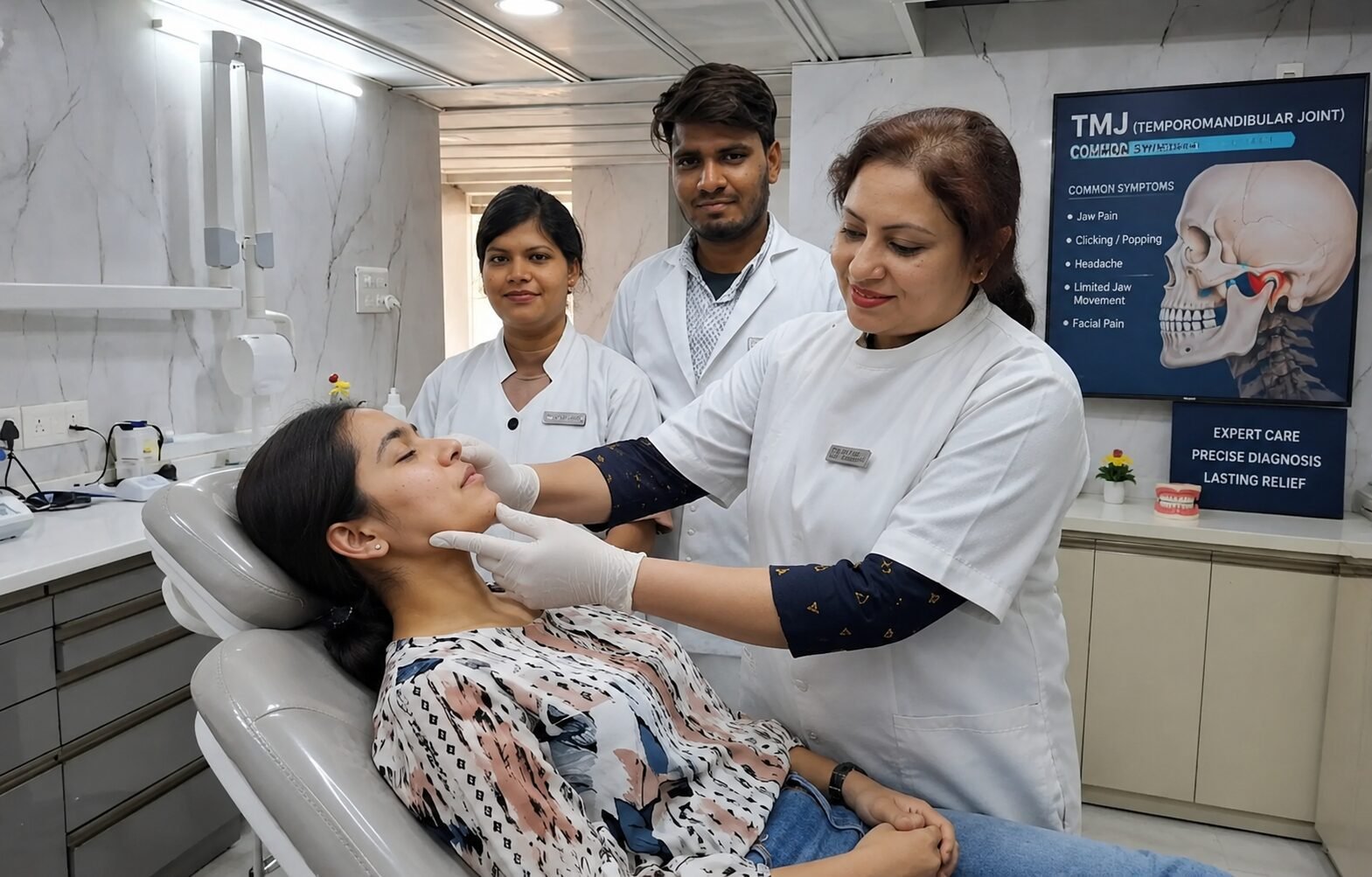
Custom Night Guard for Bruxism in Gurgaon
A custom occlusal splint (night guard) is one of the most effective tools for TMJ. It is not the same as a sports mouth guard from a pharmacy. Here is why that matters.
| Feature | Custom Splint (Lab-made) | OTC Guard (Chemist/Online) |
|---|---|---|
| Fit | Exact to your teeth | Generic, loose |
| Jaw position | Calibrated to decompress joint | Random — may worsen symptoms |
| Material | Hard acrylic resin | Soft rubber (traps clenching) |
| Durability | 3–5 years with care | Months at best |
| Bite protection | Distributes force evenly | Minimal |
Soft OTC guards feel comfortable but actually increase clenching in many people — the softness encourages the jaw muscles to bite down harder. A hard custom splint gives the muscles a stable resting point and reduces overactivity.
Cost of a custom night guard in Gurgaon varies by design. We will discuss the right type for your case at consultation. There is no standard price without a proper diagnosis.
TMJ Treatment Cost in Gurgaon — Honest Overview
We believe in pricing transparency. Here is a realistic range for the most common TMJ treatments. Exact cost depends on your diagnosis.
| Treatment | Approximate Range (INR) | Notes |
|---|---|---|
| TMJ Consultation + Examination | Clinic fee applies | Includes clinical exam and bite assessment |
| Custom Occlusal Splint (Night Guard) | ₹6,000 – ₹15,000 | Depends on splint design and material |
| Bite Adjustment | ₹1,500 – ₹4,000 | May take 1–2 visits |
| CBCT Imaging | ₹2,500 – ₹5,000 | Only when clinically required |
| Dental Restoration (if needed) | Varies | Crown, filling, or implant depending on case |
These figures are indicative. Treatment is personalised — we will not recommend anything you do not need.
Why Dr. Jyoti Singh for TMJ in Gurgaon
Dr. Jyoti Singh
MDS Prosthodontist & Implantologist | Maulana Azad Institute of Dental Sciences (MAIDS), Delhi
Most TMJ patients I see have already been to 2 or 3 doctors. They have been told to eat soft food, apply heat, and wait. Sometimes that works. Often it does not — because nobody addressed the underlying bite problem.
I approach TMJ as a bite specialist. The joint, the muscles, and the teeth are all connected. When you treat only one, you get temporary relief. When you correct the system, the relief lasts.
At Center for Dental Implants & Esthetics, we do not rush a TMJ case. We diagnose properly, explain clearly, and plan treatment you can afford step by step. Read more about Dr. Jyoti Singh’s approach and credentials.
The Gurgaon Stress–Jaw Pain Pattern
I see this almost every week. A patient in their 30s or 40s, works long hours, has WFH setup, and wakes up with a headache and stiff jaw. They have never had jaw problems before. The cause? Stress-driven jaw clenching that got worse during the pandemic and never stopped.
Gurgaon’s corporate culture creates a specific pattern of jaw muscle pain due to stress — tight deadlines, back-to-back calls, poor posture at a desk. The jaw takes the hit. A custom splint and some simple jaw exercises change lives in these cases. The relief is quick and the cost is modest.
Frequently Asked Questions
Direct answers to the most common TMJ questions
TMJ disorder (TMD) is a problem with the jaw joint or the muscles that control jaw movement. It is not always serious, but it should not be ignored. Left untreated:
- Clicking can progress to locking
- Bruxism damages teeth permanently — enamel does not grow back
- Chronic pain can affect sleep, eating, and quality of life
- Missing teeth situations worsen if the jaw load imbalance is not corrected
Most cases are manageable without surgery if caught early.
The clicking sound comes from the cartilage disc inside your TMJ shifting out of position. When you open your mouth, the condyle (round bone) moves forward, and if the disc is displaced, it snaps or pops as the bone slides over it.
- Painless clicking alone may not need immediate treatment
- Clicking with pain or limited opening needs evaluation
- Clicking that disappears suddenly — the jaw has locked — needs urgent care
Yes — in the large majority of cases. Non-surgical TMJ treatment options include:
- Custom occlusal splint (night guard) — most effective first step
- Bite adjustment to even out how teeth meet
- Jaw physiotherapy and stretching exercises
- Stress management and lifestyle changes
- Dental restorations or implants to correct bite collapse
Surgery (arthroscopy or arthroplasty) is reserved for cases with structural joint damage that does not respond to conservative treatment.
- Splint for bruxism: Many patients feel relief within 2 to 4 weeks of wearing a night guard consistently
- Bite adjustment: Immediate improvement in some cases
- Physiotherapy: 4 to 8 weeks for significant reduction in muscle tightness
- Complex bite correction (orthodontics or implants): 3 to 18 months depending on the treatment
Duration depends on how long the problem has been present and what is causing it.
Yes. Dental enamel is the hardest substance in your body — but bruxism is relentless. Over months and years of grinding:
- Teeth become flat and shorter
- Sensitivity to cold and hot increases
- Teeth crack or chip
- Enamel lost does not return — it can only be restored with crowns or veneers
A custom night guard is an investment that protects thousands of rupees worth of dental work from damage.
Yes, and this connection is very underdiagnosed. When back molars are missing:
- The bite collapses — front teeth take over chewing load they were not designed for
- The jaw joint absorbs the extra stress and becomes inflamed
- The jaw muscles work harder and go into spasm
- This can cause chronic jaw pain, headaches, and even facial asymmetry over time
Replacing missing back teeth with dental implants or a bridge restores the bite and takes the load off the jaw joint.
An occlusal splint is a custom-fabricated hard acrylic device made from a precise impression of your teeth. It repositions your jaw in a way that reduces muscle overactivity and decompresses the joint.
- Made in a dental lab to your exact measurements
- Hard material — does not encourage biting down harder (unlike soft OTC guards)
- Designed to hold the jaw in a therapeutically correct position
- Lasts 3 to 5 years with proper care
OTC guards from a pharmacy or online are generic, do not address jaw position, and in many patients, increase clenching force.
Morning jaw pain is almost always from nighttime bruxism — grinding or clenching during sleep. You will not feel it happening. Signs include:
- Sore, tight jaw muscles on waking
- Headache at the temples in the morning
- Tooth sensitivity that is worse in the morning
- Partner reports hearing grinding sounds at night
A custom night guard worn during sleep prevents the grinding and gives muscles a chance to recover.
For jaw pain, clicking, or grinding — start with a dentist, ideally a prosthodontist who specialises in bite function. A prosthodontist is best positioned to assess:
- How your teeth meet (bite alignment)
- Missing tooth impact on jaw position
- Worn teeth from grinding
- Joint position and muscle tension
An ENT is needed only to rule out ear infection. A neurologist is needed if there is a true nerve or brain-related cause — which is rare. Most jaw pain is dental/muscular in origin and responds to prosthodontic treatment.
While waiting for your appointment, these can reduce discomfort:
- Warm compress: 10 minutes on the jaw muscles, 2–3 times a day, to relax muscle tension
- Soft diet: Avoid hard, chewy, or crunchy foods that load the joint
- No wide opening: Avoid yawning wide, biting into large burgers, or resting chin on hand
- Jaw rest: Keep teeth slightly apart — lips together, teeth apart — when not eating or talking
- Stress reduction: Even 10 minutes of conscious jaw relaxation helps bruxism
These are temporary measures. They do not fix the underlying cause. A proper evaluation is still needed.
Book a TMJ Consultation in Gurgaon
Jaw pain does not have to be your normal. A proper diagnosis is the first step — and most cases have a clear, non-surgical solution. Center for Dental Implants & Esthetics has two clinics in Gurgaon, and Dr. Jyoti Singh will personally assess your jaw.
Center for Dental Implants & Esthetics — Sector 51
#166, Sector 51, Ambedkar Chowk
Close to Artemis Hospital, Gurgaon 122003
Center for Dental Implants & Esthetics — Sector 74
R1-257, 2nd Floor, M3M Cornerwalk
Sector 74, Gurugram 122004
You May Also Want to Read
Jaw Pain Due to Missing Teeth
The connection between missing back molars and jaw joint overload — and why implants protect your TMJ long term.
Read about missing tooth consequencesMisaligned Bite Causing Jaw Pain
How malocclusion stresses the jaw joint — and how orthodontic or prosthodontic correction relieves it.
Read about jaw alignment treatmentReplace Missing Teeth to Fix Jaw Balance
Dental implants do more than replace a tooth — they restore the bite forces that keep your jaw healthy.
Read about dental implants in GurgaonThis page is for informational purposes only and does not replace professional dental consultation. Symptoms described may have multiple causes. Please visit a qualified dental professional for diagnosis and personalised treatment advice.