Why Do Dental Implants Fail? Causes, Warning Signs & What To Do
Dental implants work most of the time. But when they fail, patients are caught off guard. Here is an honest guide — from a dentist who has placed over 10,000 implants in Gurgaon.
95–98% Success Rate — But the 2–5% Is Real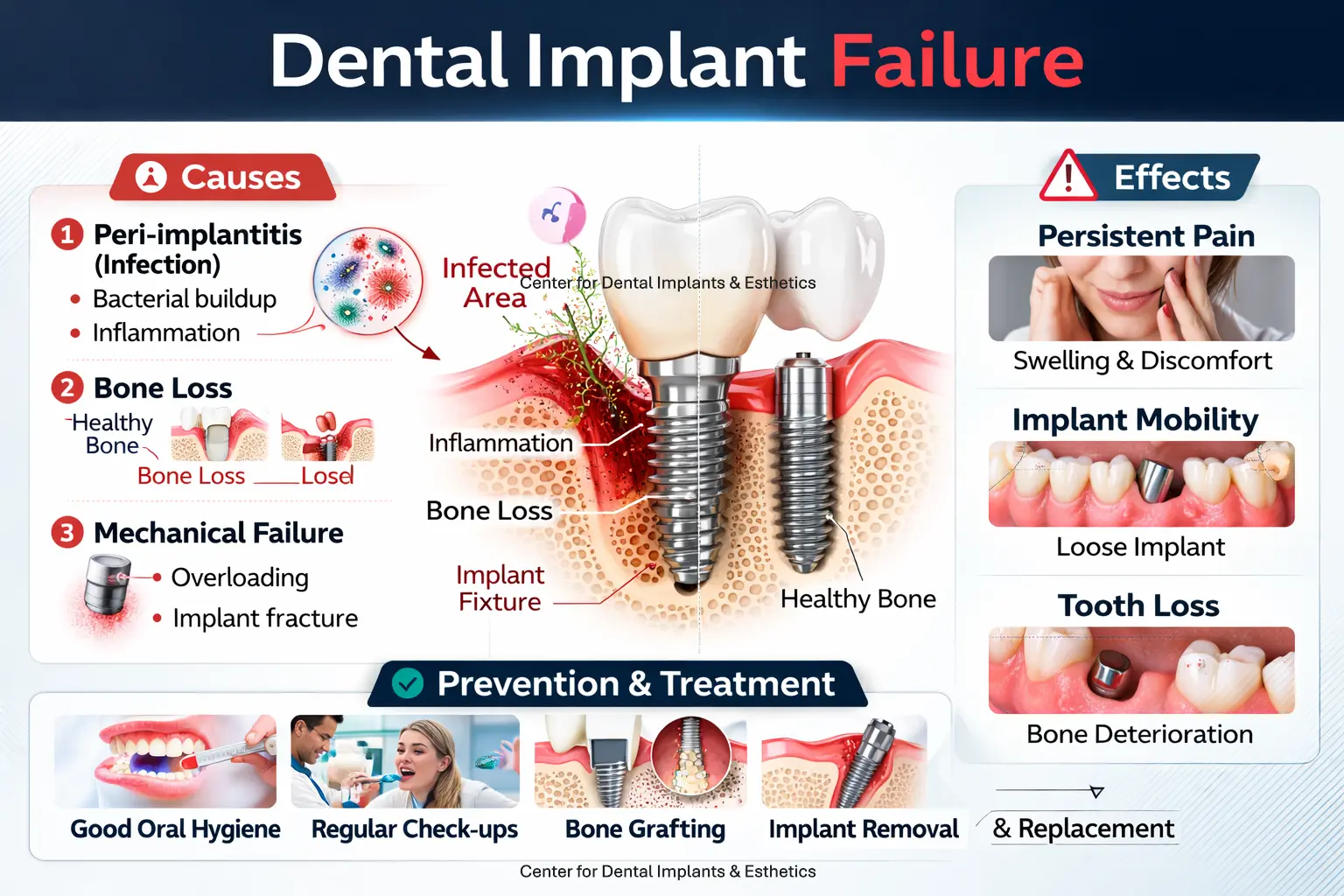
Dental implants fail mainly due to: (1) poor bone bonding (osseointegration failure), (2) infection around the implant (peri-implantitis), (3) nerve or soft tissue damage during surgery, (4) insufficient jaw bone, and (5) patient habits like smoking, teeth grinding, or poor oral hygiene. Early detection and immediate consultation with your implantologist are critical to saving a failing implant.
In This Article
- Why Implants Fail — Quick Overview
- Cause 1 — Implant Does Not Bond With Bone
- Cause 2 — Peri-Implantitis (Infection)
- Cause 3 — Nerve or Soft Tissue Damage
- Cause 4 — Not Enough Bone
- Cause 5 — Habits That Damage Implants
- Warning Signs You Must Not Ignore
- What To Do If Your Implant Fails
- Myths vs Facts
- Frequently Asked Questions
Dental implants are one of the most trusted treatments in dentistry. Studies consistently show a 95–98% success rate when placed correctly and cared for properly.
But what about the cases that do not succeed? In Gurgaon — where patients come to us from Sohna Road, South City, Golf Course Extension, Dwarka Expressway and across Delhi NCR — we see failed implants regularly. Some are from other clinics. Some, in rare cases, are ours.
Honesty matters more than marketing. So here is everything you need to know about why implants fail — and how to protect yours.
Why Implants Fail — The Two Types
Implant failure is not one single event. Doctors classify it into two types:
- Early failure — happens within the first 3–6 months, usually during the healing phase. The bone simply does not bond around the implant.
- Late failure — happens after the implant has been working fine. Often caused by infection, bone loss, or mechanical stress over time.
Both types need urgent attention. Neither should be ignored or “waited out.”
Cause 1 — The Implant Does Not Bond With the Bone
This is called osseointegration failure — and it is the most common cause of early implant failure.
Here is the simple version: after the titanium implant is placed in your jaw, your bone must grow around it and grip it tightly. Think of it like cement setting around a screw. If the cement never sets, the screw stays loose — and eventually falls out.
Wrong placement angle or position
If the implant is placed even slightly off, the bone cannot grow around it uniformly. This is why we use CBCT 3D scanning before every surgery at both our Sector 51 and Sector 74 clinics. No 3D scan = no surgery. That is our protocol.
Uncontrolled diabetes
Diabetes slows healing. The bone cannot repair and grow fast enough when blood sugar levels are high. We run a mandatory blood test before every procedure — HbA1c must be within safe range. This is non-negotiable at our clinic.
Smoking
Smoking cuts blood supply to the gums and bone. This dramatically reduces the body’s ability to heal. Smokers have a measurably higher failure rate compared to non-smokers. We advise stopping smoking for at least 2 weeks before and after surgery.
Low bone density
Patients on long-term steroids, or those with osteoporosis, may have softer, weaker bone. The implant needs firm bone to achieve stability. This is checked before surgery and factored into the treatment plan.
Cause 2 — Peri-Implantitis (Infection Around the Implant)
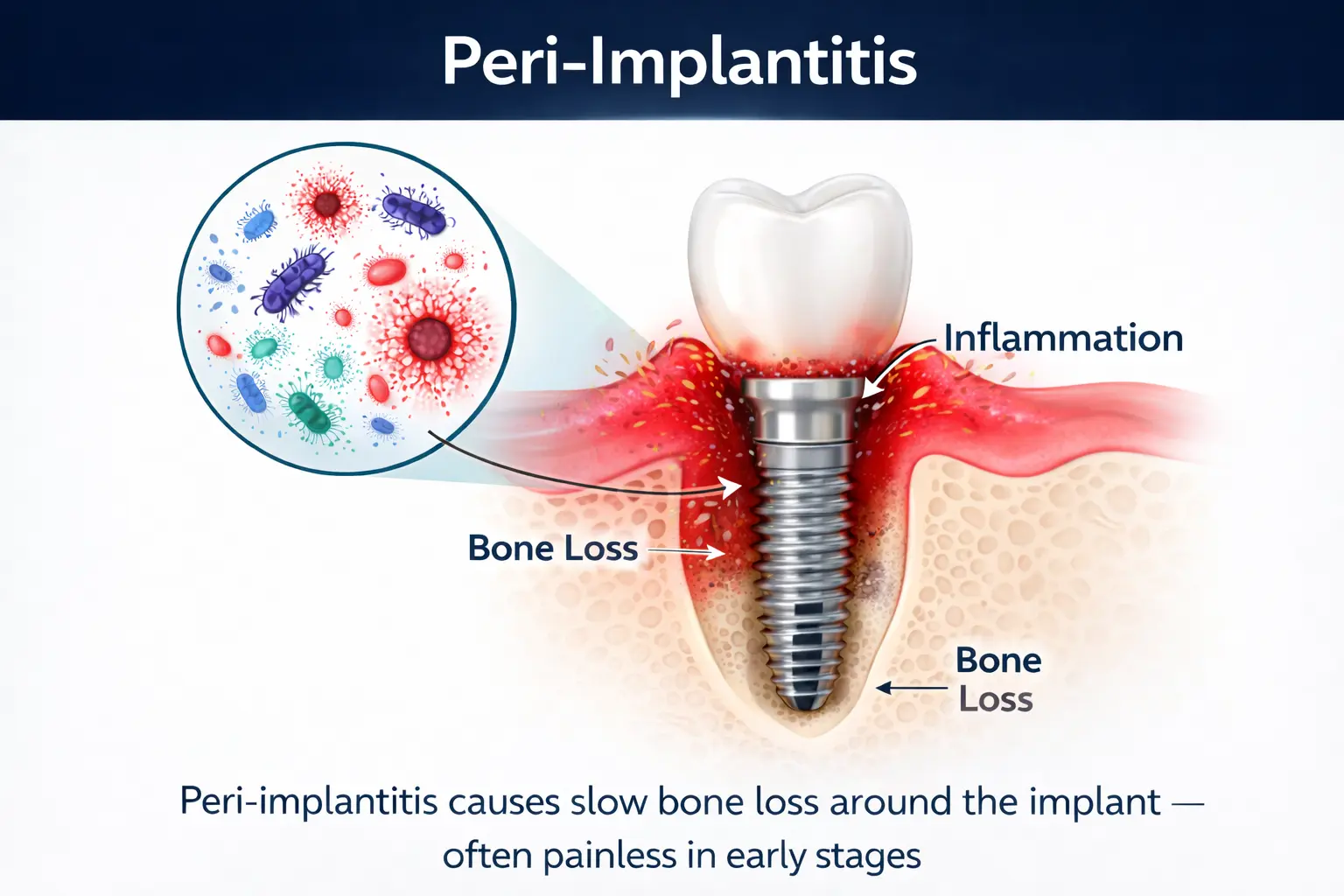
Peri-implantitis is an infection of the gum and bone around a dental implant. It is the leading cause of late implant failure — and the tricky part is that it can develop silently, without any pain, for months.
Think of it like this: gum disease destroys bone around natural teeth. Peri-implantitis does the same to bone around an implant. Once the bone is gone, the implant has nothing solid to hold on to.
How does peri-implantitis start?
- Bacteria present during surgery (poor sterilisation protocol)
- Dental cement escaping under the gum and getting trapped — this is more common than most patients realise
- Poor oral hygiene around the implant after surgery
- Skipping your yearly check-up visits
Who is most at risk in our patient population?
- Patients with diabetes — especially those with HbA1c above 8
- Smokers
- Patients with naturally thin gum tissue
- Anyone who does not clean the implant area properly every day
Peri-implantitis can begin years after a successful surgery. A patient in Golf Course Extension came to us 4 years after getting her implant done elsewhere — no pain, but the X-ray showed significant bone loss around the implant. Caught just in time. This is why we insist on annual X-ray checks.
We have a full clinical guide on this condition: Understanding Peri-Implantitis — Causes, Symptoms & Treatment
Cause 3 — Nerve or Soft Tissue Damage
The lower jaw has a major nerve — the inferior alveolar nerve — running through it. If an implant is placed too deep or too close to this nerve, it can press on it or damage it.
This is a placement error. It happens when dentists skip 3D imaging and guess the depth visually from a 2D X-ray. That approach is outdated and risky.
Signs of nerve involvement:
- Numbness in the lower lip, chin, or tongue that does not recover within a few weeks
- Tingling or burning sensation in these areas
- Pain that is different from normal post-surgery soreness
Some soreness and mild swelling after surgery is completely normal and expected for 3–5 days. But if you have persistent bleeding, severe pain, or numbness after 72 hours — call your dentist that same day. Do not wait for the next appointment.
Understanding the full procedure helps set the right expectations: How Dental Implants Work — Step by Step
Cause 4 — Not Enough Bone in the Jaw
When a tooth is missing for a long time, the jaw bone in that area slowly shrinks. This is called bone resorption. It is very common — and it catches many patients off guard when they finally decide to get an implant years after losing a tooth.
Without enough bone, there is no solid foundation for the implant. It is like trying to fix a screw into crumbling wall plaster.
The good news: in most cases, a bone graft can rebuild the area first. We do this commonly at both our Gurgaon clinics. The graft heals over a few months, and then the implant is placed in fresh, solid bone. Yes, this adds time — but it gives your implant a proper foundation to last decades.
This is a very common concern: Can I Get Dental Implants With Bone Loss? — Read More
Cause 5 — Habits That Slowly Damage Your Implant
Even a perfectly placed implant can fail if you are hard on it. Some habits cause damage so slowly that patients do not notice until a problem has already developed.
- Smoking — restricts blood supply, prevents proper healing, increases infection risk significantly
- Teeth grinding (bruxism) — creates excessive pressure on the implant crown and the bone around it. We fit a night guard for all bruxism patients before implant surgery
- Poor oral hygiene — plaque around the implant leads to peri-implantitis over time
- Skipping follow-up visits — small problems found early are easy to fix. Left for months, they become failures
- Ignoring post-op instructions — eating hard food too soon, skipping prescribed antibiotics, not cleaning with the correct technique
Warning Signs You Must Not Ignore
Your body gives signals before a complete failure. Learn these signs. They can save your implant if you act fast.
| Warning Sign | What It Could Mean | What To Do |
|---|---|---|
| Implant feels loose or moves | Failed osseointegration or significant bone loss | See your dentist the same day |
| Pain when chewing or biting | Implant under stress, possible infection | Report immediately — do not wait |
| Swelling or pus near implant | Active peri-implantitis infection | Urgent visit needed |
| Gum pulling away from implant | Gum recession — bone may be affected | Book appointment soon |
| Numbness that does not resolve | Possible nerve involvement | Urgent visit — do not delay |
| Crown comes off or cracks | Crown failure — implant may be fine | Call clinic immediately |
| Bad taste or smell at implant site | Possible hidden infection under gum | Visit for evaluation |
The single most important advice: do not adopt a wait-and-see approach. A small problem found today can be managed conservatively. Left for weeks, the same problem can mean losing the implant entirely.
What To Do If Your Implant Fails
Step 1 — Do not panic
Even a failed implant is not the end of the road. Many patients come to our Sector 51 clinic — some from as far as Faridabad and Noida — after an implant failure elsewhere, and we are able to treat and re-implant in most cases.
Step 2 — Contact your implantologist immediately
Tell your doctor exactly what you feel. Is it the crown that is loose, or does the whole implant move? Is there pain — constant, or only when eating? Any swelling? These details help us triage your situation over the phone and advise next steps.
Step 3 — Let the doctor assess before assuming the worst
In many cases, it is only the crown that has come loose from the abutment (the connector between implant and crown). This is a simple fix. The implant in the bone may be perfectly stable.
Step 4 — If the implant truly fails
The failed implant is removed carefully. The site is given time to heal. A bone graft is done if needed. In most cases, a new implant can be placed at the same site after healing is confirmed. Whether your original crown and parts can be reused depends on what is found on examination.
Also useful: Risks of Dental Implant Surgery — What Patients Need to Know
Comparing options after a failure: Why Implant Bridges Are Better Than Dentures
Myths vs Facts — Implant Failure
| Myth | Fact |
|---|---|
| Once placed, implants last forever without any care | Implants need regular professional cleaning, daily home care, and annual X-ray checks |
| Pain after surgery always means failure | Mild soreness for 3–5 days is normal. Severe or persistent pain beyond that is not |
| A cheap implant works just as well | US FDA-approved implant systems, experienced surgeons, and CBCT-guided placement make a significant difference in long-term success |
| If an implant fails, you can never get another one | Most failed implant sites can be treated with a bone graft and a new implant placed after healing |
| Diabetics cannot get dental implants | Patients with well-controlled diabetes can get implants — with blood test clearance and close monitoring throughout |
| The crown falling off means the implant failed | The crown and the implant are separate. Often only the crown comes off — the implant below is intact and stable |
Frequently Asked Questions
What is the most common reason a dental implant fails?
The most common reason is osseointegration failure — the bone does not bond properly around the titanium implant. This is usually linked to incorrect placement, uncontrolled diabetes, smoking, or low bone density. Choosing an experienced implantologist and completing pre-surgery blood tests and CBCT scans significantly reduces this risk.
How do I know if my dental implant is failing?
Key warning signs: the implant or crown moves or feels loose, pain when biting that does not improve after the first week, swelling or pus near the implant site, or the gum visibly pulling away from the implant. Any of these signs means you should call your implantologist the same day — do not wait.
Can a failed dental implant be replaced?
In most cases, yes. After the failed implant is carefully removed and the site heals, a bone graft may be needed to rebuild the foundation. Once the graft matures, a new implant can often be placed at the same location. Your implantologist will assess this on examination — failure does not mean you cannot have teeth again.
Does peri-implantitis always cause pain?
No — and this is what makes it dangerous. In the early stages, peri-implantitis can be completely painless. Bone is being lost silently while the patient feels nothing unusual. This is exactly why 6-monthly professional check-ups and annual X-rays around implants are critical, not optional.
Can smoking cause dental implants to fail?
Yes — smoking is one of the most significant and well-documented risk factors for implant failure. It reduces blood flow to the gums and bone, impairs the body’s healing response, and increases susceptibility to infection. Stopping smoking for at least 2 weeks before and after surgery is strongly recommended.
Does diabetes increase the risk of implant failure?
Uncontrolled diabetes significantly increases the risk. High blood sugar slows healing and makes infection more likely. However, patients with well-controlled diabetes — HbA1c within an acceptable range — can successfully get dental implants. We run a mandatory blood test on every patient before surgery for this reason.
The crown came off my implant — has the implant failed?
Not necessarily. The implant (the titanium screw in the bone) and the crown (the visible tooth part) are two separate components. In many cases, only the crown has come loose, while the implant below remains completely stable. Call your clinic the same day — do not leave the area exposed, as this risks infection. In most cases, it is a straightforward fix.
How long should a dental implant last if it is successful?
A well-placed implant with proper care can last 30-35 years or more — potentially a lifetime. The implant itself (the titanium fixture in the bone) is the most durable part. The crown on top may needs replacement after 15-20 years due to normal wear. Regular check-ups, daily cleaning, and avoiding smoking are the biggest factors in long-term implant success.
Worried About Your Implant? Talk To Us Today.
We see implant emergencies from across Gurgaon, Delhi NCR, and beyond. Call or WhatsApp — we will guide you.
CDIE — Sector 51, Gurgaon
Near Artemis Hospital#166, Sector 51, Ambedkar Chowk
Near Artemis Hospital, Gurugram
Haryana — 122 003
Open 7 Days | 10 AM – 8 PM
Easily reachable from Sector 46, 47, 50, 52, South City 1, DLF 4 & 5, Golf Course Road
CDIE — Sector 74, Gurgaon
M3M Cornerwalk, SPR RoadM3M Cornerwalk, SPR Road
Sector 74, Gurugram
Haryana — 122 004
Open 7 Days | 10 AM – 8 PM
Easily reachable from Sector 65, 69, 70, 71, 73, 75, Golf Course Extension, Sohna Road, Dwarka Expressway

Dr. Jyoti Singh (MDS), Diplomate WCOI (Japan region) Member AAID (American Association of Implant Dentistry) stands as a beacon of excellence in implantology within Delhi NCR region. She is a BDS and MDS(Prostho) both from Maulana Azad Institute of Dental Sciences, where she secured top honors with all India rank 1 in PG entrance examination. Her extensive experience at esteemed institutions like Clove Dental and her own Center for Dental Implants & Esthetics since 2016, Dr. Singh embodies unparalleled expertise in dental implants. Boasting a wealth of 17+ years in dentistry and backed by 18 groundbreaking research papers in leading international journals (Google Scholar) and her ResearchGate profile, she epitomizes the pinnacle of proficiency and innovation in her field. She practices in Gurugram as your friendly dentist near me.