Root Canal Treatment Alternatives in Gurgaon — What Actually Works
Your dentist said you need an RCT. Now you want to know: is there another way? Read this before you decide anything.
Why Patients in Gurgaon Search for Root Canal Treatment Alternatives
Every week, patients in Gurgaon search for alternatives to root canal treatment — and for good reasons. Fear. Cost. Doubt. They want to know if there are real options other than root canal treatment in Gurgaon before they commit to the procedure. The question is natural. The answer is not always simple. Not sure if you even need one yet? Start with our guide on signs and symptoms that indicate you need root canal treatment — it will help you understand exactly where your tooth stands. Here is what the evidence actually says.
Fear and Anxiety
- Old stories about painful RCT still circulate.
- Modern techniques and proper anaesthesia make the procedure very comfortable.
- Fear is often worse than the actual treatment.
Myths and Misinformation
- RCT causes illness — no peer-reviewed evidence supports this claim.
- Natural remedies can cure pulp infection — they cannot reach inside the tooth.
- Extraction is simpler — it is not. It creates new problems.
Cost Concerns
- The upfront cost of RCT feels high.
- Compared to extraction followed by an implant, root canal cost in Gurgaon is 3 to 5 times less than replacement.
- No replacement option matches the value of your natural tooth.
Looking for Quick Fixes
- Pulling the tooth seems faster.
- Antibiotics feel like a non-invasive solution.
- But neither addresses the infected pulp. The infection continues — and tooth infection warning signs you should never ignore can escalate quickly.
From Dr. Jyoti Singh’s Clinic — A Real Patient Story
A patient came to us last year saying his dentist in Sector 52 had recommended RCT on a molar. He had already spent three weeks trying clove oil, turmeric paste, and two rounds of antibiotics. The pain was manageable some days. When he finally came in, the infection had spread to the bone. What could have been a straightforward single-sitting root canal treatment in Gurgaon became a much longer case. We saved the tooth. But those three weeks cost him more time, more money, and more discomfort than the original RCT would have.
Dr. Jyoti Singh — MDS Prosthodontist | Center for Dental Implants & Esthetics, Sector 51, Gurgaon
Can You Save Your Tooth Without a Full Root Canal? Yes — In Some Cases
Many patients in Gurgaon ask: how do I save my tooth without root canal treatment? The honest answer is — sometimes you can. Two procedures exist that may let you avoid root canal treatment in Gurgaon if the infection is caught at exactly the right stage. Not every infected tooth needs a full root canal. Pulp capping and pulpotomy can sometimes save the tooth with less intervention. But they only work in specific situations — and if your dentist has already identified symptoms indicating you need root canal treatment, you’ll want to understand which path applies to you.
Source: Journal of Endodontics, Volume 51, 2025
Direct Pulp Capping
A medicated dressing is placed directly on the exposed pulp. The pulp is left intact.
- Works only when pulp exposure is small and accidental
- Bleeding must be minimal and controllable
- No signs of irreversible inflammation
- Young permanent teeth respond best
- Materials used: Biodentine, MTA, calcium hydroxide
- Often paired with a dental filling to seal the tooth above the capping material
Pulpotomy in Adults
Infected coronal pulp (the top portion) is removed. The healthy root pulp is preserved.
- Also called partial pulpectomy or partial RCT
- Used when infection is limited to the crown pulp
- Root canals remain healthy and untouched
- Evidence: 92% success at 2-year follow-up in adults (Endodontic Topics, 2024)
- Crown placement required after the procedure — learn about why a tooth cap is needed after RCT
Reversible vs Irreversible Pulpitis
This is the most important question your dentist must answer before recommending any treatment.
- Reversible pulpitis: Pain triggered by hot or cold, stops within seconds after removing the stimulus. Pulp can heal with a filling or pulp capping.
- Irreversible pulpitis: Pain lingers for 30+ seconds after removing stimulus. Spontaneous pain. Night pain. These signs mean the pulp cannot recover. Only root canal treatment can save the tooth.
Regenerative Endodontics
A newer approach that aims to regenerate the living tissue inside the root canal.
- Primarily used for young patients (8 to 18 years) with incomplete root development
- Not a standard alternative for adults with fully formed roots
- Requires specialised training and materials
- Research is ongoing — not yet a routine clinical option in most Indian practices
Is root canal treatment necessary in your case? There are 2 genuine alternatives to full RCT — pulp capping and pulpotomy. Both require the infection to be caught early. If your dentist has recommended full RCT, ask specifically why these options do not apply to your case. A good endodontist will explain clearly. Looking for painless root canal alternatives in Gurgaon? These conservative procedures are significantly less invasive — but only if you qualify. See our complete guide to expert root canal treatment in Gurgaon to understand what the full procedure involves.
Root Canal Treatment vs Dental Filling — Different Problems, Different Solutions
A filling and a root canal are not alternatives. They treat different stages of tooth damage.
When a Filling Is Enough
- Cavity is limited to enamel and dentine
- No bacteria have reached the pulp
- Pain stops immediately when the trigger (cold, sweet) is removed
- No spontaneous pain or swelling
- A dental filling is the right treatment at this stage — the earlier, the better
When Only RCT Can Save the Tooth
- Bacteria have entered the pulp (living centre of the tooth)
- Constant or spontaneous pain
- Swelling, abscess, or pus — recognise these as early warning signs of tooth infection that should never be ignored
- Deep crack reaching the pulp
- A filling placed over infected pulp traps bacteria underneath — the infection continues and worsens
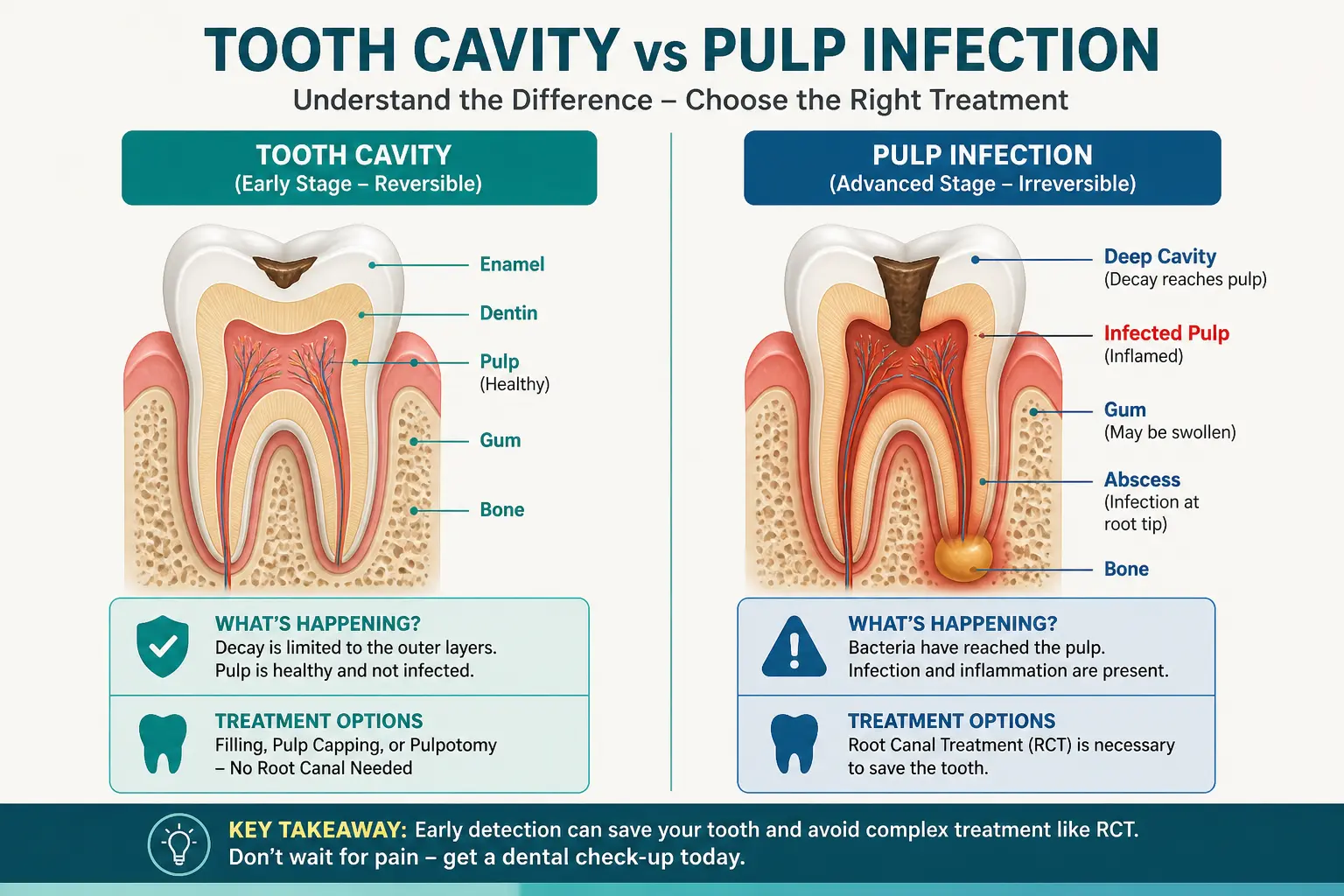
Important: Choosing a filling over RCT when the pulp is infected does not save money. It delays treatment and typically forces a tooth extraction — which then costs far more to fix with an implant or bridge. Learn more about why cavities should not be ignored.
Root Canal Treatment vs Tooth Extraction — What Really Happens After Extraction?
Extraction removes the pain. It does not remove the problem. Patients often compare tooth extraction cost vs RCT cost in Gurgaon and choose extraction because it looks cheaper. Here is what that calculation misses — and what the evidence says happens after a tooth is pulled.
I pull the tooth. Pain is gone. Problem solved. Much simpler than root canal.
Adjacent teeth drift into the gap within months. Bone under the gap begins to shrink. Chewing load shifts to remaining teeth. New problems start. Read our full guide on what happens after tooth removal and the risks of leaving a gap untreated.
Long-Term Consequences of Tooth Extraction
- Bone loss begins within 3 months of extraction. The jawbone shrinks because it has no root to stimulate it. This affects the shape of your face over years.
- Adjacent teeth tilt into the gap within 6 to 12 months. This changes your bite and makes cleaning harder, which leads to new decay.
- Chewing efficiency drops by roughly 30% when a molar is missing, as reported in the Journal of Prosthetic Dentistry (2023). Your other teeth take more load.
- Replacement costs are significantly higher. A dental implant to replace the extracted tooth costs Rs. 25,000 to Rs. 50,000 — 3 to 5 times the cost of RCT plus a crown.
- Understand the full picture with our detailed guide on the consequences of a missing tooth.
When Is Extraction Actually Necessary?
- Tooth is fractured below the gum line and cannot be restored
- Severe bone loss from advanced gum disease makes the tooth unsavable
- Failed RCT where apicoectomy is also not possible
- Tooth has completely disintegrated from decay — no solid structure remains
- Even after a failed first RCT, re-root canal treatment in Gurgaon often saves the tooth before extraction is considered — and it is also covered in our guide on why re-RCT is sometimes needed
In My Clinical Experience — Dr. Jyoti Singh
Patients who extract a molar and do not replace it often return 2 to 4 years later with bite problems, sensitivity in the opposing tooth (which now has nothing to bite against and over-erupts), and significant bone loss. By that point, a simple implant has become a more complex case requiring bone grafting. The extraction that felt like the easy option ends up being the expensive one. At Center for Dental Implants & Esthetics, we always do a complete risk assessment before agreeing to extract a tooth that root canal treatment can still save.
Dr. Jyoti Singh — MDS | Diplomate WCOI (Japan Region) | Nobel Biocare Trained
Root Canal Treatment vs Dental Implants — Not Alternatives. Two Different Situations.
Patients searching for root canal vs dental implant in India often believe these are interchangeable options. They are not. Understanding this one distinction changes everything about how you approach the decision. A dental implant cannot replace a tooth that is still present. RCT saves the tooth you have. An implant replaces one that is already gone.
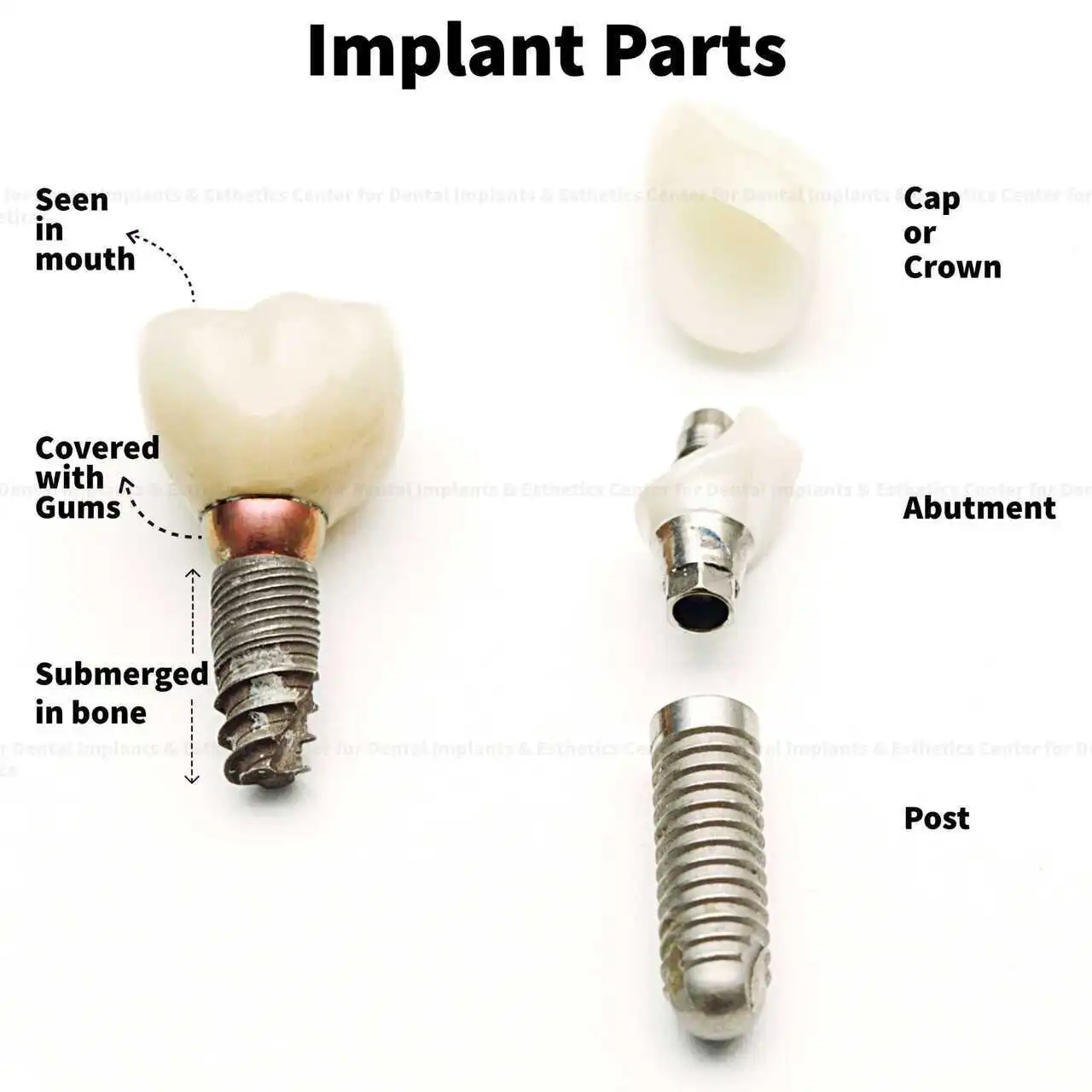
A dental implant replaces a missing tooth. It is not an alternative to saving the one you still have.
What Your Natural Tooth Has That an Implant Cannot Replicate
- Proprioception (your tooth’s pressure sensors): Natural teeth have nerve fibres in the periodontal ligament that tell your brain exactly how hard to bite. Implants do not. This is why implant patients sometimes bite too hard on hard food.
- Micro-movement: Your natural tooth moves slightly under load, which absorbs shock and protects the jawbone. An implant is fused rigidly to bone.
- No surgery: RCT requires no cutting, no drilling of bone, no healing period of 3 to 6 months.
- Reversibility: If RCT fails (rare), you can still get an implant — or explore re-root canal treatment first. Extracting for an implant is permanent and one-directional.
The rule in endodontics: Never extract a tooth that can be saved. A dental implant replacement is excellent technology — but a saved natural tooth is always the better biological outcome when it is still achievable.
Complete Cost Comparison: RCT vs Bridge vs Implant in Gurgaon 2026
No vague ranges. Real numbers based on current Gurgaon pricing at Centre for Dental Implants & Esthetics. For a full breakdown, see our dedicated root canal treatment cost in Gurgaon guide.
| Option | Gurgaon Cost (Approx.) | Time to Complete | Key Pros | Key Cons | Verdict |
|---|---|---|---|---|---|
| RCT + Zirconia Crown | Rs. 6,500 – 8,000 (RCT) + Rs. 8,000–12,000 (crown) = Rs. 14,500–20,000 total | 1–2 weeks | Saves natural tooth. Natural feel. No surgery. Longest track record. | Tooth becomes slightly brittle without crown. Rare re-treatment may be needed. | Best First Choice |
| Dental Bridge (3-unit) | Rs. 18,000 – 35,000 | 2–3 weeks | Fixed. Looks natural. No surgery required. | Neighbouring healthy teeth must be shaved down. Bone loss continues. Lifespan 10–15 years typically. | If Implant Not Possible |
| Dental Implant + Crown | Rs. 35,000 – 60,000 | 3–6 months | Does not affect adjacent teeth. Prevents bone loss. 95%+ success rate. Long lifespan. | Surgery required. Higher upfront cost. Only for already-extracted or extracted teeth. | After Extraction Only |
| Extraction Only (No Replacement) | Rs. 1,500 – 5,000 | 1 day | Quick. Lowest immediate cost. | Bone loss. Tooth drift. Long-term chewing problems. Hidden future costs far exceed savings. | Avoid if Possible |
Prices are approximate for 2026 in Gurgaon. Exact costs depend on tooth complexity, X-ray findings, and crown material selected. See our full treatment cost breakdown or book a consultation at Center for Dental Implants & Esthetics, Sector 51 for a precise estimate.
Apicoectomy — A Way to Save Teeth When Root Canal Has Not Fully Worked
Some patients have had a root canal done — and still have persistent pain or infection. This does not always mean the tooth must come out. Before accepting extraction as final, it is worth understanding both what happens when root canal treatment fails and what surgical options remain.
What Is Apicoectomy?
Apicoectomy (also called root-end surgery) is a minor surgical procedure where:
Small gum incision
A small opening is made in the gum near the tip of the infected root.
Root tip removed
The last 2 to 3 mm of the root, where bacteria persist after failed RCT, is removed.
Root end sealed
A small filling is placed at the base of the root to prevent reinfection.
Healing
Bone grows back around the treated root tip over several months. Success rates: 85 to 95% (Oral Surgery, Oral Medicine Journal, 2023).
Apicoectomy is not an alternative to RCT. It is what saves teeth when RCT alone is not sufficient. If a first root canal has not resolved your problem, also ask whether re-root canal treatment is possible before considering apicoectomy or extraction. Before agreeing to extraction after a failed root canal, always ask if apicoectomy is possible in your case.
Can Ayurvedic Treatment or Home Remedies Replace Root Canal? The Honest Answer
Many patients in India ask this. It deserves a direct and evidence-based answer — not dismissiveness, not false hope.
Oil pulling, clove oil, turmeric paste, garlic, neem, salt water rinse, Ayurvedic powders — all applied hoping to cure the infection inside the tooth.
Once the pulp is infected, it has no functional blood supply. Nothing applied from outside — including Ayurvedic or natural remedies — can penetrate the sealed interior of the root canal to kill bacteria there.
What Natural Remedies Can and Cannot Do
- Clove oil (eugenol): Provides genuine temporary pain relief. Its anaesthetic effect is scientifically documented. It does not kill bacteria inside the pulp.
- Oil pulling: Reduces surface oral bacteria. No published evidence of any effect on pulp infection.
- Garlic: Has antimicrobial properties. Cannot pass through dentine into the pulp chamber.
- Salt water rinse: Reduces surface gum inflammation and is recommended by dentists after procedures. Not a treatment for internal infection.
- Antibiotics: Can control the spread of infection temporarily. Cannot eliminate bacteria inside dead pulp tissue because there is no blood supply to deliver the antibiotic there. This is why save your tooth with RCT remains the only curative option once the pulp is fully infected.
A Note on Ayurvedic Dentistry — From Our Practice
At Center for Dental Implants & Esthetics, we have not personally found any Ayurvedic protocol that can resolve established pulp infection. We remain open to evidence. If any well-conducted clinical trial demonstrates otherwise, we will say so. Until then, our responsibility to patients is to be honest: delaying treatment with home remedies after a pulp infection is diagnosed is not a conservative choice — it is a risk to your tooth and potentially to adjacent bone. Use natural remedies for comfort while you arrange your appointment. Not instead of it.
Dr. Jyoti Singh — Studied at Maulana Azad Institute of Dental Sciences (MAIDS), New Delhi
For evidence-based tips on managing tooth pain while waiting for treatment, see our guide on dentist-recommended home remedies for toothache.
After Root Canal Treatment — Why the Crown Is Not Optional
Root canal treatment removes infected tissue and seals the canals. The tooth is saved — but it is now structurally weaker. Without a crown, most RCT-treated teeth fracture within 1 to 3 years. Some patients also experience pain after root canal treatment — understanding what is normal and what is not is important for protecting your investment in the procedure.
Without a Crown
- Tooth is brittle — prone to vertical fracture
- Success rate of RCT drops from 95% to below 50%
- Reinfection risk increases through micro-leakage
- Fracture often means the tooth must be extracted
With a Zirconia Crown
- Tooth is fully protected from fracture
- Biting forces distributed evenly
- RCT success rate: 95%+ at 5 years
- Full function and natural appearance restored
- Learn exactly why a crown after root canal is needed and about metal-free zirconia crowns
If pain persists after your procedure, do not ignore it. Our detailed guide on is pain normal after RCT explains what to watch for and when to contact your dentist.
Who Should Perform Your Root Canal Treatment in Gurgaon?
Endodontist vs general dentist for RCT in Gurgaon — this question matters more than most patients realise. The right expertise means a more predictable outcome, especially for complex molar cases. It also determines how painless your root canal treatment in Gurgaon actually is.
General Dentist
- Qualified to perform straightforward RCT cases
- Suitable for single-rooted front teeth with simple anatomy
- May refer complex cases to a specialist
- Good starting point for routine cases
Endodontist / Specialist
- 2 to 3 additional years of post-graduate training in root canal treatment
- Essential for: molars with curved canals, calcified canals, re-treatment of failed RCT, suspected cracks
- Uses advanced equipment: rotary endodontic systems, digital apex locators, CBCT 3D imaging
- Higher predictability in complex cases
About Dr. Jyoti Singh — Center for Dental Implants & Esthetics, Gurgaon
Dr. Jyoti Singh (MDS) brings 17+ years of clinical experience across Delhi NCR, having trained at Maulana Azad Institute of Dental Sciences, New Delhi — one of India’s most respected dental institutions. She holds a Diplomate from the World Congress of Oral Implantologists (Japan Region) and is Nobel Biocare and Invisalign certified. Her protocol for complex RCT cases includes mandatory CBCT 3D imaging to map canal anatomy before treatment begins — a standard not followed at most general clinics. Every case is reviewed individually. Read more about Dr. Jyoti Singh’s background and approach.
Center for Dental Implants & Esthetics — Sector 51 and Sector 74, Gurgaon
Not sure what your case needs? Read our detailed guide on who should perform your root canal treatment.
Frequently Asked Questions — Root Canal Treatment Alternatives in Gurgaon
These are the real questions patients ask when researching alternatives to root canal treatment in India. Direct answers, no fluff.
No — but it depends on the stage of infection.
- If infection is limited to the outer pulp and caught early, pulp capping or pulpotomy may be sufficient.
- Once the infection has spread to the root canals or caused an abscess, full root canal treatment in Gurgaon is the only way to save the tooth.
- Your endodontist assesses this using X-rays, pulp vitality tests, and clinical examination.
- Unsure if your symptoms point to a pulp infection? Our guide on signs you need root canal treatment walks through the diagnostic process in detail.
- Never assume RCT is unnecessary based on pain levels alone — some severe infections produce very little pain.
It can — in the right case, with the right material and follow-up.
- Calcium silicate-based materials (MTA, Biodentine) show 91.5% success at 2 years (Journal of Endodontics, 2025).
- Long-term success depends on correct case selection, crown placement after the procedure, and regular monitoring.
- If pulp capping fails, RCT is still possible — the tooth is not lost.
- Annual X-ray monitoring is recommended for the first 3 years after pulp capping.
No. Antibiotics manage spread — they do not cure pulp infection.
- Once the pulp is infected and the blood supply is compromised, antibiotics cannot reach the bacteria inside.
- Antibiotics control the spread of infection to the jaw or face — this is important and sometimes urgently necessary.
- But they do not eliminate the source. The infected tissue remains and the pain returns after the course ends.
- RCT physically removes the infected tissue — that is the only way to cure the source. Read more on tooth infection warning signs to understand why timely treatment matters.
The infection spreads — and the treatment becomes more complex and expensive.
- Within weeks to months: abscess forms at the root tip. This is painful and can swell the face.
- Infection can spread to the jawbone (osteomyelitis) — a serious condition requiring hospitalisation in severe cases.
- The tooth becomes harder to save. What was a single-sitting RCT may become multi-sitting with antibiotics and drainage.
- Adjacent healthy teeth can become affected by spreading bone infection.
- Eventually, extraction becomes the only remaining option — at which point you face the much higher cost of replacement vs the original RCT.
Ozone has proven antimicrobial properties but is not an established replacement for RCT.
- Ozone gas or ozone water can kill bacteria on contact in shallow areas like early cavities and superficial gum infections.
- It is used as an adjunct in some RCT protocols to improve canal disinfection — not as a standalone replacement.
- No peer-reviewed evidence currently supports ozone as a complete alternative to mechanical cleaning and filling of the root canals.
- Be cautious of clinics that market ozone therapy as a “natural RCT replacement” — this is not supported by dental literature.
With modern techniques and a crown: 92 to 98% at 5 years.
- Overall success rate for primary RCT (first-time treatment) with crown: 92–98% (European Society of Endodontology, 2023 guidelines).
- Re-treatment (failed RCT): 80–85% success.
- Re-root canal treatment in Gurgaon is often the preferred step before considering apicoectomy.
- Apicoectomy after failed RCT: 85–95% success.
- Success is significantly lower without crown placement after RCT.
- Choosing a specialist endodontist over a general dentist for complex cases improves outcomes measurably.
Yes — especially in the second trimester when dental infection poses real risk to the pregnancy.
- Untreated dental infection during pregnancy carries greater risk than the RCT procedure itself.
- The second trimester (months 4 to 6) is the safest window for elective dental procedures.
- Local anaesthesia (lidocaine with small adrenaline dose) is safe during pregnancy.
- Digital X-rays with lead apron have negligible radiation exposure and are safe when necessary.
- Always inform your dentist about your pregnancy and trimester before treatment begins.
Cost depends on tooth type and complexity. Here is a clear breakdown. See our complete root canal cost in Gurgaon guide for full details.
- Front teeth (incisors, canines) — single canal: Rs. 3,000 – 5,000
- Premolars — 1 to 2 canals: Rs. 4,500 – 6,500
- Molars — 3 to 4 canals (most complex): Rs. 6,000 – 8,000
- Re-treatment of previously failed RCT: Rs. 7,000 – 10,000
- Crown (zirconia, recommended): Rs. 8,000 – 12,000 additional
- Total for a molar with crown: approximately Rs. 14,000 – 20,000
- Compare this to dental implant replacement after extraction: Rs. 35,000 – 60,000
In almost every case, yes — saving the molar is significantly better than extracting it.
- Molars do most of your chewing. Losing one affects eating comfort considerably.
- The gap from a missing molar causes adjacent and opposing teeth to drift and over-erupt within months. Our guide on what happens after tooth removal documents this in detail.
- Replacing a molar with an implant costs 3 to 5 times more than saving it with RCT. See the cost of RCT vs extraction side by side.
- Molar RCT is more complex (3 to 4 canals, harder to access) — always choose a specialist for molar treatment.
Root canal treatment is safe. Historical concerns have been thoroughly disproved.
- An old and thoroughly discredited theory (the “focal infection theory” from the 1920s) falsely linked RCT to systemic disease. It has been rejected by every major dental and medical organisation.
- Modern endodontics uses sterile instruments, rubber dam isolation, and advanced sealing materials — infection control is very well established.
- The American Association of Endodontists, European Society of Endodontology, and Indian Dental Association all confirm RCT safety.
- No peer-reviewed evidence links properly performed RCT to any systemic illness. For a full debunking of persistent myths, see our guide on 8 myths about root canal treatment.
Not Sure Which Option Is Right for Your Case?
Every tooth is different. Book a consultation at Center for Dental Implants & Esthetics, Gurgaon. You will get an honest assessment — not a sales pitch.
Sector 51 — Near Artemis Hospital
Center for Dental Implants & Esthetics
#166, Sector 51 (Ambedkar Chowk)
Close to Artemis Hospital, Gurgaon 122003
Sector 74 — M3M Cornerwalk
Center for Dental Implants & Esthetics
R1-257, 2nd Floor, M3M Cornerwalk
Sector 74, Gurugram 122004
Related Reading — Go Deeper on Your Questions
Everything About Root Canal Treatment
What happens inside the tooth, step by step. What to expect before, during, and after your procedure. The complete guide.
Read: What Is Root Canal Treatment? →8 Myths About Root Canal — Still Believed in 2026
Painful. Causes illness. Better to extract. These myths are still causing patients to make decisions they later regret. See what the evidence says.
Read: RCT Myths vs Reality →Apicoectomy — When RCT Alone Is Not Enough
Persistent infection after root canal does not always mean extraction. Find out when apicoectomy can rescue a tooth that seems lost.
Read: Apicoectomy Patient Guide →This page is for informational purposes only and does not replace professional dental consultation. Symptoms described may have multiple causes. Please visit a qualified dental professional for diagnosis and personalised treatment advice.