Failed Implants in the Upper Jaw: Why I Kept 2 Old Implants and Rebuilt with Full-Arch Implants
He came to us with five old upper implants. Two had failed and one was infected. The bone was thin and his bite had collapsed. He feared another failure.
During surgery, one implant I had planned to remove was still firm enough to keep. Here is how I decided what stays, why I waited before his final teeth, what improved and what still needs treatment.
- 51-year-old patient from Delhi
- 2 old implants kept, 5 new placed
- About 10 months, surgery to final teeth
Failed Dental Implants Replacement: Case at a Glance
If your implants have failed, trying again can feel heavy. This patient felt the same.
I am sharing his case with his written consent. You will see how I think through a failed implant case, from the first scan to the final teeth. All photos on this page show only the inside of the mouth.
Five Old Implants, Two Failures and One Infection: What He Faced Before Coming to Us
He was 51. He manages a few shops in Delhi and travelled to Gurgaon for his treatment.
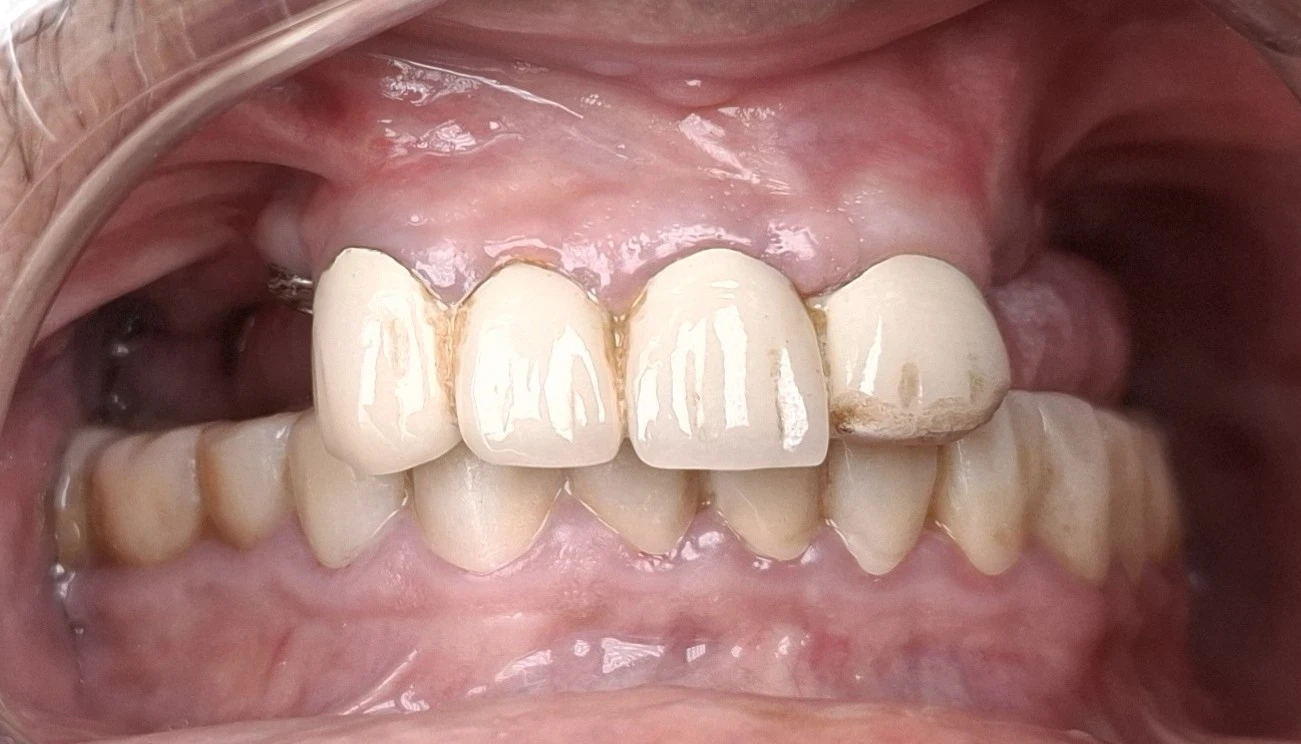
Only a few upper front teeth were left. He had five old implants in the upper jaw. Each one had a different story.
What had happened to each old implant
| Old implant site | What had happened | What I did |
|---|---|---|
| Upper left, premolar area | Failed about 4 months after placement and 3 months after teeth were fitted | Removed during this surgery. Bone grafted where needed |
| Upper left, first molar area | Failed over the same period | Removed during this surgery. Bone grafted where needed |
| Upper left, canine area | Infected, painful and inflamed | Removed during this surgery, with care to protect bone |
| Upper right, premolar area | Planned for removal, but found firm in bone during surgery | Kept after cleaning and bone regeneration |
| Upper right, first molar area | No symptoms, but placed too far towards the palate (roof of the mouth) | Kept |
Three of the five old implants could not be used, for different reasons. I removed all three during this surgery. Two stayed.
He had met several dentists, and each gave a different plan. His worry was simple. If I spend again, will it fail again?
In my clinical experience, patients with a failed implant fear the second try more than the surgery itself.
How it affected his daily life
- He could not chew at the back of his mouth
- He lived on soft, semi-solid and liquid food
- He had repeated episodes of pain and infection
- He felt shy to smile because back teeth were missing
- He did not want a removable denture, as he meets customers all day
- My implant failed. What if another one fails too?
- A 2018 meta-analysis in Brazilian Oral Research pooled 11 studies of implants placed at sites with earlier failures
- Survival was 88.7% at sites with one earlier failure and 67.1% at sites with two
- These are pooled study numbers, not a prediction for one person. The studies were of low to moderate quality, and the authors ask for larger studies
- An earlier failure does not rule out another implant. Cause, bone, gums, bite and health need checking first
Want to know why implants fail? Read our guide on dental implant failure causes. For a step by step view, see how to fix a failed dental implant.
Full Arch Implants with Limited Bone: What the CBCT Scan Showed
At my clinic, every implant case starts with a CBCT scan. It is a 3D X-ray of your jaw. It shows bone height, bone width and where the sinus sits.
The American Academy of Oral and Maxillofacial Radiology recommends cross-sectional imaging for every implant site, with CBCT as the method of choice.
What I found in his jaw
Old implant problems
- Infection around some sites
- Bone loss around the failed and infected implants
- I had to decide which implants stay and which go
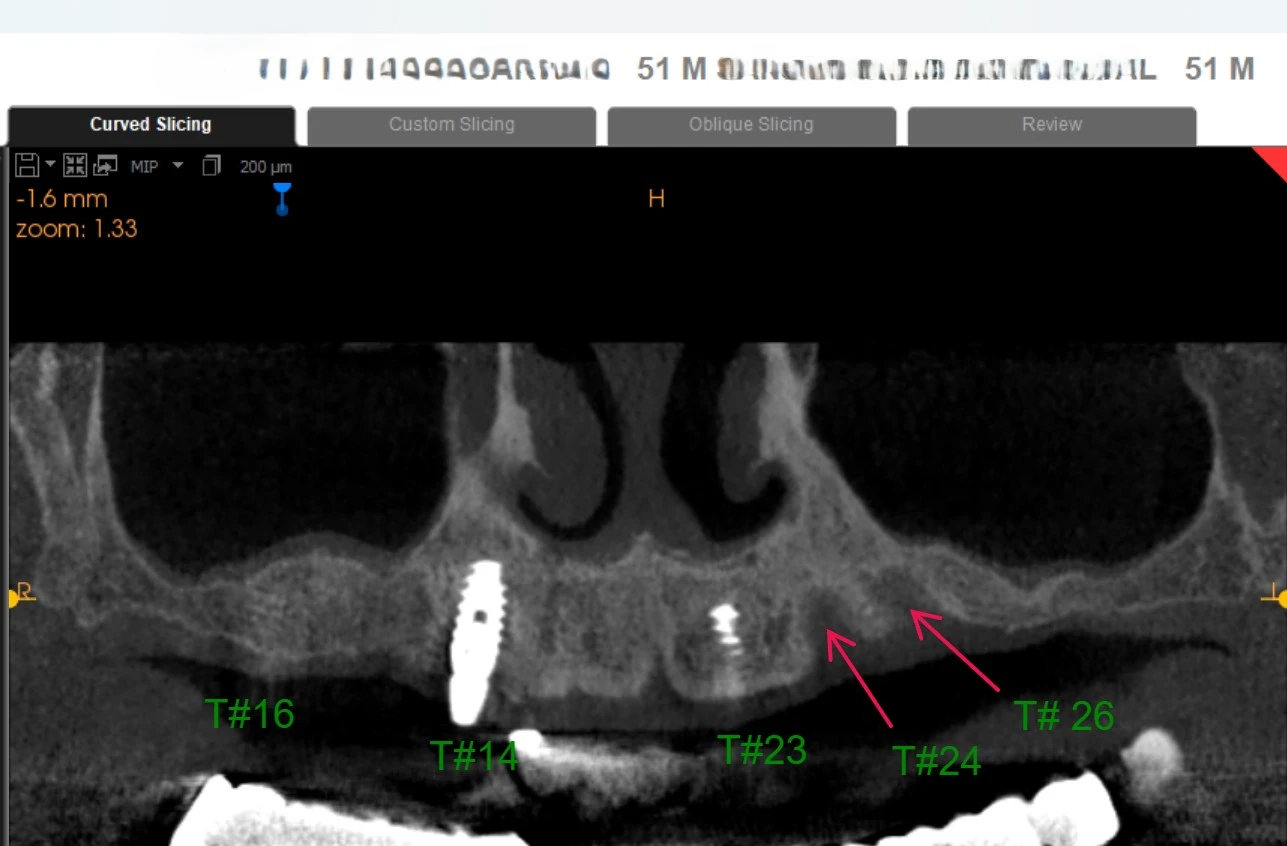
Very little bone
- Bone height about 10 to 12 mm in places
- Bone width about 5 to 6 mm
- The sinus extended into areas where bone for implants was limited
- He did not want sinus lift surgery
Weak front teeth
- The remaining teeth looked fine in the mouth
- The scan showed bone loss and thin bone
- Root canal concerns and other problems were present
Collapsed bite
- Class III jaw relationship (lower jaw sits ahead of the upper)
- History of jaw joint (TMJ) discomfort
- His lower fixed teeth had an uneven angle
Two options I gave him
- Option A: Keep the remaining front teeth and restore the arch in sections. This needs more planning around the back bone and may need sinus surgery
- Option B: Remove the weak teeth and build one full upper arch on implants
Neither option suits everyone. He chose Option B. He wanted one complete plan and fewer surgeries in future. He also wanted to avoid sinus surgery. If you have low upper bone, see our page on sinus lift in Gurgaon to know when it is needed.
The plan: upper full arch on seven implants
- 5 new implants, plus 2 old implants kept if they were safe at surgery
- Digital planning and a surgical guide to carry the plan into the mouth
- Thin bone leaves little room for error, so planning came first
A review of 30 studies found guided surgery accurate enough in full arches, with a safety margin of 2 mm sideways and 1 mm in depth. See guided implant surgery.
Can Old Implants Be Kept? The Decisions I Made During Surgery
Before surgery, my plan was to remove the problem implants. Once I opened the site, one implant told a different story.
Keeping one implant that was still firm
One implant on the upper right was firm in bone. Soft inflamed tissue sat around two to three threads. Removing it would have cut a new hole in thin bone.
Firmness alone is not a reason to keep an infected implant. I also looked at the bone around it, how deep the infection went, and whether I could clean the surface well.
- I cleaned the implant surface with a titanium brush and a chemical rinse
- I grafted the area with guided bone regeneration (GBR). GBR uses bone graft and a membrane to rebuild bone
- I closed the site and kept the implant, with his agreement
Keeping a second implant that sat off position
Another old implant on the upper right had no symptoms. It sat too far towards the palate. It was stable in bone, so I kept it as part of the new plan.
A 2012 review (74 studies) reported that regenerative treatment may achieve re-osseointegration (bone growing back onto the implant) in selected cases. Success is not guaranteed, and cleaning alone is not enough. To understand the infection, read about peri-implantitis causes and treatment.
Removing three old implants without losing more bone
The two failed implants and the infected implant, all on the upper left, were removed in the same surgery. I used a trephine bur (a hollow cutting tool) and reverse torque to protect the thin bone around it. Where the site needed support, I placed bone graft and a collagen membrane. See also bone grafting for implants.
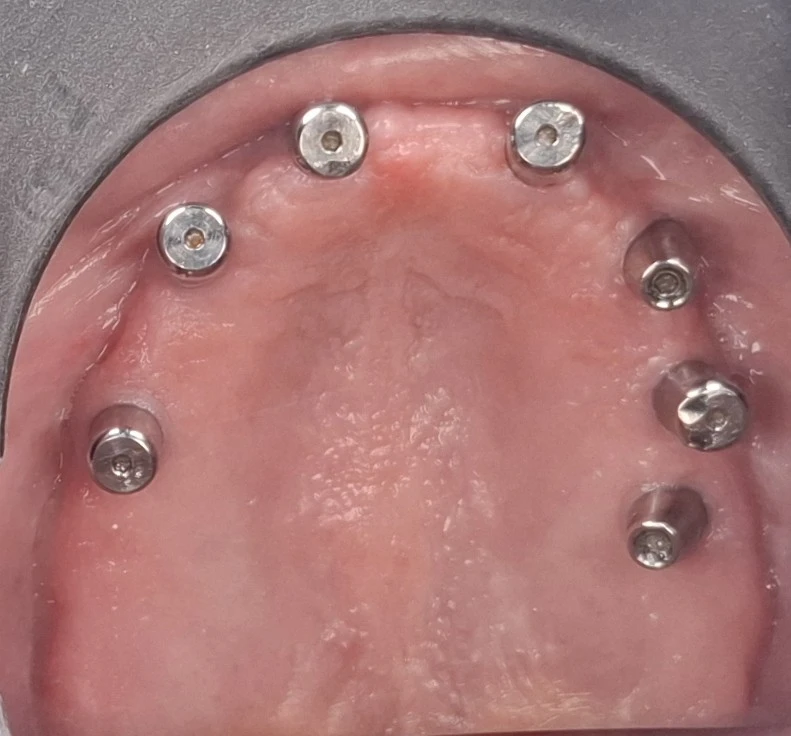
Five new implants, two of them tilted
- 5 new DIO implants were placed using the surgical guide
- The two back implants were tilted to gain length and avoid the sinus
- Total: 7 implants (2 old kept, 5 new)
- One sitting, local anaesthesia, about 2.5 to 3 hours
- All 5 new implants showed good starting stability, as per my surgical records
A 2022 meta-analysis (24 studies, 2,637 patients) reported 93.91% implant survival and 99.31% bridge survival for tilted and straight implants. Bone loss was slightly higher around tilted implants.
Why I Waited: Delayed Loading After Full Arch Implant Surgery
He wanted fixed teeth fast. After years of trouble, I understand why. I still chose to wait.
Fixed temporary teeth on the day of surgery are possible only in selected cases. I check how firmly each implant holds (torque). I also check bone quality, grafted sites, bite forces, how the implants are spread and your health.
In his case, several of these pointed to waiting. When fixed temporary teeth are suitable, they cost extra. Otherwise I give a removable temporary denture.
Four reasons I delayed his fixed teeth
Earlier failures
- He had lost implants before
- The new implants needed quiet healing time
Grafted sites
- Bone graft needs time to mature
- Chewing load too early can disturb it
Overall health
- His diabetes was controlled, with HbA1c of about 6 to 6.5%
- I considered it as one part of his overall assessment
His own choice
- He agreed to a temporary removable denture
- He understood why waiting was safer
Health checks before surgery
- Blood tests, including blood sugar, before any surgery
- A 2024 Cureus review defined well-controlled diabetes as HbA1c of 7% or less. Poor control (above 8%) worsened bone loss and gum health around implants
- He chewed tobacco in the past and quit about 10 years ago. I noted it, because a 2024 analysis reported more marginal bone loss with smokeless tobacco than with cigarettes, compared with non-users
What research says about early fixed teeth
- A 2022 meta-analysis found no significant survival difference between low and higher insertion torque in immediately loaded implants
- Early fixed teeth can work well. In his case, the risk list was longer, so waiting was safer
The temporary phase
- He wore a temporary removable denture with a soft reline
- I adjusted it a few times for pressure spots
- Plaque collected around some healing caps, so I coached him on cleaning
- The implants stayed stable through healing
| Stage | What happened | Time |
|---|---|---|
| Scan and plan | Exam, CBCT, two options discussed, surgical guide planned | Planning visit |
| Surgery | Old implants checked, 5 new implants, grafting, one sitting | About 2.5 to 3 hours |
| Healing | Temporary removable denture, reviews, soft diet | About 5 to 6 months |
| Trial and final teeth | 3D-printed trial, then screw-retained PFM bridge | 3 prosthetic visits |
| Total | Surgery to final teeth, including a delay for his work schedule | About 10 months |
Fixing a Collapsed Bite: How I Planned the Final Upper Teeth
A stable implant is half the job. Think of implants as the foundation of a house. The roof must still sit right on top.
His teeth had to meet the lower teeth in a comfortable way. So I planned the teeth first and the implants after.
What I checked before choosing tooth position
- Position and shape of his lower teeth
- Speech and pronunciation
- Upper lip length and movement
- Smile line
- Tooth size, shape and shade
- Space available for the bridge
- How the upper and lower teeth meet
I opened his bite by about 2 mm compared with the earlier position, to restore lost height.
Why a 3D-printed trial came first
Before the final bridge, he tried a 3D-printed PMMA trial. PMMA is a strong acrylic plastic. We checked:
- Size, shape and length of the teeth
- His smile
- Bite contact between upper and lower teeth
- His comfort and acceptance
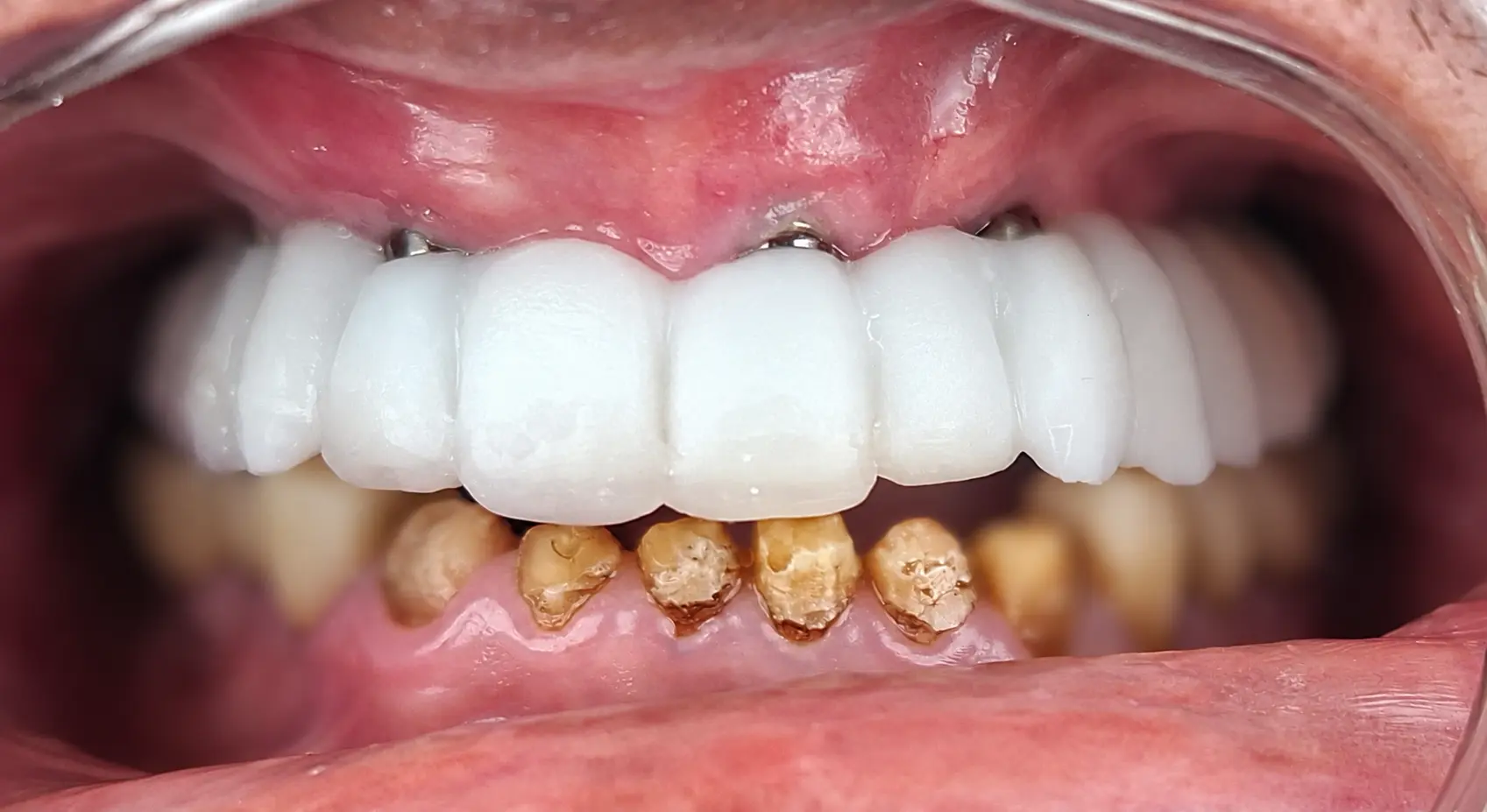
He approved it after small chairside changes. I carried those measurements into the final bridge. This also reduced the number of final visits.
Why I chose PFM over zirconia for his final teeth
- He wanted zirconia, like his lower teeth
- The space was only about 7 mm
- The frame design and cost also had to match his needs
- I made a screw-retained PFM bridge on a milled cobalt-chromium frame with ceramic layers
- Screw-retained means I can open the bridge for service later
Final Result: Chewing, Smile and What Is Still Being Treated
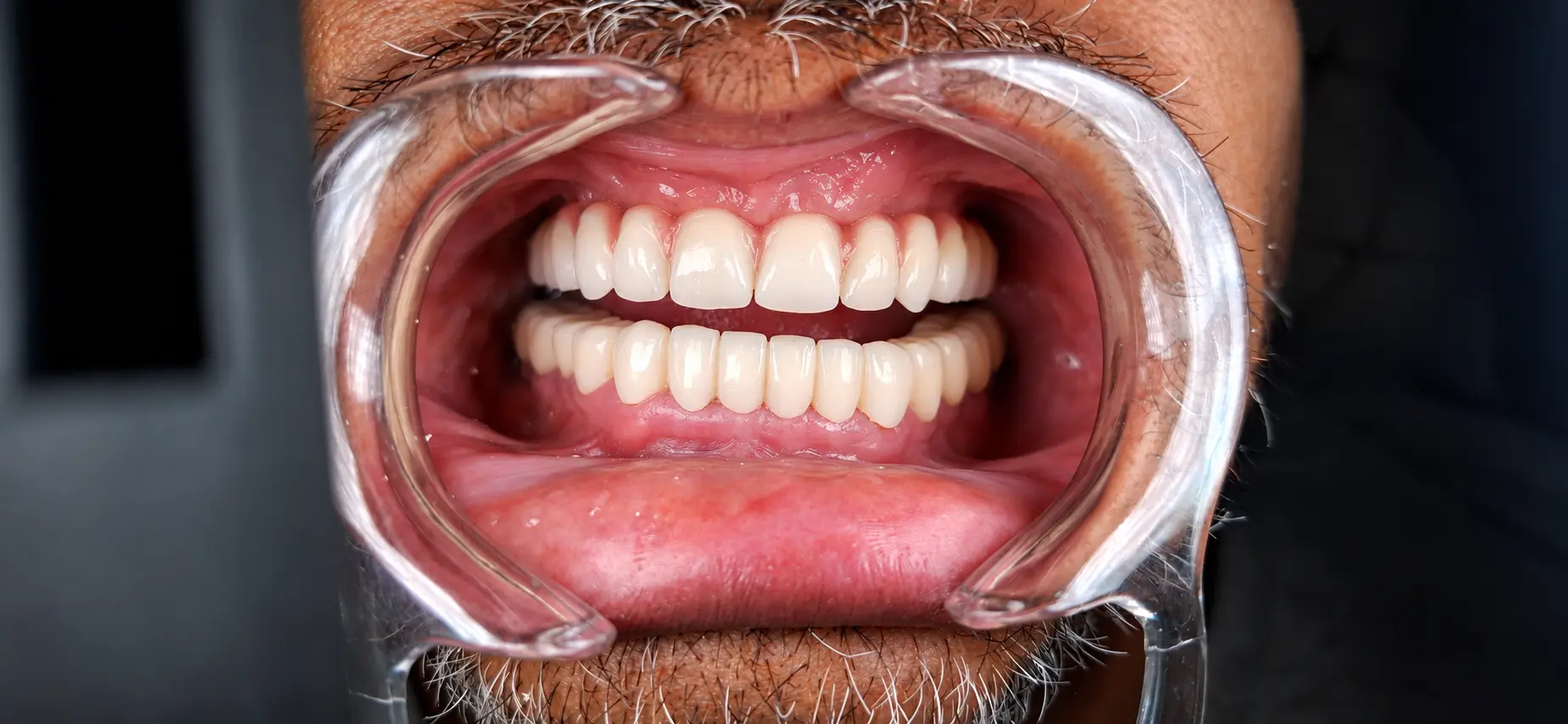
What improved
- His upper teeth now show when he smiles. Before, they were short and barely visible
- His lip support and face profile improved
- He told us he can eat chips, namkeen and chole bhature, and has tried nuts
- He has no upper denture to remove at work
- He now brushes and cleans around the bridge more regularly
What is still being treated
His jaw joint (TMJ) problem did not go away. During bite correction he had an acute phase of TMJ pain. His OPG showed reduced joint space on the left.
- The front lower teeth of his old bridge had lost their guidance, so I made a new lower temporary set
- He is on conservative TMJ physical therapy
- At his latest review, he reported that about 35% of his earlier discomfort remained. This is what he told us, not a measured result
The implants fixed his teeth. His jaw joint needs its own care. See our page on TMJ treatment in Gurgaon.
This is one patient’s result. It is not a promise for your case. Results depend on your bone, health, habits and follow-up.
Implant teeth still need daily cleaning and regular reviews. If you are planning a full set of fixed teeth, read about full mouth dental implants in Gurgaon.
What Patients with Failed Implants Can Learn from This Case
A failure does not mean every implant goes
- Each old implant needs its own assessment
- Here, 3 were removed and 2 stayed
The next plan must fix the cause
- Look at the cause of failure, the bone and the bite
- Plan the teeth first, then the implants
Timing and jaw joint need individual care
- Final teeth, healing time and TMJ symptoms differ for each patient
- Share your habits and health so I can plan for you
Full Arch Implant Cost After Implant Failure: What Adds to the Bill
Cost worried him as much as failure did. His case needed extra steps that a standard package does not cover.
Failed Dental Implants and Full Arch Implants: Your Questions Answered
Can dental implants be replaced after they fail?
- Yes, in many cases. The first step is to find why the implant failed
- A 2018 meta-analysis in Brazilian Oral Research (11 studies) reported 88.7% survival for implants placed at sites with one earlier failure and 67.1% at sites with two
- These are study averages, not a prediction for one person
- I check bone, infection, bite and your health before I plan the next implant
Can full arch implants be placed when the upper jaw has little bone?
- Sometimes yes. A CBCT scan decides
- In this case, bone height was about 10 to 12 mm and width about 5 to 6 mm in places
- Options include tilted implants, bone grafting or a sinus lift. I chose tilted implants because he did not want sinus surgery
- Some patients still need grafting or a sinus lift
Can an implant with infection around it be kept?
- Sometimes. It depends on how firm the implant is, how much bone is left and whether the surface can be cleaned well
- In this case, one firm implant with inflammation around 2 to 3 threads was cleaned, grafted and kept. Results are not guaranteed. See the surgery decisions
- In my clinical experience, a loose implant or one with deep bone loss often needs removal. I decide after a full examination and scan
What is a tilted implant, and is it safe in the upper jaw?
- A tilted implant is placed at an angle so it can be longer and avoid the sinus
- Reviews of tilted and straight implants report high survival, with slightly more bone loss around tilted ones. The figures are in the surgery section
- Whether tilted implants suit you depends on your scan
Why wait before fitting fixed teeth after full arch implant surgery?
- Waiting lets implants and grafts heal without chewing load
- In this case I waited because of earlier failures and grafted sites. His controlled diabetes was part of my overall assessment
- His implants and grafts were ready in about 5 to 6 months
- Early loading can work when stability is very good. I decide case by case
Can I get fixed temporary teeth on the day of surgery?
- Only in selected cases. I check how firmly the implants hold (torque), and also bone quality, grafts, bite, implant spread and your health
- If fixed temporary teeth are suitable, they cost extra
- If not, I give a removable temporary denture
- Temporary teeth are not the final teeth
Is PFM or zirconia better for full arch implant teeth?
- Neither is better for everyone. Space, bite, frame design and budget decide
- In this case the space was about 7 mm, so I made a screw-retained PFM bridge on a milled cobalt-chromium frame
- Zirconia is an option when space and design allow it
- Screw-retained means I can open the bridge for service
Can full arch implants fix a collapsed bite?
- In suitable cases, yes. The final teeth can restore lost height and balance the bite
- In this case I opened the bite by about 2 mm and tested it with a 3D-printed trial first
- Jaw joint pain (TMJ) needs its own assessment. His still needs care
- Read about TMJ treatment in Gurgaon
Can I get full arch implants with diabetes or a past tobacco chewing habit?
- Often yes, if diabetes is controlled and you tell me about your habits
- Poor diabetes control and smokeless tobacco are both linked to more bone loss around implants. The research is in why I waited
- This patient had an HbA1c of about 6 to 6.5% and had quit tobacco about 10 years earlier
How long does a full arch implant case like this take?
- This case took about 10 months from surgery to final teeth
- Surgery was one sitting of about 2.5 to 3 hours under local anaesthesia
- Implants and grafts were ready in about 5 to 6 months. Final teeth took 3 prosthetic visits
- Timelines change with bone, grafting, health and your schedule
Failed Implant or Thin Upper Bone? Get a Clear Plan Before You Decide
Bring your old records, X-rays or CBCT scan if you have them, your medical history and your medicine list. I will assess your case, explain which options may suit you, and discuss the likely steps, risks and costs.
Sector 51 Clinic
- Center for Dental Implants & Esthetics
- #166, Sector 51, (Ambedkar Chowk), Close to Artemis Hospital, Gurgaon, Haryana 122003
- Close to Golf Course Road and DLF Phases 1 to 5
- Book an appointment
- Open in Google Maps
Sector 74 Clinic
- Center for Dental Implants & Esthetics
- R1 – 257, 2nd Floor, M3M Cornerwalk, Sector 74, Gurugram, Haryana 122004
- Close to Golf Course Extension Road and Dwarka Expressway
- Book an appointment
- Open in Google Maps
Keep Reading
Why do implants fail?
- Learn the common causes, from infection to bite overload
- Know the warning signs so you can act early
- Read: dental implant failure causes
Not enough bone?
- See how bone is rebuilt before or with implants
- Understand when grafting is needed and when it is not
- Read: bone grafting for implants
Four implants or six?
- Compare support, cleaning and long-term load
- Find which one fits your bone and bite
- Read: All-on-4 vs All-on-6 implants
Research sources used on this page
- American Academy of Oral and Maxillofacial Radiology position statement on imaging for dental implants: pubmed.ncbi.nlm.nih.gov/22668710
- Gomes et al., survival of implants in previously failed sites, Brazilian Oral Research, 2018: scielo.br
- Outcomes of fixed full-arch rehabilitations supported by tilted and axially placed implants, International Journal of Oral & Maxillofacial Implants, 2022: pubmed.ncbi.nlm.nih.gov/36170316
- Accuracy of static computer-assisted implant surgery in full arches, International Journal of Oral & Maxillofacial Implants: quintessence-publishing.com
- Decontamination of titanium implant surface and re-osseointegration to treat peri-implantitis, International Journal of Oral & Maxillofacial Implants, 2012: dare.uva.nl
- Influence of low insertion torque values on survival of immediately loaded implants, Journal of Clinical Periodontology, 2022: pmc.ncbi.nlm.nih.gov/articles/PMC10092009
- Success rates of dental implants in patients with diabetes, Cureus, 2024: ncbi.nlm.nih.gov/pmc/articles/PMC11759002
- Nicotine and tobacco products and peri-implant bone loss, Nicotine & Tobacco Research, 2024, as reported by DrBicuspid: drbicuspid.com
- US FDA 510(k) database, DIO Corporation UF(II) Implant System, K170608: accessdata.fda.gov
Disclaimer: This page is for informational purposes only and does not replace professional dental consultation. Symptoms described may have multiple causes. Please visit a qualified dental professional for diagnosis and personalised treatment advice.
Dr. Jyoti Singh (MDS), Diplomate WCOI (Japan region) Member AAID (American Association of Implant Dentistry) stands as a beacon of excellence in implantology within Delhi NCR region. She is a BDS and MDS(Prostho) both from Maulana Azad Institute of Dental Sciences, where she secured top honors with all India rank 1 in PG entrance examination. Her extensive experience at esteemed institutions like Clove Dental and her own Center for Dental Implants & Esthetics since 2016, Dr. Singh embodies unparalleled expertise in dental implants. Boasting a wealth of 18+ years in dentistry and backed by 18 groundbreaking research papers in leading international journals (Google Scholar) and her ResearchGate profile, she epitomizes the pinnacle of proficiency and innovation in her field. She practices in Gurugram as your friendly dentist near me.