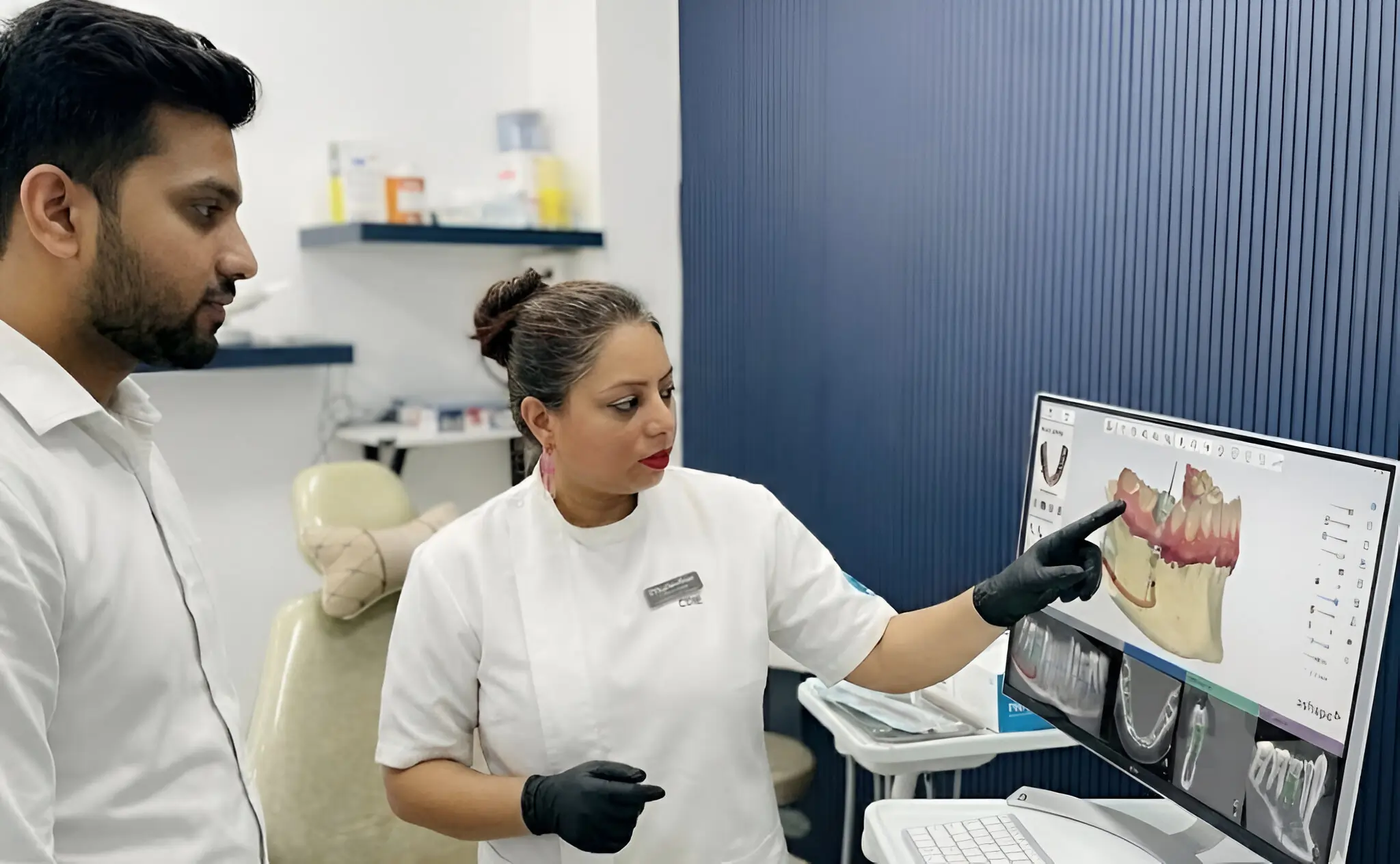
Dental Implant Healing Stages: Day by Day, Week by Week Recovery Timeline
Is your swelling normal? Why is your gum white? Can you chew yet? Dr. Jyoti Singh (MDS Prosthodontist) answers what patients in our Gurgaon clinic actually ask, stage by stage.
You just got a dental implant. Now a new worry starts. Is this swelling too much? Is this pain normal? Why does my gum look white? You are not alone, this is the most common message our Gurgaon clinic gets from implant patients.
This guide is written like Dr. Jyoti Singh is explaining your own healing, stage by stage, question by question.
Updated August 2026
Quick answer: Full bone fusion (called osseointegration) takes 3 to 6 months. But surface healing, meaning gums closing and swelling going down, is usually done in 1 to 2 weeks.
Dental Implant Healing Timeline: Day by Day, Week by Week
Here is the full implant recovery timeline in one table. Save this, you will refer back to it more than once.
| Time After Surgery | What Happens | Is It Normal? |
|---|---|---|
| Day 1 | Mild bleeding, numbness wearing off | Yes |
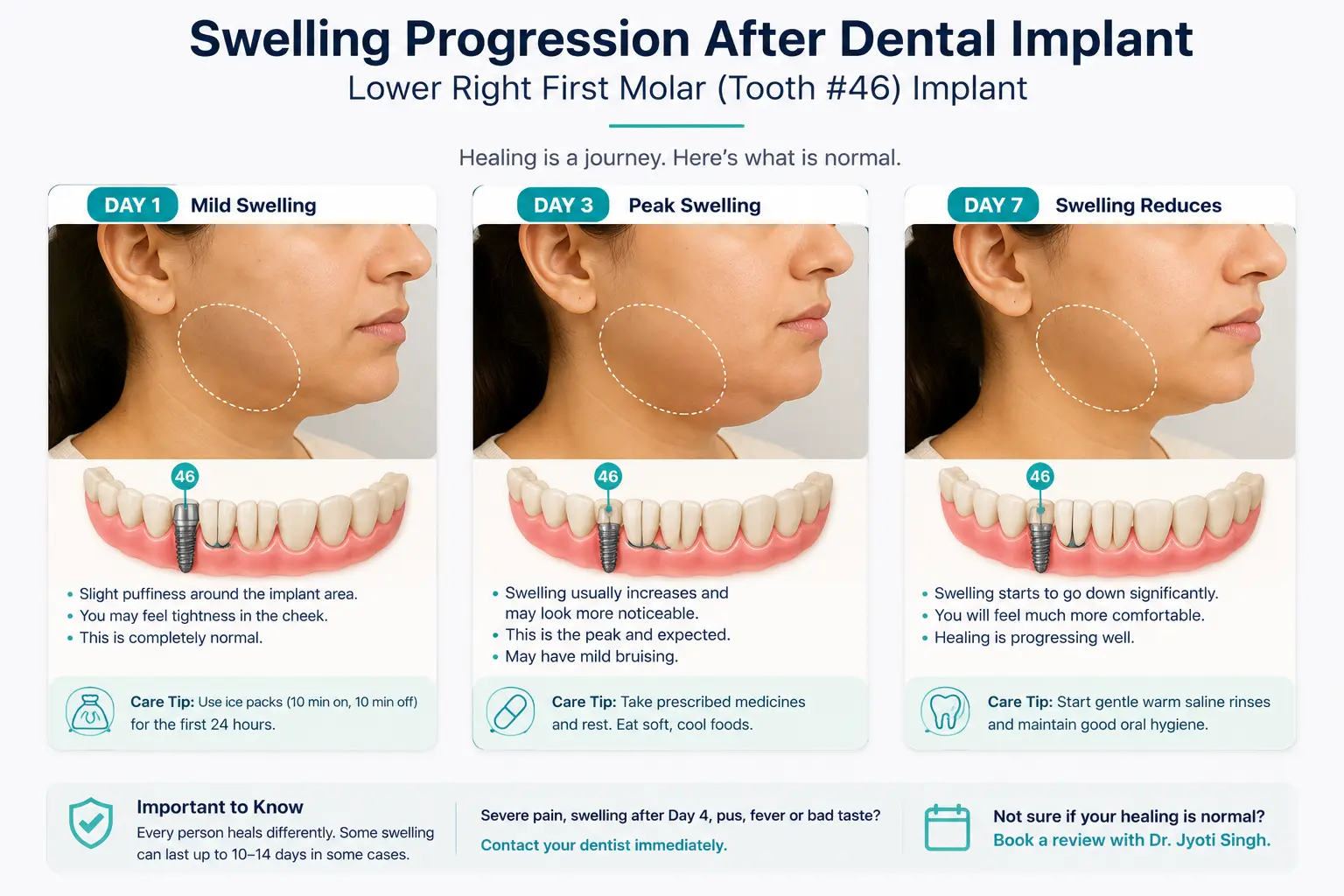
| Day 2-3 | Swelling peaks, some bruising on cheek | Yes |
| Week 1 | Gum tissue starts closing over the implant | Yes |
| Week 1-2 | Stitches removed (if non-dissolving) | Usually |
| Week 2-4 | New bone cells start forming on the implant surface | Yes |
| Month 2-3 | Bone matures around implant, osseointegration progressing | Yes |
| Month 3-6 | Implant ready for final crown, confirmed on CBCT | Usually |
Timeline based on published osseointegration healing data. Source study.
Had your implant placed somewhere else and unsure if it’s healing right? We offer a second opinion healing assessment with CBCT review.
WhatsApp Us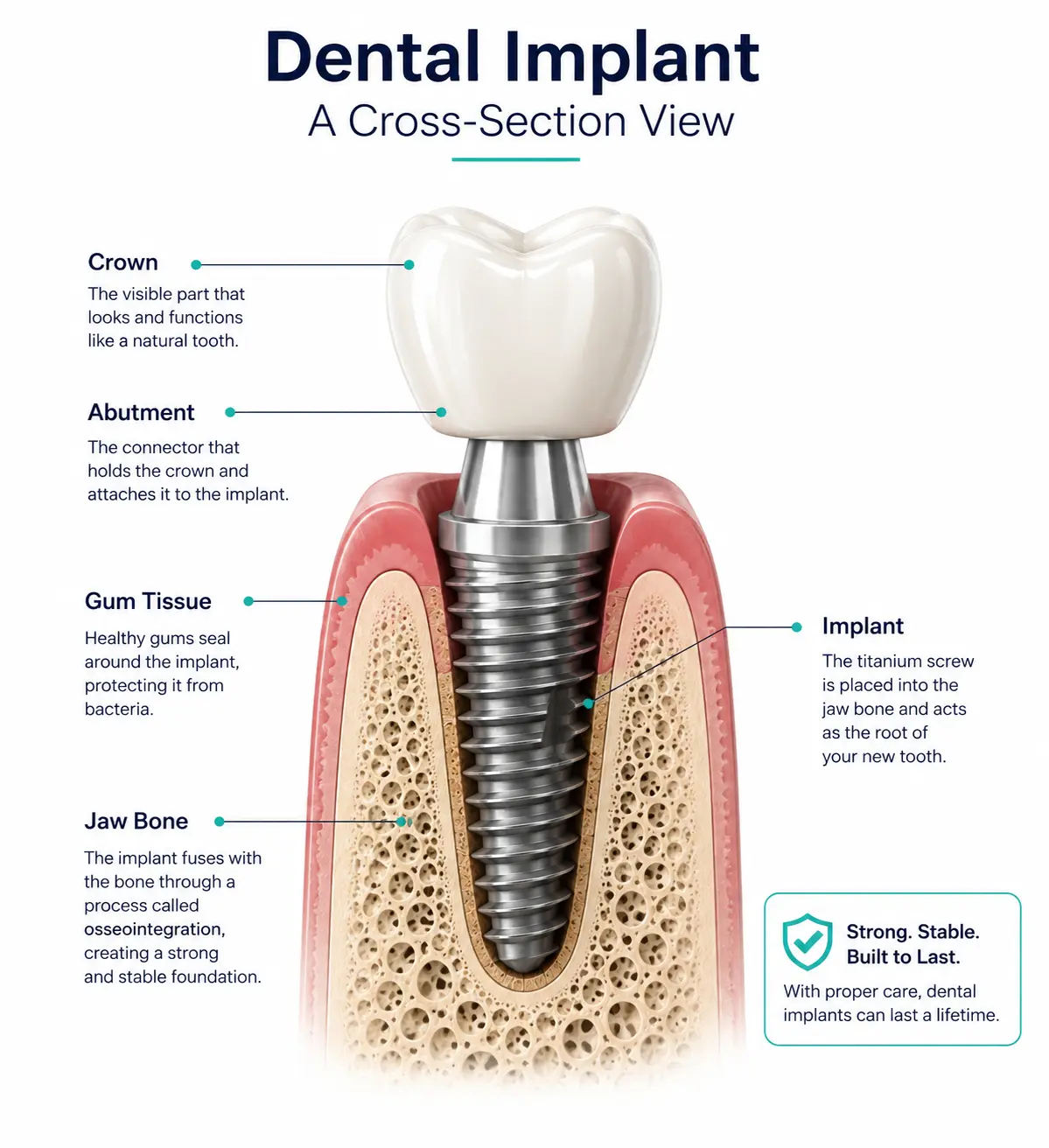
Why Implant Healing Time Is Different For Everyone
Your lower jaw (mandible) bone is denser. It usually heals faster, in about 3 to 4 months. Your upper jaw (maxilla) is softer, so it can take 4 to 6 months.
Smoking, uncontrolled diabetes, and bone grafting all change this timeline. Dr. Jyoti checks your bone density on CBCT scan before giving you an exact number, not a guess.
Is My Swelling and Bleeding Normal? (First 24 to 72 Hours)
The first day is about rest. A blood clot has already formed over your implant site, this is your body’s healing response starting.
- Bleeding: Light, pinkish. Bite on gauze for 30-45 minutes.
- Numbness: Local anaesthesia wears off in 3-5 hours. Some tingling is normal.
- Food: Cold, soft food only. Smoothies, ice cream, cooled khichdi.
- Sleeping: Keep your head slightly raised with an extra pillow.
- Medicine: Take antibiotics and painkillers exactly as prescribed, even if you feel fine.
Why Is My Gum White? Gum Healing in Week 1 and 2
- Swelling: Peaks on Day 2 or 3, then goes down daily. Ice packs help (15 min on, 15 min off).
- Gum colour: White or pale tissue around the implant is normal healing tissue, not infection.
- Mouth opening: May feel a little tight, especially for back tooth implants.
- Diet: Stay soft. Dal, mashed vegetables, paneer, curd rice.
Week 2: Stitch Removal Visit
If Dr. Jyoti used non-dissolving stitches, this is when they come out, a quick, painless visit. Your gum should look pink and closed by now.
Bone Healing After Implant: What Is Osseointegration?
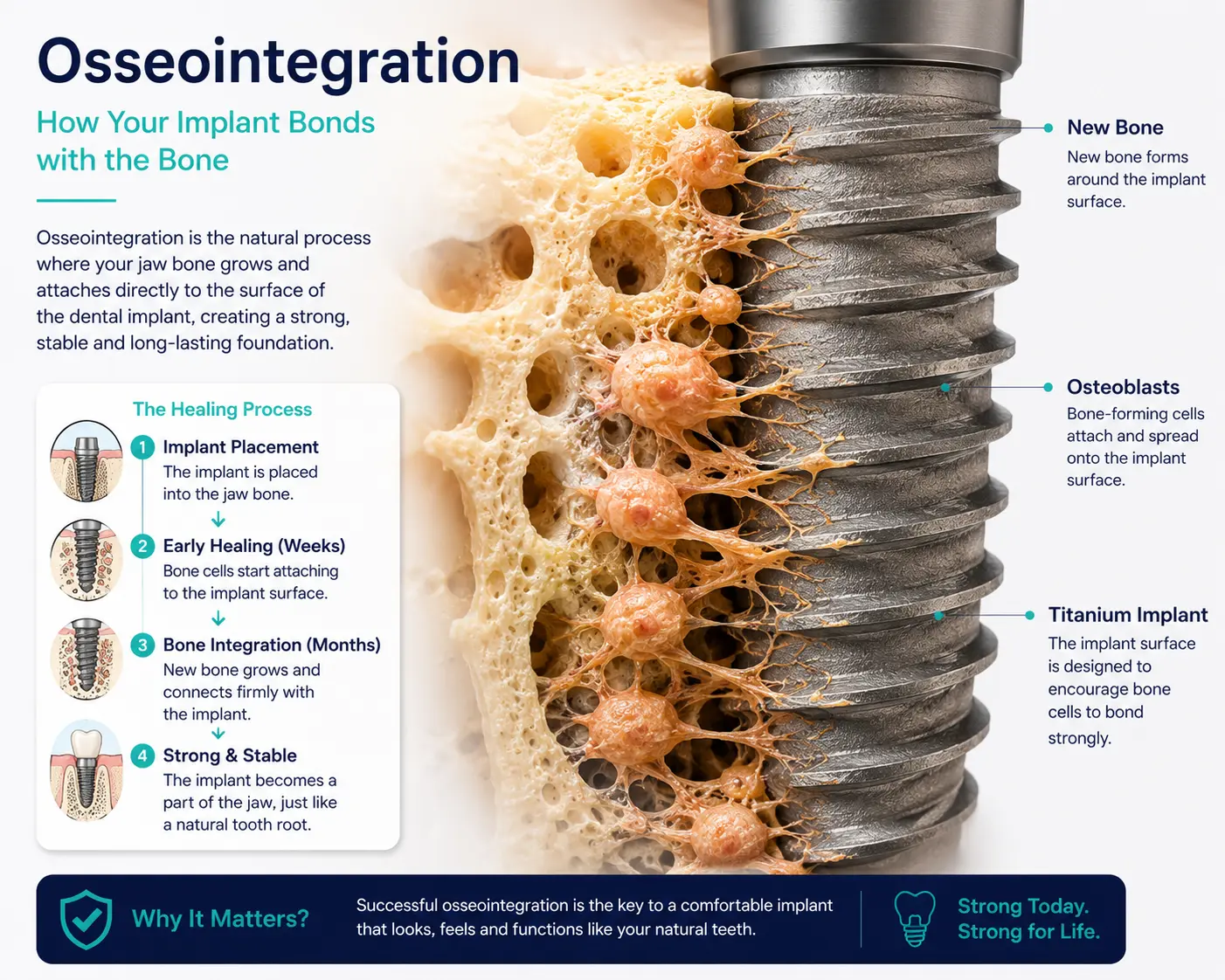
This is the most important part of implant screw healing, and it happens where you cannot see it, deep inside your jaw bone.
- Week 2-4: New bone cells begin forming directly on the implant surface.
- Week 8-12: This new bone matures into strong, load-bearing bone.
- Month 3+: Implant stability is checked before we even consider loading it with a crown.
Bone maturation timeline per peer-reviewed literature. Source study.
Not every implant heals at the same speed. We use CBCT and stability checks to decide exactly when it is safe to place your crown, not a fixed calendar date.
See How We Use CBCTMonth 2 to 4: Bone Strengthening and Temporary Teeth
- No pain does not mean fully healed. Bone fusion continues below the surface.
- You may get a temporary tooth here, so you are not walking around with a gap.
- A temporary tooth can be fixed or removable, depending on the torque (grip strength) your implant achieved at placement. Higher torque allows a fixed temporary, sometimes with an added cost. Lower torque means a removable one, for your own safety.
- Chew carefully on the other side till Dr. Jyoti clears you.
Final Crown Placement: How We Decide You Are Ready
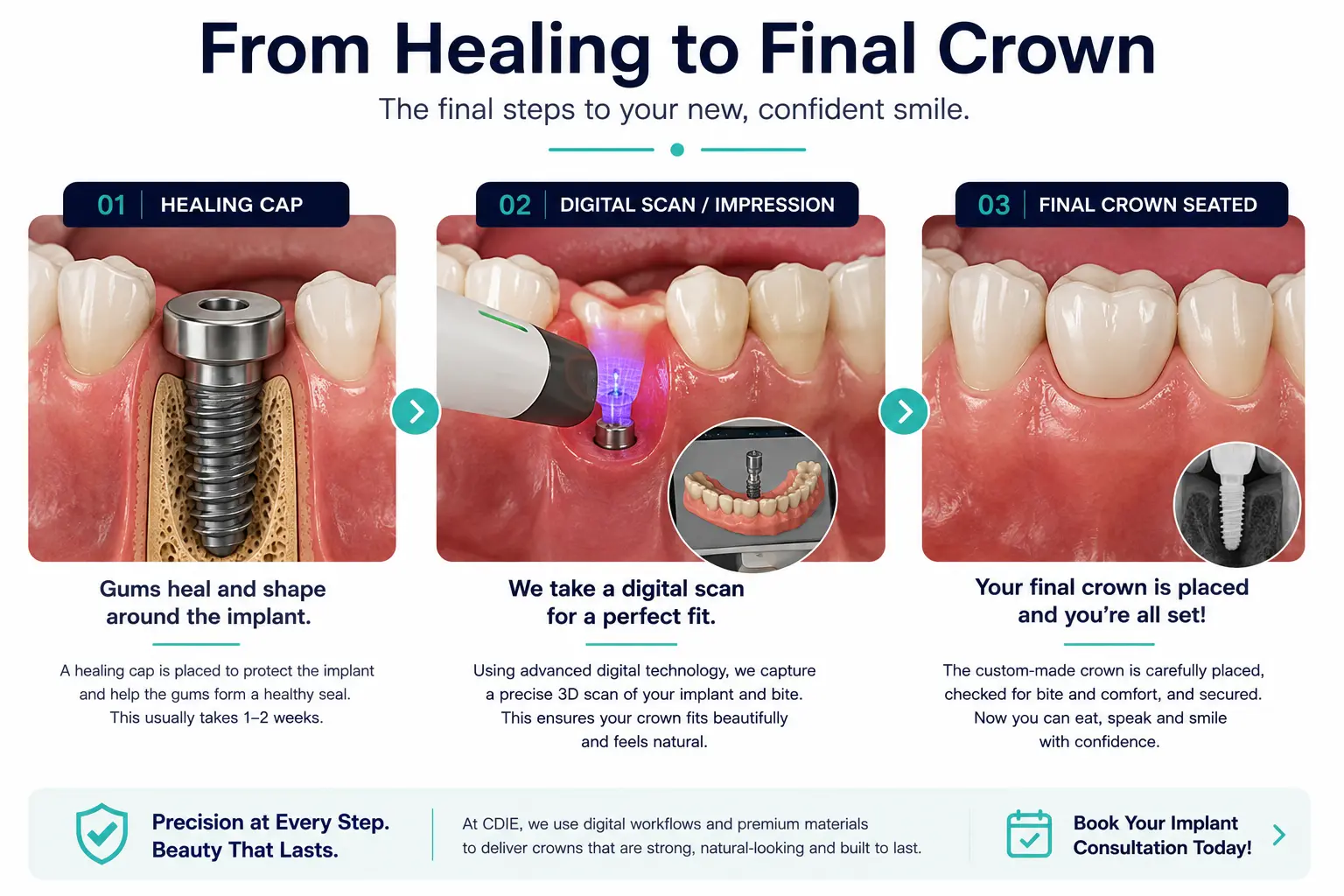
Before your final crown, Dr. Jyoti confirms healthy bone fusion with a CBCT scan, a 3D X-ray that shows bone around your implant clearly, not just a flat picture.
- Implant stability checked before we load it with any permanent crown.
- Digital bite scanning, no messy putty impressions.
- Crown shade matched to your natural teeth.
- Bite adjustment so the new tooth feels natural while chewing.
- Follow-up visit scheduled to monitor how the crown settles.
Read more on the full process: how dental implants work.
How We Monitor Your Healing at CDIE
Healing well is not luck, it comes from planning. Here is what happens behind the scenes at every implant case in our Gurgaon clinics.
CBCT Planned
Every implant is planned on a 3D scan, not a flat X-ray guess.
Blood Test Protocol
Mandatory blood work before surgery, catches risk factors early.
Stability Checked Before Loading
We confirm implant stability before any crown goes on top.
Monitored Follow-ups
Scheduled check-ins track your healing, not a one-time visit.
Crown Never Rushed
Final crown timing is based on your bone, not a fixed date.
Digital Bite Scanning
Accurate fit before crown delivery, less chair-side adjustment.
A Patient’s Healing Journey, Start to Finish
Reading a timeline is one thing. Seeing how it plays out for a real case helps more. Here is a typical single implant journey we see in our Gurgaon clinics.
Small, manageable swelling. Soft food, resting at home.
Swelling at its peak, cheek visibly puffy. Right on schedule.
Stitches removed. Gum closing up well, swelling almost gone.
Feels completely normal, but bone fusion is still quietly progressing.
CBCT confirms bone fusion. Final zirconia crown delivered.
A typical patient journey based on cases seen at our clinic. Details are illustrative, not a specific patient record.
Can I…? Quick Answers For Implant Recovery
| Question | Answer |
|---|---|
| Can I brush my teeth? | Yes, gently, from Day 2 onward |
| Can I fly after implant surgery? | Usually yes, after 48-72 hours if healing is normal |
| Can I smoke? | No, it slows healing and raises failure risk |
| Can I drink coffee or tea? | After 24 hours, once bleeding has stopped |
| Can I rinse with mouthwash? | Only after 24 hours, use a mild, alcohol-free rinse |
| Can I sleep on the implant side? | Avoid it for the first week, sleep on the other side |
| Can I wear my denture after implant surgery? | Usually not directly over the site, check with Dr. Jyoti first |
| Can I drive after implant surgery? | Yes, once numbness and sedation effects have worn off |
| Can I exercise? | Wait 5-7 days, avoid heavy gym or running |
| Can I drink alcohol? | Avoid while on antibiotics or painkillers |
| Can I use a straw? | No, the suction can disturb the healing clot |
Normal vs Infection: What Should Worry You
Green: Normal, No Action Needed
- Mild to moderate swelling for 2-3 days
- Light bruising on cheek or jaw
- Slight bleeding on Day 1
- White or pale tissue around implant
- Tightness while opening mouth wide
Yellow: Watch Closely
- Swelling still present after Day 5
- Mild discomfort past Week 2
- Slight bad taste that improves with rinsing
- Difficulty chewing beyond Week 2
- Call us if it does not improve in 48 hours
Red: Call Us Immediately
- Pain getting worse after Day 3-4, not better
- Pus or persistent bad taste
- Implant feels loose or moving
- High fever
- Bleeding that will not stop
Think something isn’t healing normally? Do not wait it out and worry alone.
Book an Implant ReviewFor deeper reading: causes of dental implant failure and peri-implant infection, symptoms and treatment.
Implant Pain Timeline and Food Timeline After Surgery
| Time | What You Can Eat |
|---|---|
| Day 1 | Cold smoothies, ice cream (no crunchy bits) |
| Day 2-3 | Khichdi, dal, mashed vegetables |
| Week 1 | Curd rice, soft paneer, boiled eggs |
| Week 2 | Soft pasta, well cooked sabzi |
| Month 2 | Soft chicken or fish, idli, dhokla |
| Month 3+ | Near normal diet, still avoid very hard or sticky food on that side |
| Day | Typical Pain Level |
|---|---|
| Day 1 | Moderate, controlled with prescribed medicine |
| Day 2-3 | Moderate, peaks with swelling |
| Day 4-7 | Mild, noticeably better |
| Week 2 | Almost gone, mild tenderness only |
Dr. Jyoti Singh’s Clinical Tip
“I tell every patient the same thing. Feeling normal by Day 10 is a good sign, but it does not mean bone fusion is complete. I have placed over 10,000 implants, and the ones that last decades are the ones where we did not rush the final crown. Trust the timeline, not just how you feel.”
MDS Prosthodontist, MAIDS Delhi • Diplomate WCOI (Japan Region) • Nobel Biocare trained • 17+ years experience. Read Dr. Jyoti’s full profile.
Questions We Receive Daily After Implant Surgery
These are the exact questions patients message us about most, sorted quick and honest.
Why is there a hole where my implant is?
A small hole or gap right after surgery is normal, it is where the implant sits before the gum fully closes over it. It shrinks over the next 1-2 weeks.
Why is my implant screw visible?
If you can see a small metal part, it is usually the healing cap or abutment, not the implant itself coming loose. This is placed on purpose to shape your gum.
Why is my healing cap loose?
A slightly loose healing cap is usually not an emergency, but do not try to tighten it yourself. Call us so we can check and re-secure it.
Can food get stuck near my implant?
Yes, especially around the healing cap. Rinse gently with warm salt water after meals till your gum fully closes.
Why is there a bad taste in my mouth?
A mild taste in the first few days can be from the healing process itself. A strong, persistent bad taste with swelling needs a check for infection.
My stitches came out early, is that a problem?
Sometimes a stitch loosens on its own before your removal visit. It is usually fine if there is no heavy bleeding, but let us know so we can take a look.
My temporary tooth fell off, what do I do?
Keep it safe if you can, avoid chewing on that side, and call us to get it re-fixed. Do not try to glue it back yourself.
Why is there a clicking sound when I bite?
This can mean your bite is slightly high on the temporary tooth or crown. It is a quick adjustment visit, not a sign of implant failure.
Can my implant move slightly during healing?
A fully integrated implant should not move at all. Any noticeable movement, even slight, needs an urgent check, this is different from normal tightness or sensitivity.
Why does my implant feel like it is vibrating?
A vibrating or buzzing feeling is often nerve sensitivity settling down, not the implant itself. If it continues beyond a few weeks, get it evaluated.
Common Mistakes That Slow Down Implant Healing
Smoking too early
Cuts blood supply to the healing gum and bone.
Using a straw
Suction can disturb the healing blood clot.
Eating hard food
Puts pressure on an implant that is not fused yet.
Skipping antibiotics
Raises infection risk around the implant.
Touching the site
Fingers and tongue can bring in bacteria.
Heavy gym too soon
Raises blood pressure and can restart bleeding.
Does Healing Time Change By Implant Type?
Yes. Bigger cases need more planning and slightly longer healing. Here is a quick guide, each links to its own detailed page.
Implants With Bone Grafting
Adds extra healing time before implant placement.
Bone grafting for implantsImmediate vs Delayed Implants
Same day placement changes your healing plan.
Immediate vs delayed implantsPreparing Before Your Implant Surgery
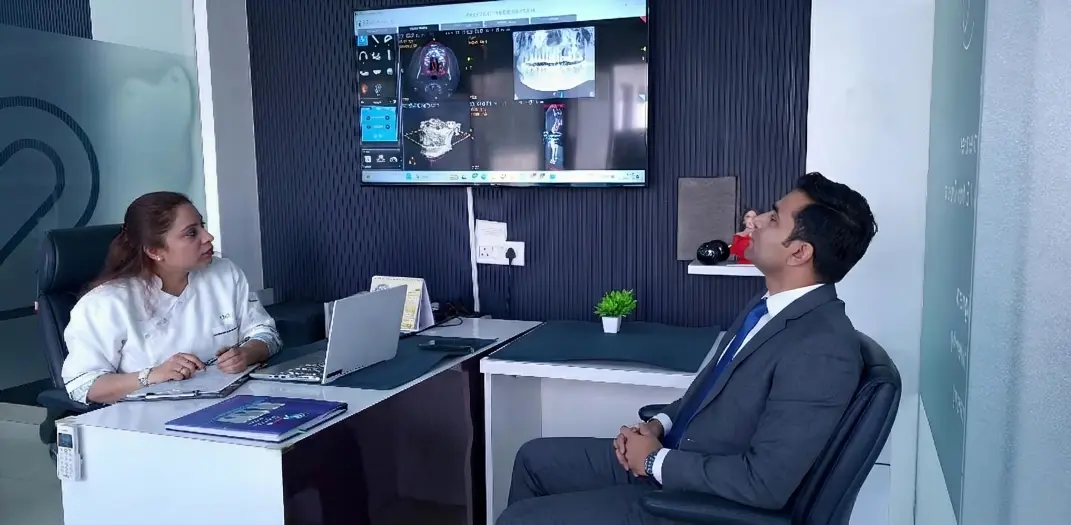
A lot of your healing outcome actually gets decided before surgery even starts. Two things worth reading before your appointment:
Frequently Asked Questions on Implant Healing
- Mild tenderness at 2 weeks can still be normal, especially for back teeth.
- Pain that is getting worse, not better, is not normal.
- Possible causes are infection, implant not fully seated, or bite pressure on a temporary tooth.
- Call the clinic for a quick check rather than waiting it out.
- White or pale tissue right after surgery is normal healing tissue.
- It happens because of temporary reduced blood flow while the area repairs.
- It should turn pink again within 1-2 weeks.
- If it turns grey, black, or smells bad, get it checked.
- Avoid chewing on that side for the first 2 weeks at least.
- Soft food only till Dr. Jyoti clears the site.
- Full chewing pressure is usually allowed only after the final crown, around month 3-6.
- Yes, though it is not common. Overall implant survival is around 90-95% at 10 years in clinical studies.
- Failure during healing usually happens due to infection, smoking, or the implant not getting enough bone contact.
- Good bone density check with CBCT before surgery lowers this risk a lot.
- You cannot feel osseointegration directly, it happens at a cellular level inside the bone.
- Your dentist checks it using implant stability readings and a CBCT scan before the crown stage.
- Steady, reducing discomfort and no looseness are good outward signs.
- Well managed diabetes, HbA1c under 8, does not significantly reduce implant success rates.
- Poorly controlled diabetes can slow gum and bone healing.
- Our mandatory blood test protocol before surgery checks this before we plan your implant.
- A healing cap is a small cover screwed onto the implant to shape the gum around it.
- It usually stays for 2 to 4 weeks, till the gum forms a natural collar shape.
- It is removed painlessly when your dentist takes the impression for your crown.
- Light walking is fine from Day 1.
- Avoid heavy gym, running, or weight lifting for at least 5-7 days.
- Raised blood pressure from intense workouts can restart bleeding at the site.
- Most patients describe it as moderate discomfort, not severe pain.
- Pain is highest Day 1 to 3, then drops quickly.
- Prescribed painkillers, taken on time, keep it well controlled for almost everyone.
- Usually 3 to 6 months after implant placement.
- Lower jaw implants are often ready sooner than upper jaw implants.
- Final timing is confirmed with a CBCT scan, not a fixed calendar date.
Read Further On Your Implant Journey
What Does It Actually Cost?
Curious about the full price picture before you commit, including bone graft and crown costs?
Check dental implant cost in GurgaonMeet Your Implantologist
See Dr. Jyoti Singh’s credentials, 10,000+ implants placed, and why patients trust her CBCT-first approach.
Read about the best implantologist in GurgaonWorried About Implant Failure?
Know the real causes of implant failure so you can avoid them from Day 1.
Understand dental implant failure causesHave a Question About Your Own Healing?
Every implant patient at Center for Dental Implants & Esthetics gets a CBCT-guided plan and a personal healing schedule. Reach out directly, our team will guide you.
Sector 51 Clinic
Center for Dental Implants & Esthetics
#166, Sector 51 (Ambedkar Chowk), Close to Artemis Hospital, Gurgaon, Haryana 122003
Sector 74 Clinic
Center for Dental Implants & Esthetics
R1-257, 2nd Floor, M3M Cornerwalk, Sector 74, Gurugram, Haryana 122004
This page is for informational purposes only and does not replace professional dental consultation. Symptoms described may have multiple causes. Please visit a qualified dental professional for diagnosis and personalised treatment advice.
Call Today If:
- Your implant feels loose
- You have a fever
- Swelling is increasing after Day 4

Dr. Jyoti Singh (MDS), Diplomate WCOI (Japan region) Member AAID (American Association of Implant Dentistry) stands as a beacon of excellence in implantology within Delhi NCR region. She is a BDS and MDS(Prostho) both from Maulana Azad Institute of Dental Sciences, where she secured top honors with all India rank 1 in PG entrance examination. Her extensive experience at esteemed institutions like Clove Dental and her own Center for Dental Implants & Esthetics since 2016, Dr. Singh embodies unparalleled expertise in dental implants. Boasting a wealth of 17+ years in dentistry and backed by 18 groundbreaking research papers in leading international journals (Google Scholar) and her ResearchGate profile, she epitomizes the pinnacle of proficiency and innovation in her field. She practices in Gurugram as your friendly dentist near me.